The Impact of Neutrino Oscillations on Supernovae
Researchers have demonstrated that neutrino-flavor oscillations can both stimulate and prevent supernovae by integrating a comprehensive model of these…
Researchers have demonstrated that neutrino-flavor oscillations can both stimulate and prevent supernovae by integrating a comprehensive model of these oscillations into simulations of collapsing stars.
Numerical models of core-collapse supernovae have matured greatly over the past few decades. With impressive accuracy, they now couple relativistic gravity, magnetohydrodynamics, nuclear physics, and neutrino transport. Neutrinos, copiously produced in the collapsed core, are the main driver of most of these supernovae. Neutrino oscillations are probably the most crucial ingredient that is still missing from the majority of models, even though their presence and possible importance have long been suggested. The reason for this gap in modeling is twofold: Many relevant physical parameters are poorly known, and the most important oscillation processes are very difficult to simulate. Now Ryuichiro Akaho at Waseda University in Japan and colleagues have made a key step toward a self-consistent model and revealed some complexities that arise when incorporating neutrino oscillations [1].
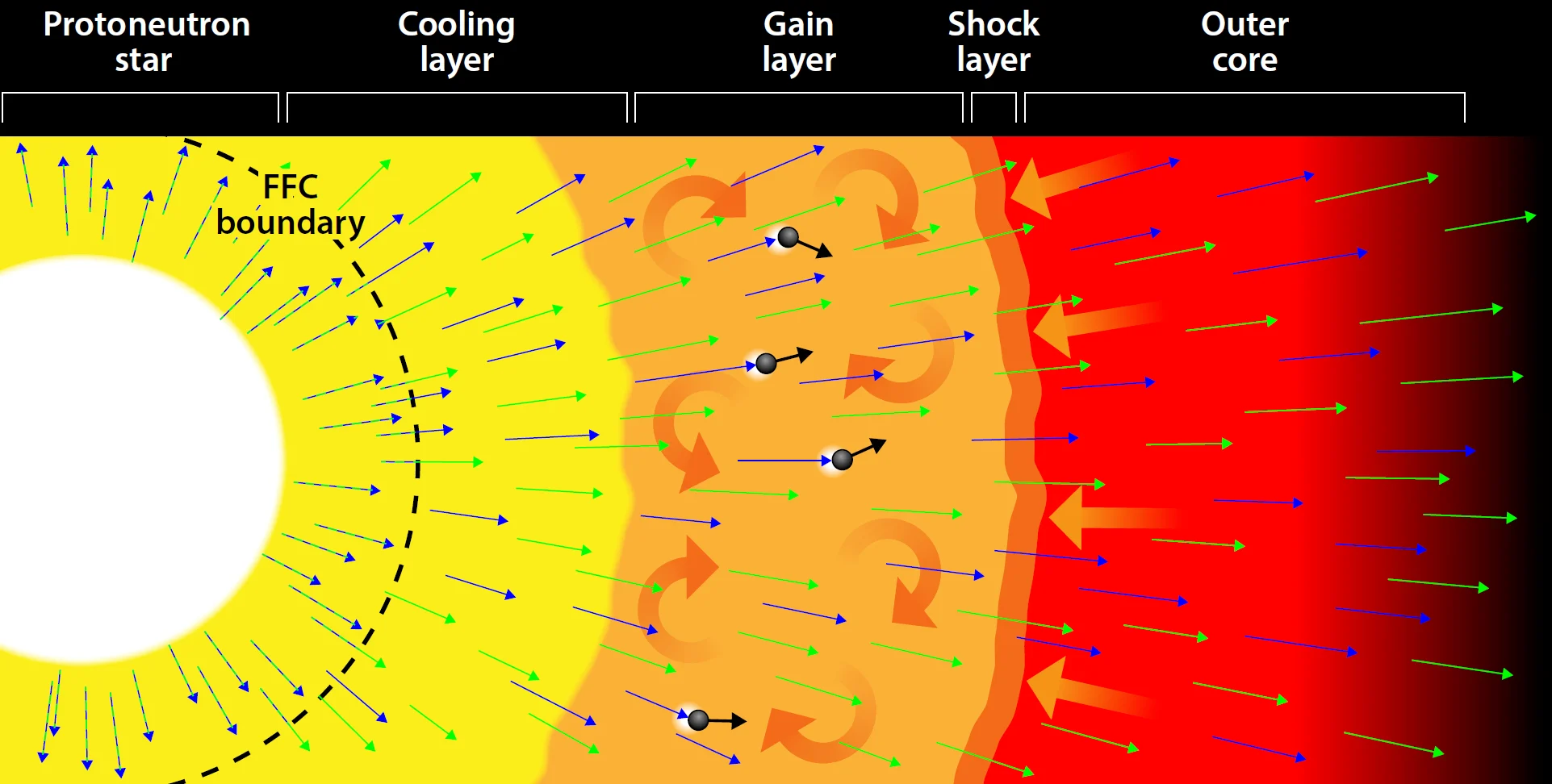
Stars are supported against their own gravity primarily by gas pressure, which is maintained by exothermic nuclear reactions. In high-mass stars, nuclear burning starts with the fusion of hydrogen into helium and continues through progressively heavier elements until the core is dominated by iron-group nuclei, at which point fusion no longer releases energy. Pressure support then no longer suffices to stabilize the core, and it collapses to a protoneutron star, a hot compact object with about 1.5 solar masses concentrated in a radius of a few tens of kilometers. During the collapse, a shock wave forms at this object’s surface and stalls after propagating outward for only about 100 km (Fig. 1). Neutrinos generated in and around the protoneutron star can heat the surrounding gas, increasing its energy. Whether or not heating suffices to unbind the gas from the star depends on its relative contribution compared to the pressure of the gas that is still in free fall toward the star’s center. If the heating is sufficient, the star blows up in a core-collapse supernova [2].
Neutrinos of all three flavors are emitted during core collapse, but not all are equally effective at triggering an explosion. Electron-type neutrinos interact with matter via both charged and neutral current reactions, while mu and tau neutrinos interact only via the latter. Hence, not only do the neutrino energy spectra affect the outcome of the collapse but also the fractions of the total luminosity carried by the different flavors. These fractions can change because of neutrino oscillations, a process for which we have evidence from solar neutrinos [3]. The conversion rates depend on unknown parameters such as the neutrino masses and “mixing angles.” They also depend on the environment, with the high neutrino densities in the supernova core allowing for processes that are not relevant under less extreme conditions. Of those processes, the most important may be fast-flavor conversion (FFC), in which interactions among neutrinos trigger a collective flavor swap on very short timescales.
The effect of FFC on the neutrino-flavor fractions is highly relevant to core collapse but very complicated to model. FFC may operate at nanosecond timescales, corresponding to neutrino propagation distances of just centimeters. These time and length scales are far below the resolution achievable in core-collapse simulations. Furthermore, FFC depends crucially on the distribution of the neutrinos in momentum space—that is, how neutrino trajectories cross each other—which most simulation codes approximate only rudimentarily using a limited number of angular momenta [4–6]. Typical treatments of FFC deal with these limitations by incorporating the simplified momentum distributions into local, high-resolution, quantum-kinetic models of neutrinos propagating through tiny representative volumes [7]. These models define prescriptions that connect the initial momentum-space distribution of neutrinos of different flavors to the rate of flavor conversion. Then, the prescriptions feed into global simulations with much coarser time and length scales [8]. Such underresolved and approximate simulations cannot fully determine where FFC occurs and what the final neutrino spectra should look like.
Akaho and collaborators go beyond these methods by incorporating a prescription of the FFC in a code that solves the angle-dependent Boltzmann-neutrino-transport equation [9]. This method is more complex and comes at considerably higher computational cost than codes based on few angular momenta, but it describes the neutrinos’ momentum-space distribution in detail. Using this method, they compare the evolution of several core-collapse models with and without the inclusion of FFC.
Both with and without neutrino oscillations, the researchers find that low-mass stars explode, whereas heavier stars fail to do so. While the dichotomy between explosions and failures is a well-known result of supernova theory, the crucial outcome of the simulations is that FFC can enhance both tendencies: Low-mass stars explode more readily, whereas heavier ones become even less prone to explode. A similar ambiguity in the effect of neutrino oscillations on core-collapse dynamics has been observed before [10]. However, this is the first work to show the effect using a method explicitly evolving the neutrinos’ momentum-space distribution. Thus, in comparison with previous studies, the approach requires fewer free parameters and is better suited to determine where FFC occurs and how it changes the distribution among neutrino flavors. Indeed, Akaho and colleagues identify regions that a more approximate momentum-based method misidentifies as FFC stable or unstable, both of which are errors that could alter the predicted dynamics of the collapse.
The study highlights the importance of neutrino oscillations in stellar core collapse and encourages supernova modelers to account for them in their codes. But it also warns that too simple an approach may not suffice and that striving for a Boltzmann, rather than momentum-based, code might be worth the (admittedly enormous) effort. Until then, studies such as this one can provide valuable guidance in calibrating and refining the existing methods
References
- M. Aker et al. (KATRIN Collaboration), “Direct neutrino-mass measurement based on 259 days of KATRIN data,” Science 388, 180 (2025).
- M.G. Betti et al., “Neutrino physics with the PTOLEMY project: Active neutrino properties and the light sterile case,” J. Cosmol. Astropart. Phys. 2019, 047 (2019).
- A. Casale et al., “β-decay spectrum of tritiated graphene: Combining nuclear quantum mechanics with density functional theory,” Phys. Rev. C 113, 054607 (2026).
- A. Apponi et al. (PTOLEMY Collaboration), “Heisenberg’s uncertainty principle in the PTOLEMY project: A theory update,” Phys. Rev. D 106, 053002 (2022).
Figure 1 shows a cross section of a collapsing star’s core. All regions of the core emit and absorb electron neutrinos (blue arrows) and muon and tau neutrinos (green arrows). Energy loss is favored in the cooling layer by the emission and absorption balance, but energy gain is favored in the gain layer. Thermal pressure supports the cooling and gain layers. When the outer portion of the core collides with the gain layer, it creates a shock since it is unsupported and falls inward due to gravity. Neutrinos oscillate quickly between electron, muon, and tau flavors within the fast-flavor-conversion region (dashed black line).