Neutrino Flavor: Unlocking the Deepest Secrets of the Universe
Neutrinos are among the most mysterious and fundamental particles in the universe. These nearly massless particles pass through matter almost undetected, yet…
On this page
Neutrinos are among the most mysterious and fundamental particles in the universe. These nearly massless particles pass through matter almost undetected, yet they carry critical information about the origins, structure, and evolution of the cosmos. By studying neutrino flavor, we gain insight into some of the deepest questions in physics: the asymmetry between matter and antimatter, the inner workings of stars, and the mechanisms that shaped the early universe.
In this article, we examine the physics of neutrino flavor, the phenomenon of neutrino oscillation, and the profound implications of these discoveries for cosmology and particle physics.
What Is Neutrino Flavor?
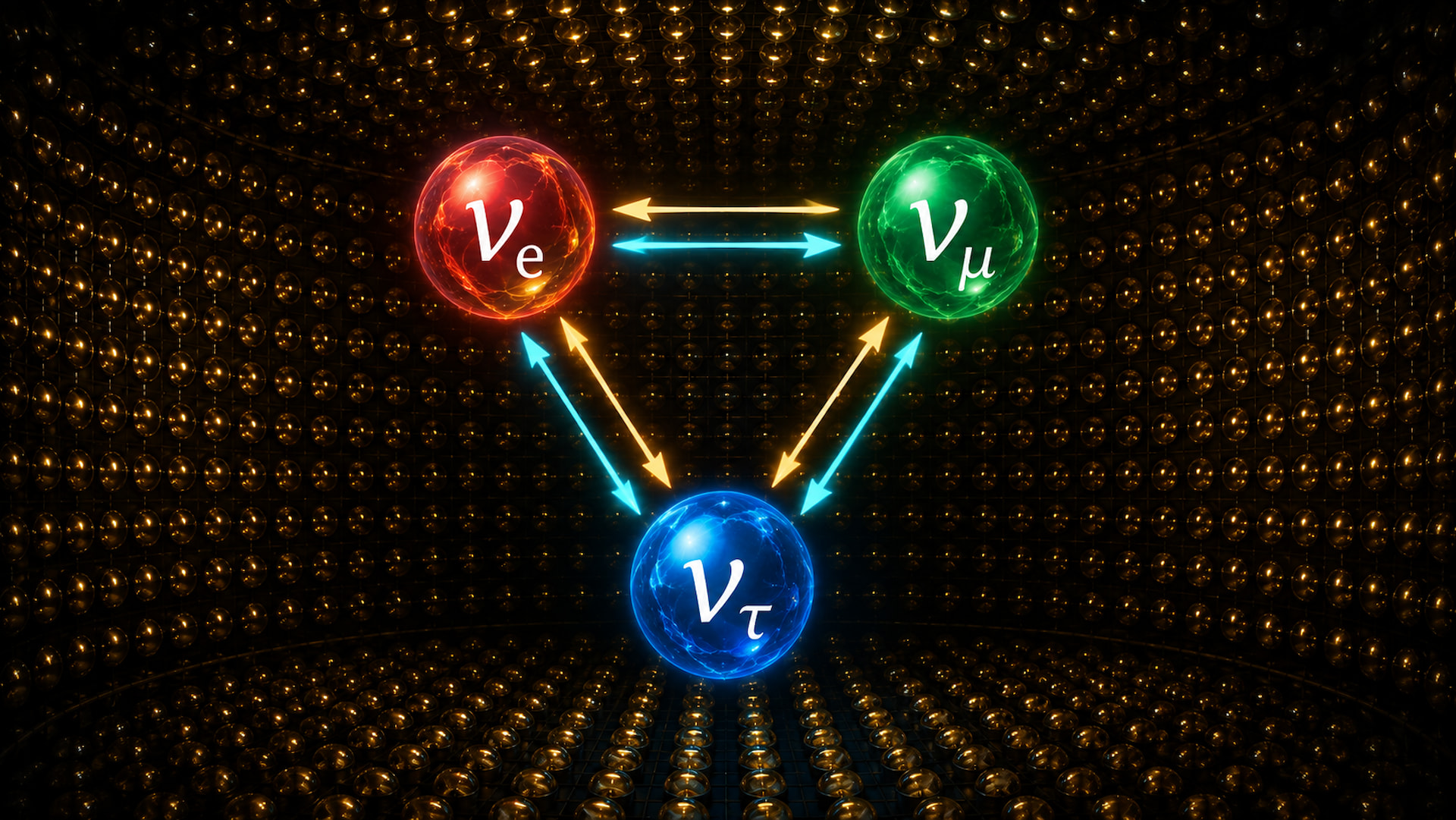
Neutrinos exist in three distinct varieties known as flavors:
-
Electron neutrino (νe)
-
Muon neutrino (νμ)
-
Tau neutrino (ντ)
Each flavor corresponds to a charged lepton partner in the Standard Model of particle physics. These flavors are not static identities; neutrinos possess the extraordinary ability to transform from one flavor into another as they travel through space.
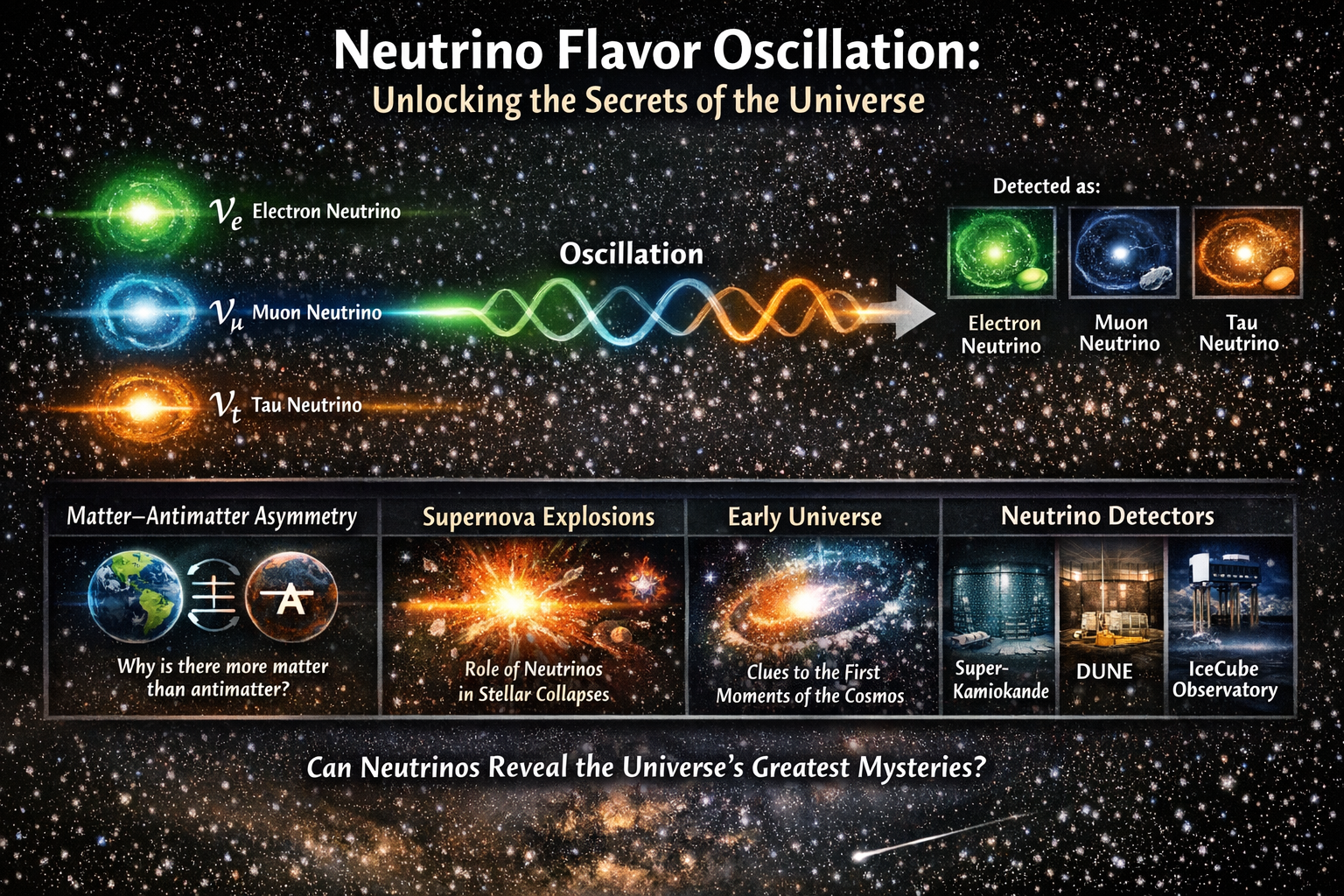
This transformation process is known as neutrino oscillation, and it is one of the most significant discoveries in modern physics.
The Physics of Neutrino Oscillation
Neutrino oscillation occurs because the flavor states of neutrinos are quantum superpositions of mass states. While neutrinos are produced and detected in flavor states, they propagate as mass eigenstates.
As these mass states evolve differently over time due to their slightly different masses, the neutrino’s flavor probability changes.
Key Properties of Neutrino Oscillation
-
Quantum superposition of mass states
-
Phase differences during propagation
-
Probability transitions between flavors
This leads to the remarkable result that a neutrino created as an electron neutrino may later be detected as a muon or tau neutrino.
Mathematical Framework of Neutrino Flavor Mixing
The relationship between flavor states and mass states is described by the PMNS matrix (Pontecorvo–Maki–Nakagawa–Sakata matrix).
∣να⟩=∑i=13Uαi∣νi⟩|\nu_\alpha\rangle = \sum_{i=1}^{3} U_{\alpha i} |\nu_i\rangle∣να⟩=i=1∑3Uαi∣νi⟩
Where:
-
να\nu_\alphaνα = flavor state (e, μ, τ)
-
νi\nu_iνi = mass eigenstate
-
UαiU_{\alpha i}Uαi = PMNS mixing matrix element
The oscillation probability between flavors is given by:
P(να→νβ)=sin2(2θ)sin2(1.27Δm2LE)P(\nu_\alpha \rightarrow \nu_\beta) = \sin^2(2\theta)\sin^2\left(\frac{1.27\Delta m^2 L}{E}\right)P(να→νβ)=sin2(2θ)sin2(E1.27Δm2L)
Where:
-
θ\thetaθ = mixing angle
-
Δm2\Delta m^2Δm2 = mass-squared difference
-
LLL = distance traveled
-
EEE = neutrino energy
These parameters determine the oscillation frequency and amplitude.
Why Neutrino Flavor Matters for the Universe
Neutrinos are incredibly abundant. Trillions pass through every human body each second. Despite their elusive nature, they provide critical clues about the structure of the universe.
Key cosmic insights provided by neutrino flavor studies
1. The Matter–Antimatter Asymmetry
One of the greatest mysteries in physics is why the universe contains more matter than antimatter.
Neutrino flavor transitions may violate CP symmetry, meaning neutrinos and antineutrinos behave slightly differently. If confirmed, this asymmetry could explain why matter survived after the Big Bang.
2. Understanding Stellar Explosions
During supernova explosions, enormous numbers of neutrinos are produced.
By observing changes in neutrino flavor from supernovae, scientists can:
-
Study the collapse of stellar cores
-
Understand heavy element formation
-
Investigate extreme gravitational environments
Neutrino signals arrive before visible light, making them early messengers of cosmic events.
3. Probing the Early Universe
Neutrinos were formed seconds after the Big Bang.
Their behavior preserves information about:
-
primordial particle interactions
-
early universe energy densities
-
cosmological expansion rates
Studying neutrino flavor helps reconstruct conditions in the earliest moments of cosmic history.
How Scientists Detect Neutrino Flavor
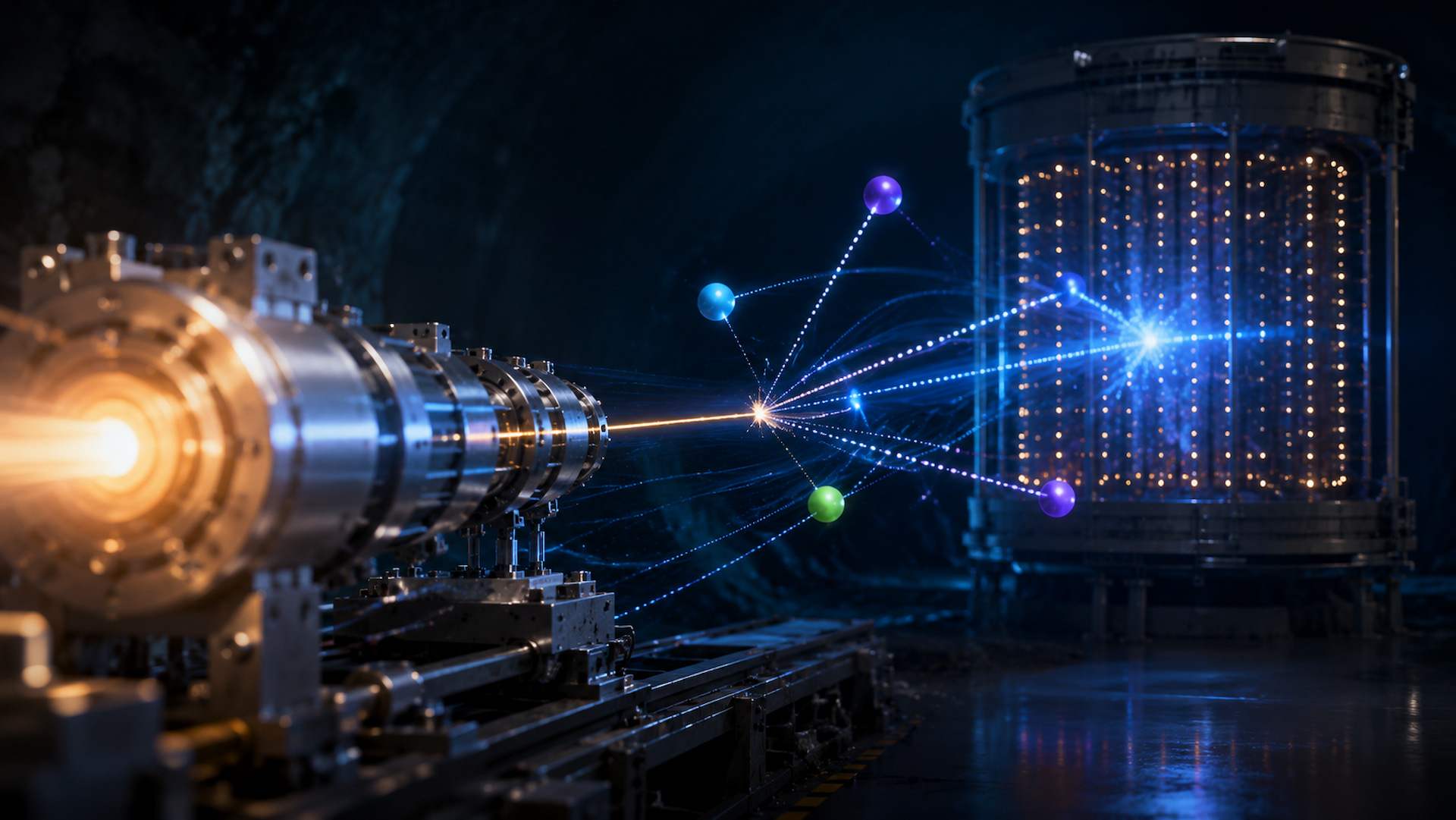
Because neutrinos interact extremely weakly with matter, detecting them requires massive detectors and sensitive instrumentation.
Major neutrino observatories include:
-
Super-Kamiokande (Japan)
-
IceCube Neutrino Observatory (Antarctica)
-
DUNE – Deep Underground Neutrino Experiment (USA)
-
Sudbury Neutrino Observatory (Canada)
These facilities detect neutrinos via secondary particles created when neutrinos interact with detector materials such as water, ice, or liquid argon.
Different interaction signatures allow scientists to identify the incoming neutrino flavor.
The Role of Neutrino Flavor in the Standard Model
The discovery of neutrino oscillation proved that neutrinos have mass, contradicting the original Standard Model prediction.
This revelation forced physicists to revise the Standard Model and explore new theoretical frameworks.
Possible extensions include:
-
Seesaw mechanisms
-
Sterile neutrinos
-
Leptogenesis models
-
Grand unified theories
Neutrino flavor measurements are therefore central to discovering physics beyond the Standard Model.
Current Experiments Exploring Neutrino Flavor
Modern neutrino experiments aim to precisely measure oscillation parameters and detect CP violation.
Major global research projects
DUNE (Deep Underground Neutrino Experiment)
DUNE will study neutrino beams traveling 1,300 km through Earth to observe oscillations and measure CP violation.
Hyper-Kamiokande
An upgraded neutrino observatory in Japan designed to detect atmospheric and accelerator neutrinos with unprecedented precision.
JUNO (China)
A reactor neutrino experiment focused on determining the neutrino mass hierarchy.
These experiments are expected to redefine our understanding of particle physics.
Future Discoveries from Neutrino Flavor Research
The next generation of neutrino experiments may answer several fundamental questions:
-
Do neutrinos violate CP symmetry?
-
What is the true ordering of neutrino masses?
-
Are there additional sterile neutrino species?
-
Can neutrinos explain dark matter interactions?
These answers may transform our understanding of the universe at the most fundamental level.
Neutrino Flavor as a Gateway to Cosmic Understanding
Neutrino flavor research sits at the intersection of particle physics, astrophysics, and cosmology. By observing how neutrinos change identity as they travel through space, we gain a direct probe into the fundamental laws governing matter and energy.
Every measurement of neutrino flavor deepens our knowledge of the universe’s origins, its structure, and the physical principles that shape reality itself.
As next-generation detectors come online, neutrinos will continue to illuminate some of the most profound mysteries of the cosmos.