When Neutron Stars Collide: How Neutrino Flavor Transformations Shape the Universe
Extreme Astrophysics and the Hidden Role of Neutrinos We examine one of the most energetic and transformative events in the universe: the collision of neutron…
On this page
Extreme Astrophysics and the Hidden Role of Neutrinos
We examine one of the most energetic and transformative events in the universe: the collision of neutron stars. These mergers not only generate gravitational waves detectable on Earth, but also create environments where fundamental particle physics directly influences cosmic evolution.
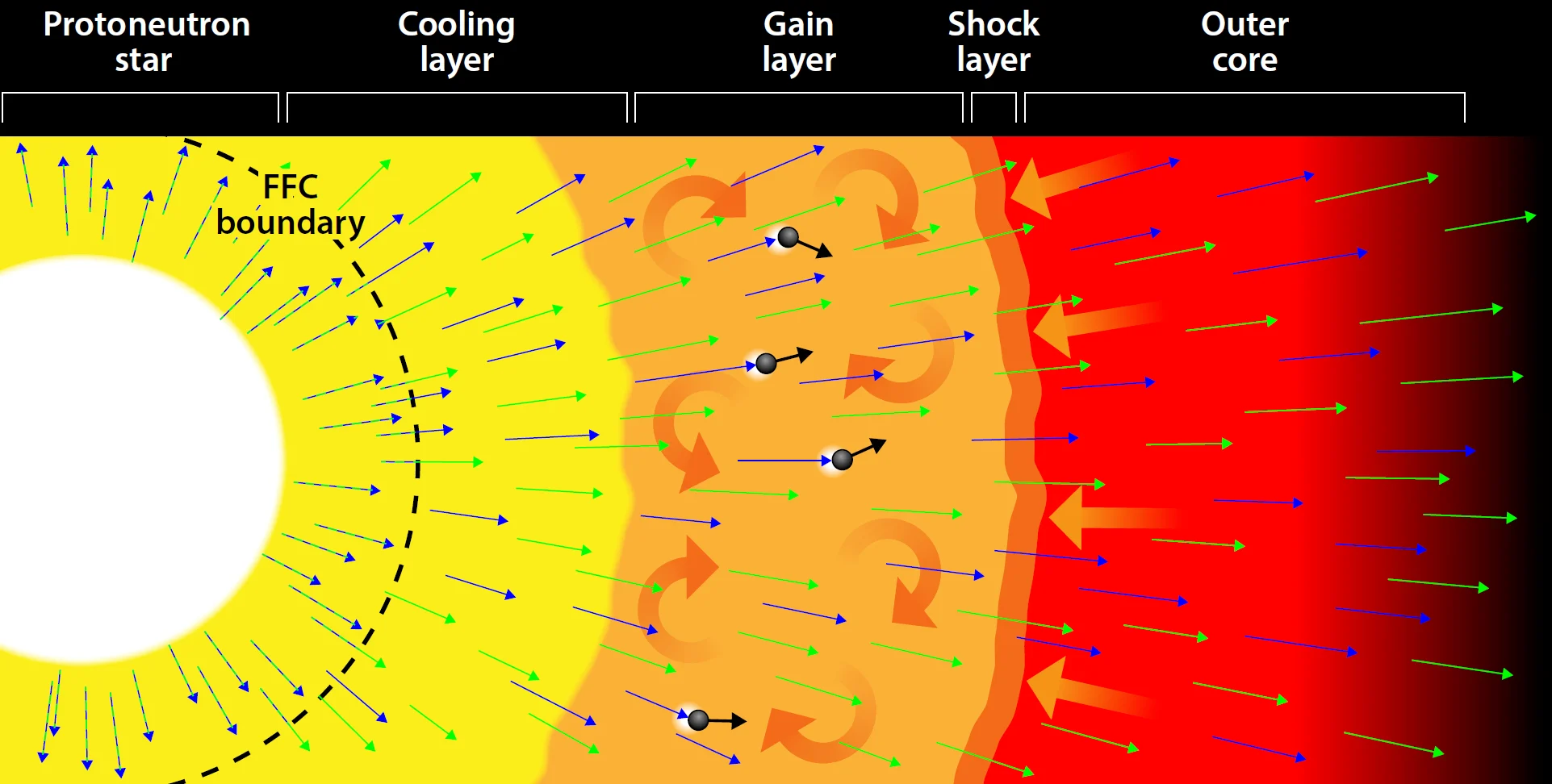
At the heart of this phenomenon are neutrinos—elusive, weakly interacting particles that exist in three distinct “flavors.” During neutron star mergers, these neutrinos undergo rapid transformations between flavors, fundamentally altering the physical outcome of the collision.
Neutron Star Mergers: Cosmic Laboratories of Matter and Energy
Neutron stars are among the densest objects known, formed from the remnants of collapsed massive stars. When two such objects spiral inward and collide, they release enormous quantities of energy and matter.
During this process:
- Temperatures rise to billions of degrees
- Dense matter is violently ejected into space
- Vast numbers of neutrinos are produced
These mergers are key sites for the creation of heavy elements via the rapid neutron capture process (r-process), responsible for producing materials such as gold and platinum.
Understanding Neutrino Flavors and Oscillations
Neutrinos exist in three flavors:
- Electron neutrinos
- Muon neutrinos
- Tau neutrinos
A defining property of neutrinos is their ability to change flavor as they propagate—a quantum phenomenon known as neutrino oscillation.
In extreme astrophysical environments like neutron star mergers, this transformation occurs rapidly and collectively, influenced by:
- High densities of matter
- Strong gravitational fields
- Intense neutrino-neutrino interactions
These conditions make flavor transformations far more complex than in terrestrial experiments.
Breakthrough Simulations: Modeling Flavor Transformations in Mergers
Recent supercomputer simulations have, for the first time, successfully incorporated neutrino flavor transformations into neutron star merger models.
These simulations reveal that:
- Flavor mixing occurs on extremely short (nanosecond) timescales
- It significantly alters the composition of matter ejected during the merger
- It changes the structure of the merger remnant and surrounding environment
Previously, most models neglected these transformations due to their computational complexity and incomplete theoretical understanding.
How Neutrino Flavor Changes Affect Matter
The flavor of a neutrino determines how it interacts with matter. This is crucial because:
- Electron neutrinos can convert neutrons into protons
- Other flavors (muon, tau) interact differently and do not drive the same reactions
As neutrinos change flavor, they directly influence the neutron-to-proton ratio in the ejected material.
Key Consequences:
- Increased neutron richness in ejecta
- Enhanced production of heavy elements
- Changes in nucleosynthesis pathways
Simulations show that flavor transformations can increase neutron abundance by more than a factor of five in certain regions.
Heavy Element Formation: The Origin of Gold and Beyond
The production of heavy elements depends critically on neutron-rich conditions. When neutrino flavor transformations occur:
- Electron neutrino abundance decreases in low-density regions
- Matter becomes more neutron-rich
- The efficiency of the r-process increases dramatically
This leads to:
- Orders-of-magnitude increases in the production of lanthanides and heavier elements
- A deeper understanding of the cosmic origin of precious metals
Thus, neutrino physics is directly linked to the material composition of the universe.
Impact on Observable Signals: Gravitational Waves and Emissions
Neutron star mergers produce multiple observable signals:
- Gravitational waves
- Gamma-ray bursts
- Electromagnetic radiation across the spectrum
Neutrino flavor transformations influence these signals by altering:
- The dynamics of the merger
- The composition of ejecta
- The thermodynamics of the remnant
This means that accurate modeling of flavor oscillations is essential for interpreting observational data from detectors on Earth.
The Physics of Collective Neutrino Behavior
In dense environments, neutrinos do not behave independently. Instead, they exhibit collective effects, including:
- Self-interactions between neutrinos
- Quantum entanglement of flavor states
- Rapid equilibration across flavor distributions
These interactions can lead to synchronized or unstable flavor transformations, dramatically amplifying their impact on the surrounding matter.
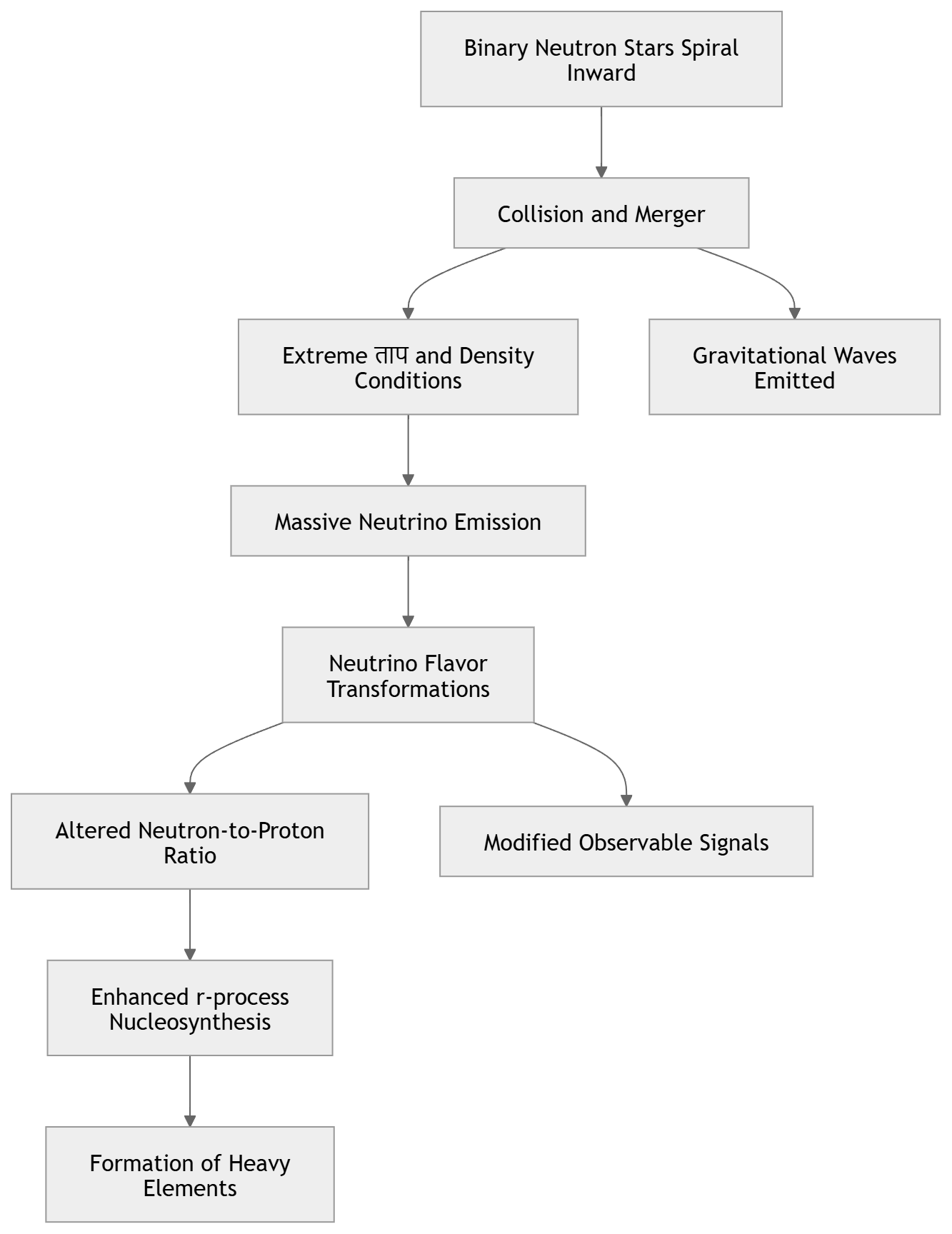
Process Overview: From Collision to Element Creation
Why This Discovery Redefines Astrophysics
Incorporating neutrino flavor transformations into neutron star merger models represents a major shift in astrophysics:
- It resolves discrepancies in heavy element production
- It improves predictions for gravitational wave signatures
- It connects particle physics directly with cosmological evolution
Most importantly, it demonstrates that even the smallest particles—neutrinos—can determine the outcome of the universe’s most violent events.
Conclusion: Neutrinos as Architects of the Cosmos
We conclude that neutrino flavor transformations are not a minor correction but a fundamental driver of neutron star merger physics. By governing the balance between neutrons and protons, neutrinos dictate the formation of the heaviest elements and influence observable cosmic signals.
Understanding these processes unlocks deeper insight into:
- The origin of matter
- The behavior of extreme astrophysical systems
- The fundamental laws of physics under extreme conditions
Neutron star collisions are not merely violent cosmic events—they are precision laboratories where quantum mechanics, relativity, and nuclear physics converge, with neutrinos acting as the invisible architects of the universe.
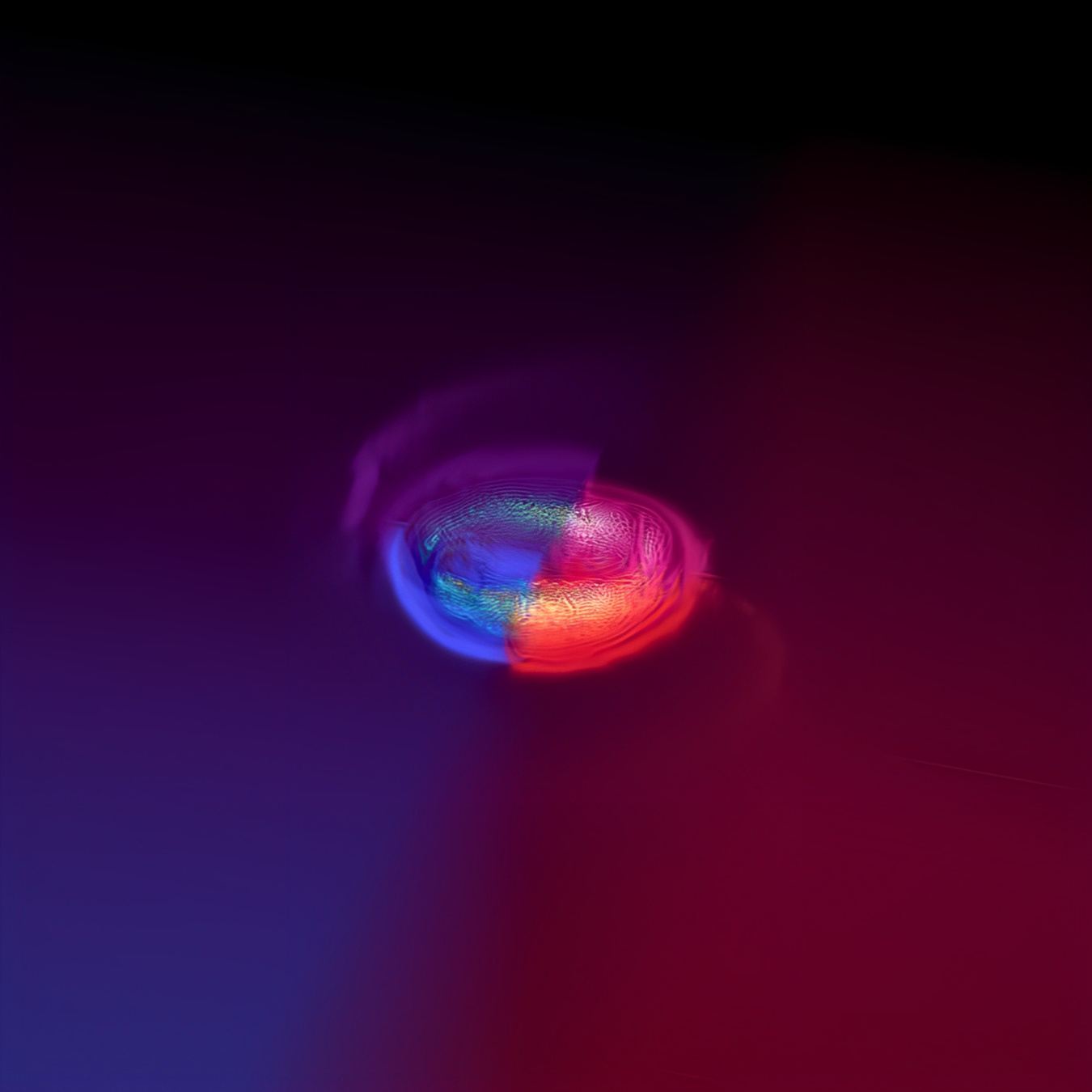
A 3D view of the energy densities of electron neutrinos, electron anti-neutrinos, heavy-lepton neutrinos and heavy-lepton anti-neutrinos about five milliseconds after neutron stars collide.
Image courtesy of the authors.