The Most Difficult Beam Ever Built Might Transform Physics
A particle born in one identity can arrive wearing another. Few discoveries in modern physics have unsettled the Standard Model more profoundly than neutrino…
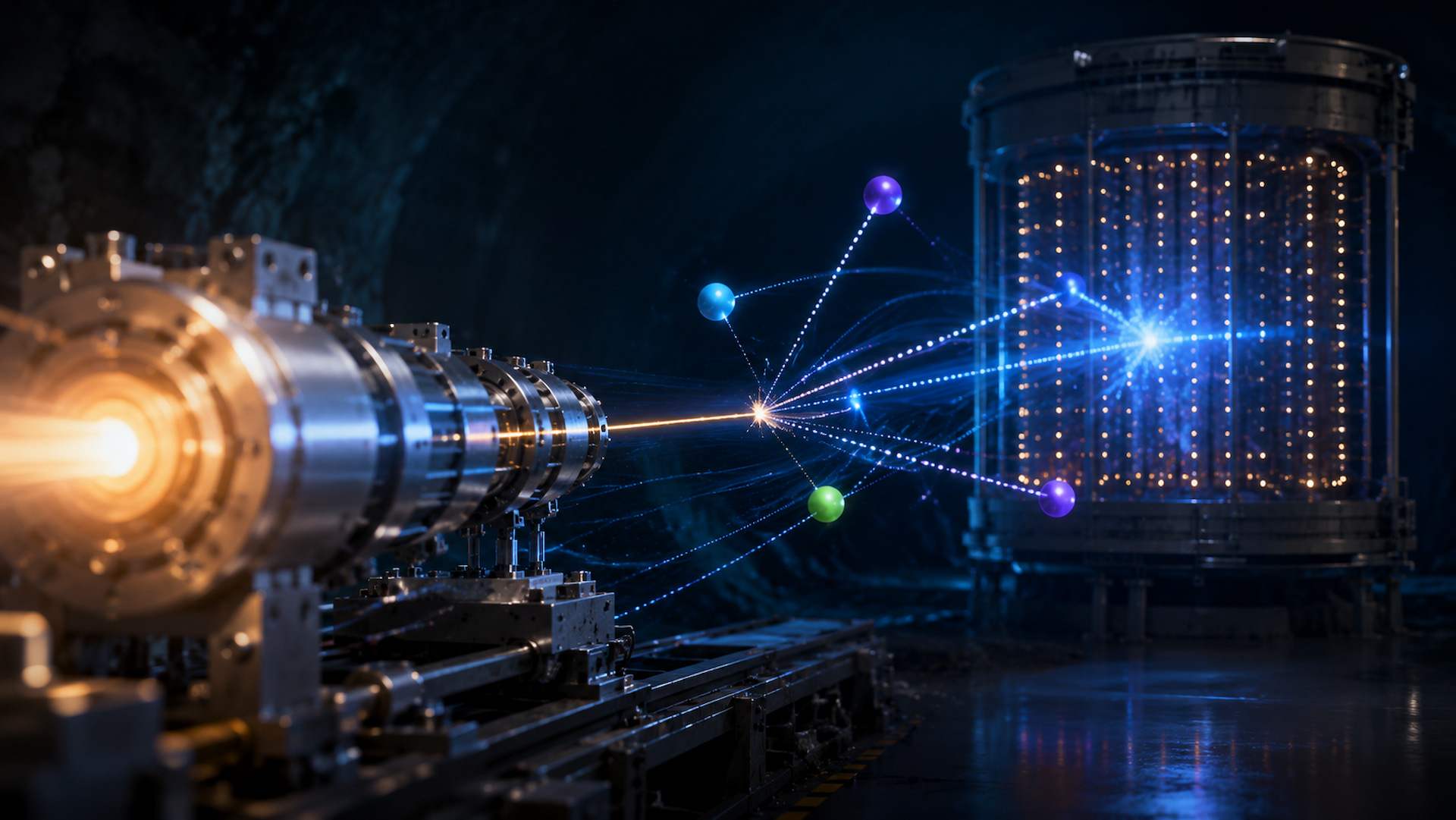
A particle born in one identity can arrive wearing another. Few discoveries in modern physics have unsettled the Standard Model more profoundly than neutrino oscillations, the strange quantum process through which electron, muon, and tau neutrinos continuously transform as they travel across space. For decades, physicists have refined gigantic detectors and powerful accelerator beams in pursuit of a deeper understanding of this behaviour. Yet an uncomfortable truth has remained at the centre of every major oscillation experiment: nobody truly knows the exact neutrino beam that leaves the source.
That uncertainty now stands as one of the greatest obstacles in precision neutrino physics.
The next generation of long-baseline experiments, including Hyper-Kamiokande and DUNE, aims to answer some of the most consequential questions in particle physics. Researchers hope to determine the ordering of neutrino masses, investigate whether neutrinos and antineutrinos behave asymmetrically, and search for hidden neutrino states that may lie beyond current theory. These facilities will generate unprecedented volumes of data by sending neutrino beams across hundreds of kilometres toward massive underground detectors. Statistical limitations are no longer the central concern. The real challenge comes from the beam itself.
Modern accelerator neutrino beams remain fundamentally imprecise machines. The standard approach, rooted in the magnetic horn concept developed at CERN in the early 1960s by Simon van der Meer, begins by smashing high-energy protons into a target to create showers of pions and kaons. Magnetic horns then focus these unstable particles before they decay into neutrinos and charged leptons. The resulting neutrino flux spans a broad range of energies whose exact structure depends on highly complex proton-nucleus interactions that remain difficult to model accurately. Every oscillation measurement must therefore wrestle with uncertainties originating long before a neutrino ever reaches a detector.
The problem becomes even more severe once neutrinos interact with matter. Since the incoming neutrino energy is unknown, experiments must reconstruct it indirectly from the debris left behind after neutrino-nucleus collisions. Nuclear effects, final-state interactions, and poorly constrained weak-interaction cross sections all introduce additional uncertainties. In practice, modern neutrino oscillation physics has become entangled with the messy interior dynamics of atomic nuclei.
There is, however, an alternative. It was proposed almost half a century ago.
In 1979, Bruno Pontecorvo introduced the concept of neutrino tagging, an elegant method that transforms the neutrino beam from an uncertain statistical object into a sequence of individually measured particles. The principle is deceptively simple. When a charged pion decays into a muon and a muon neutrino, precise measurements of the pion and muon momenta allow the neutrino momentum to be reconstructed through four-momentum conservation. Instead of estimating beam properties statistically, physicists can determine the energy of each neutrino interaction event-by-event.
If fully realised, neutrino tagging would fundamentally alter accelerator neutrino physics. Flux uncertainties would collapse. Neutrino energies would become directly measurable with extraordinary precision. Oscillation analyses that currently depend on complicated nuclear reconstruction models could instead rely on known incoming neutrino kinematics. Muon, pion, and kaon beams produced alongside the neutrinos would also become exceptionally well characterised secondary resources for precision physics.
The first serious attempt to build such a system emerged during the final years of the Soviet Union at the Tagged Neutrino Facility in Protvino. The experiment managed to record two candidate tagged-neutrino events before political collapse brought the programme to an abrupt end. The idea survived, but the technology required to make it practical did not yet exist.
The scale of the problem bordered on absurd. For every neutrino interaction observed in a detector, roughly ten trillion pion decays occur upstream. A viable tagged-neutrino beam therefore requires detectors capable of identifying enormous numbers of charged particles with astonishing temporal precision. Beam instrumentation must distinguish signals separated by mere picoseconds while operating inside intense radiation environments. In the 1990s, no detector system could realistically achieve those requirements.
The situation changed dramatically during the past two decades.
A revolution in fast-timing detector technology, driven largely by the demands of the Large Hadron Collider and its future upgrades, reshaped the limits of particle tracking. Modern silicon detectors now operate with timing resolutions once considered impossible. Technologies such as low-gain avalanche detectors, depleted monolithic active pixel sensors, and advanced three-dimensional silicon architectures routinely achieve timing performance in the range of tens of picoseconds while surviving extreme radiation doses.
These developments were accelerated by the needs of the NA62 experiment, designed to study one of the rarest known kaon decays. Its beam instrumentation demanded an entirely new approach to timing. The result was the TDCPix chip and the GigaTracker spectrometer, the first large-scale four-dimensional tracking detector in high-energy physics, capable of measuring particle trajectories in both space and time with remarkable accuracy.
The consequences extended far beyond kaon physics.
Because the NA62 beam naturally produces intense neutrino fluxes through kaon decay, researchers realised the facility could also function as a laboratory for neutrino tagging. Data collected in 2022 revealed a neutrino interaction candidate successfully matched to its parent decay. The reconstructed neutrino energy reached a relative precision of just 0.3 percent, an extraordinary achievement in a field where conventional accelerator neutrino beams often carry uncertainties exceeding 10 percent.
That single event carried symbolic weight far beyond its statistical significance. For the first time, neutrino tagging had moved from theoretical ambition into demonstrated reality.
The proof-of-concept triggered renewed interest across the neutrino community. The NuTag collaboration began exploring how tagged beams could unlock measurements inaccessible to conventional facilities. Their work converged with efforts from the ENUBET collaboration, which pioneered monitored neutrino beams based on slow proton extraction rather than pulsed magnetic horns. Together, these ideas evolved into the proposed nuSCOPE facility at CERN.
The design revives many of the original ambitions of the Soviet-era Tagged Neutrino Facility while exploiting modern detector capabilities unavailable to earlier generations. A slow-extracted proton beam from CERN’s SPS accelerator would strike a target to produce pions and kaons. Magnetic optics would select mesons within a narrow momentum range before ultra-fast timing detectors measure their trajectories. Downstream detectors would then record the associated muons and neutrino interactions. With sufficient spatial and temporal precision, individual neutrinos could be matched directly to their parent decays.
The implications are profound. Neutrino cross-section measurements, currently among the dominant systematic uncertainties for future oscillation experiments, could potentially reach accuracies near the one-percent level. Such datasets would become foundational references for neutrino physics over decades.
Beyond standard oscillation measurements, tagged beams could also expose phenomena invisible to present facilities. Hypothetical sterile neutrinos, for example, might generate rapid oscillation signatures currently smeared out by broad energy distributions. Precision muon and pion beams produced alongside the neutrinos would create additional opportunities for rare-decay studies and high-precision measurements.
A deeper shift also begins to emerge. For half a century, neutrino experiments largely pursued higher intensities and larger detectors. The future may depend less on producing more neutrinos and more on understanding every neutrino individually. Precision, not scale alone, could define the next era of neutrino physics.
In that sense, neutrino tagging represents more than a detector upgrade. It marks the transition from statistical neutrino astronomy to controlled neutrino metrology, where the most elusive particles in nature are finally placed on a clock precise enough to follow their transformations in real time.