Newly Observed Neutrino Challenges Modern Particle Physics: A Comprehensive Analysis
A Breakthrough in Neutrino Astronomy We are witnessing a pivotal moment in modern astrophysics.

On this page
A Breakthrough in Neutrino Astronomy
We are witnessing a pivotal moment in modern astrophysics. A newly observed neutrino has disrupted established theoretical frameworks, forcing us to reconsider long-held assumptions about the fundamental building blocks of the universe. This discovery is not merely an incremental step forward—it is a profound anomaly that may redefine our understanding of particle physics, cosmic radiation, and the origins of high-energy phenomena in the universe.
What Are Neutrinos? Understanding the Universe’s Most Elusive Particles
Neutrinos are subatomic particles with extremely small mass and no electric charge. They interact so weakly with matter that trillions pass through the human body every second without detection. Produced in nuclear reactions—such as those in stars, supernovae, and particle accelerators—neutrinos serve as unique messengers from the most energetic and distant events in the cosmos.
Key properties of neutrinos include:
- Near-zero mass
- No electric charge
- Weak interaction via the weak nuclear force
- Ability to traverse vast cosmic distances unimpeded
These properties make neutrinos ideal probes for studying extreme astrophysical environments.
The Discovery: Anomalous High-Energy Neutrino Detection
Recent observations have revealed a neutrino with properties that defy current theoretical predictions. Detected by advanced neutrino observatories, this particle exhibited:
- Exceptionally high energy levels beyond expected cosmic sources
- A trajectory inconsistent with known astrophysical emitters
- Interaction signatures that challenge the Standard Model of particle physics
Such anomalies suggest either an unknown cosmic origin or previously undiscovered physical processes.
Why This Neutrino Is Different
1. Energy Beyond Known Limits
The detected neutrino possesses energy levels significantly exceeding those typically produced by known cosmic accelerators such as supernovae or active galactic nuclei. This raises the possibility of:
- Unknown astrophysical sources
- Exotic cosmic phenomena
- New particle interactions
2. Unexpected Directionality
Unlike most neutrinos traced back to identifiable cosmic events, this particle appears to originate from a region of space with no known high-energy activity. This discrepancy introduces new questions about hidden or dark sources in the universe.
3. Interaction Anomalies
The way this neutrino interacted within the detector deviates from established interaction patterns. This could indicate:
- New neutrino flavors or states
- Unknown forces or interactions
- Physics beyond the Standard Model
Implications for Particle Physics
The Standard Model has long served as the foundation for understanding subatomic particles. However, this discovery exposes potential limitations:
- Incomplete understanding of neutrino mass and oscillation
- Possible existence of sterile neutrinos
- Indications of new fundamental forces
If confirmed, these findings could lead to a paradigm shift in theoretical physics.
Potential Cosmic Origins of the Anomalous Neutrino
We consider several hypotheses for the origin of this neutrino:
1. Hidden Astrophysical Sources
Unidentified cosmic structures or phenomena may be emitting high-energy neutrinos undetectable through traditional electromagnetic observation.
2. Dark Matter Interactions
The neutrino could be a byproduct of dark matter annihilation or decay, offering a rare glimpse into one of the universe’s greatest mysteries.
3. Exotic Cosmic Events
Phenomena such as cosmic string interactions or primordial black hole evaporation could produce neutrinos with such extreme properties.
Detection Technology: How We Observed the Impossible
Modern neutrino observatories rely on vast detection systems embedded deep underground or in ice. These detectors capture rare neutrino interactions through faint light emissions known as Cherenkov radiation.
Detection Process Overview
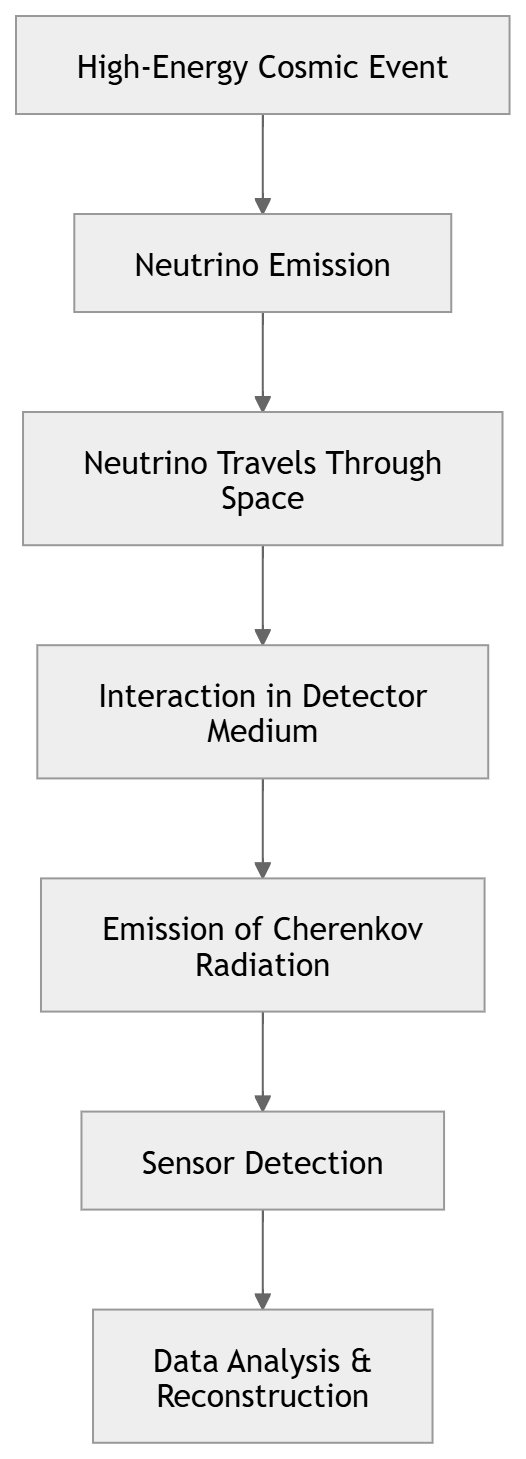
This process enables scientists to reconstruct the energy, direction, and type of incoming neutrinos with remarkable precision.
Challenges and Next Steps in Research
The scientific community now faces several urgent challenges:
- Verifying the observation through independent detections
- Refining models to accommodate the anomaly
- Expanding detector sensitivity and coverage
- Investigating potential correlations with other cosmic signals
Global collaboration will be essential to decode the implications of this discovery.
The Future of Neutrino Research
This event marks the beginning of a new era in neutrino astronomy. Future developments may include:
- Next-generation detectors with enhanced sensitivity
- Integration with multi-messenger astronomy (gravitational waves, gamma rays)
- Breakthroughs in quantum field theory and cosmology
We stand at the threshold of uncovering deeper truths about the universe.
A Turning Point in Understanding the Cosmos
The newly observed neutrino is more than an anomaly—it is a signal that our current understanding is incomplete. As we continue to investigate, we anticipate transformative insights that could reshape the foundations of physics and expand our comprehension of the universe’s most enigmatic forces.
The journey has just begun, and the implications are vast.
Artist’s rendering of the KM3NeT undersea neutrino observatory in the Mediterranean Sea.
Illustration: Edward Berbee, Nikhef