A Solid-State Route to Neutrino Mass
The radioactive decay of tritium bound to graphene is described by new density-functional-theory calculations, which provide a means of modeling…
The radioactive decay of tritium bound to graphene is described by new density-functional-theory calculations, which provide a means of modeling investigations that may provide clearer insights on neutrino mass.
Neutrinos must have mass, as evidenced by the finding that they fluctuate during propagation, alternating between three “flavors” (electron, muon, and tau). However, neither their absolute mass scale nor the mass ordering—that is, whether the lightest neutrino state is primarily electron-, muon-, or tau-like—are known. One of the main objectives of contemporary particle physics is to ascertain these characteristics. Measuring the energy spectrum of electrons released in nuclear β decay, especially from tritium, is a potential method since a nonzero neutrino mass somewhat alters the spectrum of electrons released because the neutrino removes a portion of the decay energy. This approach has been pushed to its limit by precision experiments like KATRIN, which have established an upper constraint on the neutrino mass of roughly 0.45 eV [1].
While molecular tritium gas is used in KATRIN, emerging approaches seek to go beyond this by incorporating tritium into synthetic materials. For instance, utilizing tritiated graphene—graphene containing tritium atoms bonded to its surface—could increase the mass detection sensitivity tenfold, according to the PTOLEMY project at the Gran Sasso National Laboratory in Italy [2].
In this regard, Valentina Tozzini of the Institute of Nanoscience in Pisa, Italy, and associates report a density-functional theory (DFT) first-principles analysis of tritium β decay on graphene [3]. The framework for upcoming neutrino-mass investigations based on tritiated graphene is laid by their explanation of how nuclear decay couples to a complicated material environment, which is a significant step toward predicting the electron spectrum in such systems.
This strategy is based on the idea that functionalized graphene can provide a novel way to investigate weak-interaction processes like radioactive decay. Tritium functions here as a transducer, converting a radioactive decay involving a neutrino into an emitted electron, just like infrared light striking a photocathode releases detectable electrons. In this sense, tritiated graphene can be thought of as a neutrino equivalent of night-vision goggles.
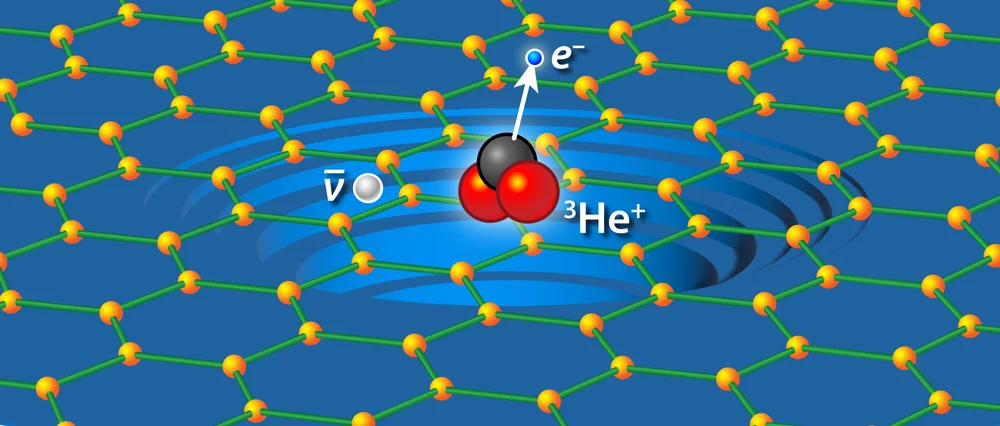
However, this transduction proceeds through a change in nuclear states, unlike an infrared detector. Tritium bonded to a graphene sheet decays to create a recoiling helium-3 ion, an electron, and a (anti-)neutrino (Fig. 1). This leads us to the main topic of the paper: the quantum states that the decayed helium-3 ion inhabits. Understanding these states is crucial for connecting the measured electron spectrum to the underlying nuclear dynamics when the substrate is present, and eventually to the neutrino mass. The researchers note that this fascinating topic entails characterizing the behavior of the system over a broad variety of timescales. They create new DFT extensions and integrate them with a thorough examination of the nuclear configurations involved in the process in order to overcome this difficulty.
When tritium β decays, the highest energetic electrons released are almost relativistic, moving at almost the speed of light. On the ultrafast timescale determined by the weak contact driving the nuclear transition (on the order of 10-21 seconds), their emission gives the daughter nucleus of helium-3 a nearly immediate momentum kick. The surrounding electrons and carbon atoms in graphene react to this abrupt disruption over slower timescales. Predicting the kinetic energy carried by the released electron, which is measured with great resolution distance from the decay site, requires an understanding of this reaction.
Tritiated graphene is a useful “stopwatch” for examining quantum nuclear dynamics because of this separation of timescales [4]. Helium will eventually separate from the substrate since it is inert and interacts with graphene only weakly. However, immediately following the decay, it stays as a slow-moving ion trapped in the potential well that the tritium atom had inhabited. The quick, outgoing electron successfully takes a picture of the energy configuration of the system during this short time. Its energy spectrum reaches the “end point,” or maximum permitted by the decay, which corresponds to the generation of (anti-)neutrinos at rest. High-statistics observations of the released electrons can be used to investigate the influence of the neutrino mass on spectrum aberrations, which is most noticeable under these circumstances.
One significant distinction from traditional tests with gaseous molecular tritium is the impact of the solid-state environment. Because the sensitivity to the neutrino mass in those experiments is limited to the small area close to the end point, very powerful tritium sources are needed to gather enough statistics. Furthermore, the numerous potential rovibrational excitations of the daughter molecular ion (³HeT+) generated by the decay of diatomic tritium (T2) significantly extend this region. Consequently, the final point is an empirically unresolvable dense manifold of closely spaced spectral features.On the other hand, when tritium is linked to graphene, the much heavier substrate inhibits the helium-3 nucleus’s recoil, so that virtually no kinetic energy is deducted from the released electron. The effect that underlies Mössbauer gamma-ray spectroscopy is similar to this behavior: Extremely sharp spectral patterns are produced by recoil-free emission from nuclei attached to a solid. Helium occupies a discrete set of bound states if it is still contained in a three-dimensional potential. In the electron energy spectrum, each of these states is associated with a distinct excitation energy and, consequently, a somewhat different termination point. Because of this, the distortion caused by neutrino mass is duplicated at each of these energy thresholds rather than being limited to a single end point.
The resulting pattern, which is recorded in the number, locations, and amplitudes of the spectral characteristics, offers several handles for extracting neutrino mass information as well as a comprehensive fingerprint of the postdecay dynamics.
In order to account for the harsh, nonadiabatic conditions of the decay, the researchers investigate various approximations. In the semisudden approximation, the electronic structure follows the nuclear position without completely relaxing, whereas in the sudden approximation, it is believed to remain frozen just after the transition. For helium, both methods anticipate a distinct set of excited bound states. Additionally, they estimate that the density of states becomes very sparse for energy intervals of order 20–200 meV above each excitation threshold. The impacts of a finite neutrino mass are anticipated to appear in this exact location. Crucially, these energy spacings fall within PTOLEMY’s estimated energy resolution of approximately 10 meV.
These findings demonstrate the potential and difficulties of simulating β decay in complex systems, where many-body effects and many timescales need to be handled consistently. However, they also indicate a qualitatively different realm where the underlying physics can be enhanced rather than obscured by solid-state systems.
I can only encourage the researchers—onward and upward!—as their work proceeds into a thrilling confrontation with experiment. More generally, a new era of ultrasensitive testing is being ushered in by the convergence of neutrino, nuclear, solid-state, and atomic physics. This could result in significant findings regarding the fundamental rules of nature.
Figure 1: Diagram of using tritiated graphene to detect neutrinos. An electron (e–), an antineutrino (v–), and a recoiling helium ion (3He+) are the products of tritium decay. Tozzini and associates used first-principles calculations to study this process, specifically relating the neutrino mass to the electron emission spectrum [3].