Japan’s Underground Telescope Detects “Ghost Particles”: How Neutrinos Reveal the Hidden Universe
The detection of neutrinos—often called “ghost particles”—represents one of the most important frontiers in modern astrophysics.

On this page
The detection of neutrinos—often called “ghost particles”—represents one of the most important frontiers in modern astrophysics. In Japan, a sophisticated underground observatory has achieved groundbreaking results by detecting these elusive particles with unprecedented sensitivity. Through advanced instrumentation and innovative scientific collaboration, we are now able to observe signals from some of the most energetic and mysterious processes in the universe.
This article explores how Japan’s neutrino telescope works, why neutrinos are called ghost particles, and how their detection is reshaping our understanding of astrophysics, particle physics, and cosmology.
What Are Neutrinos? The “Ghost Particles” of Physics
Neutrinos are subatomic particles with extremely small mass and no electric charge. They interact with matter only through the weak nuclear force and gravity, making them extraordinarily difficult to detect.
Trillions of neutrinos pass through every human body every second, yet almost none interact with atoms. This near invisibility has earned them the nickname “ghost particles.”
Key Characteristics of Neutrinos
| Property | Description |
|---|---|
| Electric charge | Neutral |
| Mass | Extremely small (close to zero) |
| Interaction | Weak nuclear force and gravity |
| Speed | Close to the speed of light |
| Sources | Stars, supernovae, nuclear reactions, cosmic rays |
Because neutrinos rarely interact with matter, they travel across the universe almost completely undisturbed, carrying pristine information about their cosmic origins.
Japan’s Underground Neutrino Telescope
Japan hosts one of the world’s most advanced neutrino observatories: a massive underground detector located deep beneath a mountain. The facility is designed to isolate extremely rare neutrino interactions from background noise.
Why the Detector Is Located Underground
The detector is placed more than 1,000 meters below the surface to shield it from cosmic radiation and other particle interference. Rock layers above the detector act as a natural filter, allowing only neutrinos to penetrate.
The telescope consists of an enormous tank filled with ultra-pure water surrounded by thousands of sensitive light detectors called photomultiplier tubes (PMTs).
When a neutrino interacts with water molecules, it produces a faint flash of blue light known as Cherenkov radiation. The detectors capture this flash, allowing scientists to reconstruct the neutrino’s energy and direction.
How the Neutrino Detection Process Works
Below is a simplified representation of the detection mechanism used by the Japanese neutrino observatory.
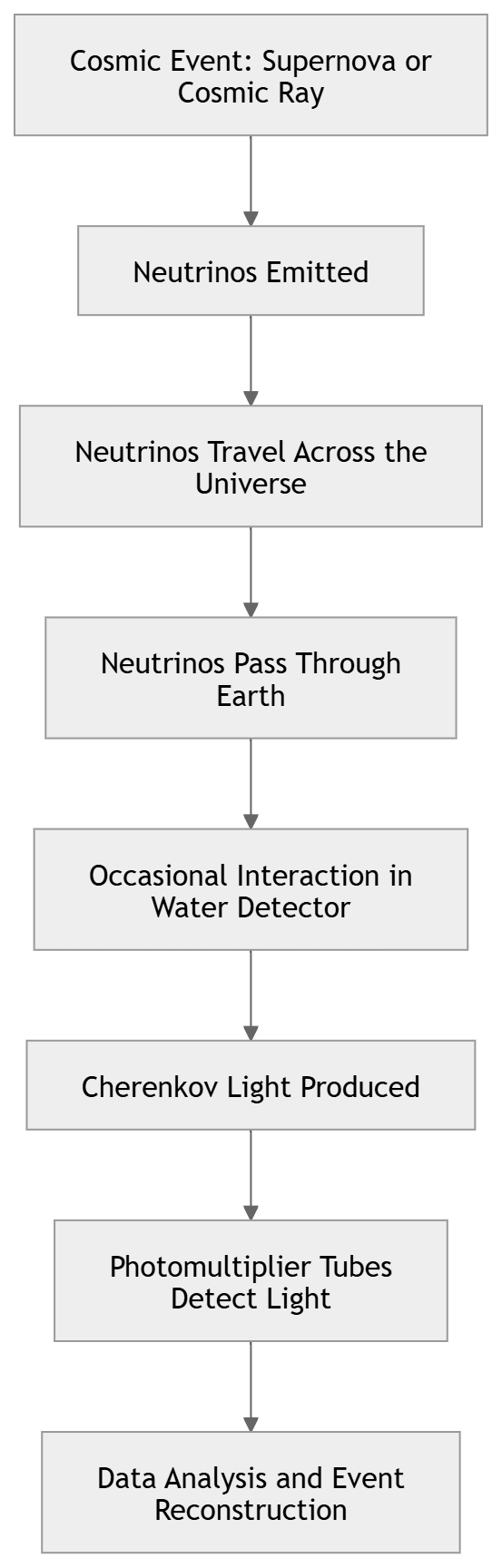
This process allows researchers to identify neutrino interactions that occur perhaps only a few times per day within billions of particles passing through the detector.
Breakthrough Detection of High-Energy Cosmic Neutrinos
The Japanese telescope has recently detected neutrinos originating from extremely energetic cosmic events, such as:
-
exploding stars (supernovae)
-
gamma-ray bursts
-
black hole jets
-
interactions of cosmic rays with matter
These detections provide valuable clues about the most violent phenomena in the universe.
Because neutrinos travel unimpeded through matter and magnetic fields, they allow scientists to trace cosmic events directly to their sources, unlike photons or charged particles which can be deflected.
Why Neutrino Astronomy Matters
Traditional astronomy relies on electromagnetic radiation—visible light, radio waves, or X-rays. However, many cosmic environments are opaque to light, hiding crucial processes from telescopes.
Neutrinos penetrate these environments freely.
Advantages of Neutrino Astronomy
-
Direct observation of stellar cores
-
Early detection of supernova explosions
-
Insight into black hole formation
-
Understanding cosmic ray origins
-
Testing fundamental particle physics
By observing neutrinos, we gain access to regions of space that were previously impossible to study.
The Role of Cherenkov Radiation in Detection
Cherenkov radiation is the key phenomenon enabling neutrino detection in water-based observatories.
When a charged particle created by a neutrino interaction moves faster than light travels through water (which is slower than in a vacuum), it produces a cone of blue light.
Thousands of photomultiplier sensors surrounding the detector capture these faint signals.

The pattern and timing of the light flashes reveal the direction, type, and energy of the neutrino.
Global Collaboration in Neutrino Research
Japan’s neutrino telescope operates as part of an international network of neutrino observatories, including:
-
IceCube Neutrino Observatory (Antarctica)
-
KM3NeT (Mediterranean Sea)
-
Sudbury Neutrino Observatory (Canada)
These facilities collectively enable scientists to perform multi-messenger astronomy, combining neutrino observations with gravitational waves and electromagnetic signals.
This approach dramatically improves our ability to analyze cosmic events.
Implications for Particle Physics
Beyond astrophysics, neutrino observations also challenge our understanding of fundamental physics.
Researchers are investigating:
-
neutrino oscillations (flavor changes)
-
neutrino mass hierarchy
-
possible sterile neutrinos
-
physics beyond the Standard Model
Japan’s detector has already contributed significantly to precision measurements of neutrino oscillations, confirming that neutrinos change identity as they travel through space.
The Future of Neutrino Telescopes
Next-generation upgrades aim to dramatically increase detector sensitivity and data precision. Planned improvements include:
-
expanded detector volume
-
more photomultiplier sensors
-
enhanced data processing systems
-
improved background suppression
These advancements will allow scientists to detect far more neutrinos from distant cosmic sources, potentially uncovering unknown astrophysical phenomena.
Conclusion
Japan’s underground neutrino telescope represents one of the most powerful tools for exploring the invisible universe. By capturing rare interactions of ghost-like neutrinos, scientists gain direct insight into the most energetic and hidden processes in space.
As detection technology improves and global collaborations expand, neutrino astronomy will continue to transform our understanding of the cosmos—revealing secrets from the cores of stars, the edges of black holes, and the earliest moments of the universe itself.