A New Type of Laser That Would Fire Neutrinos Is Proposed by Physicists
Bose Einstein condensates could be used as a potential tool to generate powerful neutrino beams.
On this page
Bose Einstein condensates could be used as a potential tool to generate powerful neutrino beams.
The Science
A novel method for producing neutrinos at faster speeds has been proposed by physicists. This approach would make use of a Bose-Einstein condensate, a state of matter near absolute zero. It would take use of quantum processes, which can generate neutrinos more quickly than typical radioactive decays. This device would generate a sizable and manageable neutrino beam. They might be comparable to photons, or light particles, in an optical laser.
The Impact
Neutrinos are fundamental particles that interact extremely weakly with matter. It is very difficult to produce and detect neutrinos. It requires large detectors and powerful sources such as nuclear reactors or particle accelerators. A controllable, coherent source of neutrinos on a bench-top scale would have a significant impact on neutrino research. This type of technology would provide new opportunities to understand their interactions and quantum mechanical properties. In addition, the specific radioactive decays that would enable such a controllable, coherent neutrino source on a small scale could lead to new applications. These applications could include production of rare isotopes for medical physics and neutrino-based communication.
Summary
Lasers have been revolutionary in enabling the development of many aspects of modern science and technology. They are based on the amplification of light via stimulated emission. This is a quantum mechanical process whereby an excited atom is forced to emit a second photon upon absorption of another with the same wavelength. Due to their tiny masses, neutrinos behave similarly to photons in many situations. However, they cannot be used for lasing because their fermionic nature inhibits stimulated emission. For this reason, it is not possible to develop a neutrino laser using this traditional mechanism.
A related but distinct quantum enhancement effect in photons is Dicke superradiance. This is an amplification of the spontaneous emission process through quantum correlations that develop within a gain medium. Unlike lasing, superradiance is possible for fermions. As such, this effect could enable quantum mechanical amplifications of neutrino emission, assuming certain conditions are met. Of all of these conditions, it’s particularly important that neutrinos emerging from different atoms are not distinguishable based on their quantum phases. Due to the high energy of neutrinos produced in beta and electron capture decays, this criterion is difficult to meet in ordinary matter. However, scientists can maintain this indistinguishability by using a radioactive Bose Einstein condensate.
This new theoretical work investigates the conditions for coherence and amplification in a superradiant neutrino laser. Scientists found that they could use a realistically sized Bose-Einstein condensate of the radioactive atom rubidium-83 to accelerate neutrino-producing electron capture decays from a half-life of 86.2 days to a few minutes. They could monitor this amplification by capturing the daughter atom krypton-83, which serves as a tracer of the decay rate.
CREDIT:
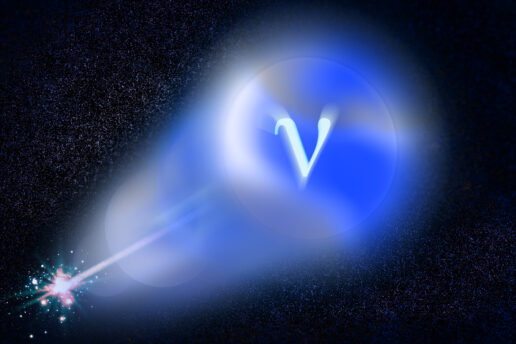
Artist impression of a trapped radioactive vapor decaying into a coherently-beamed stream of neutrinos (symbolized by v).
Image courtesy of JOSE-LUIS OLIVARES/MIT, ISTOCK