Neutrino Mass: The Latest Physics Breakthroughs Solving One of the Universe’s Biggest Mysteries
Neutrinos are among the most enigmatic particles in the universe. For decades, physicists have attempted to determine one crucial property: their mass.
On this page
Neutrinos are among the most enigmatic particles in the universe. For decades, physicists have attempted to determine one crucial property: their mass. Although neutrinos are incredibly abundant—trillions pass through every human body each second—their mass remains extraordinarily difficult to measure.
Recent breakthroughs in experimental physics are bringing scientists closer than ever to solving the neutrino mass problem, a discovery that will profoundly reshape our understanding of particle physics, cosmology, and the evolution of the universe.
In this article, we examine the latest scientific progress, the experimental techniques driving discovery, and the implications of finally determining the mass of neutrinos.
What Are Neutrinos?
Neutrinos are elementary particles belonging to the lepton family in the Standard Model of particle physics. They interact only through the weak nuclear force and gravity, making them extremely difficult to detect.
Key properties of neutrinos include:
-
Electrically neutral
-
Extremely small mass
-
Weak interaction with matter
-
Nearly light-speed travel
There are three known neutrino flavors:
-
Electron neutrino (νe)
-
Muon neutrino (νμ)
-
Tau neutrino (ντ)
A remarkable phenomenon known as neutrino oscillation allows neutrinos to change between these flavors as they travel through space.
Why Determining Neutrino Mass Matters
The discovery that neutrinos possess mass already forced physicists to revise the Standard Model. However, the exact value of the neutrino mass remains unknown.
Determining this value is crucial because it influences:
-
The formation of large-scale cosmic structures
-
The evolution of galaxies
-
The total mass-energy balance of the universe
-
Extensions of the Standard Model of particle physics
Neutrinos are the second most abundant particle in the universe after photons, meaning their collective mass may significantly affect cosmic evolution.
How Scientists Measure Neutrino Mass
Direct measurement of neutrino mass requires extraordinary precision because neutrinos are so light.
The most powerful experimental method involves analyzing beta decay energy spectra, particularly using the isotope tritium.
During beta decay:
-
Tritium transforms into helium
-
An electron and a neutrino are emitted
-
The energy distribution of emitted electrons reveals clues about neutrino mass
The relationship between decay energy and neutrino mass can be described conceptually as:

Neutrino Mass: The Latest Physics Breakthroughs Solving One of the Universe’s Biggest Mysteries
The KATRIN Experiment: Leading the Global Effort
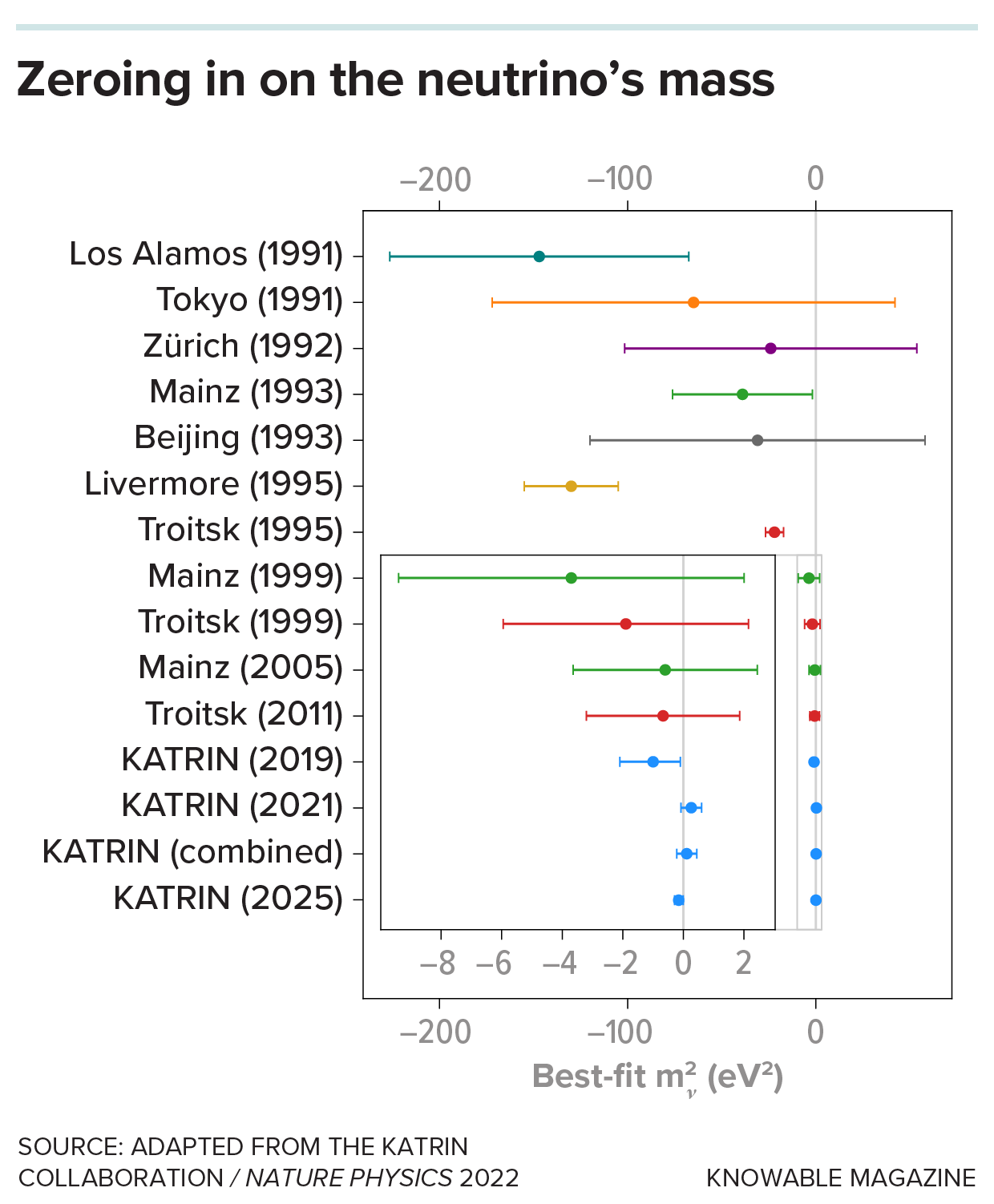
One of the most advanced experiments dedicated to neutrino mass measurement is the KATRIN (Karlsruhe Tritium Neutrino Experiment) in Germany.
KATRIN is designed to measure the neutrino mass with unprecedented sensitivity.
Key features include:
-
A 70-meter-long experimental apparatus
-
Ultra-precise spectrometers
-
Tritium beta decay sources
-
Extremely stable magnetic and electric fields
The experiment analyzes the final electrons produced in beta decay and measures their energies with extraordinary precision.
Recent measurements have dramatically tightened the upper limit on neutrino mass, bringing physicists closer to the true value than ever before.
Cosmological Observations and Neutrino Mass
In addition to laboratory experiments, astrophysical observations provide powerful indirect constraints on neutrino mass.
Cosmologists analyze:
-
Cosmic Microwave Background (CMB)
-
Large-scale galaxy distributions
-
Gravitational lensing
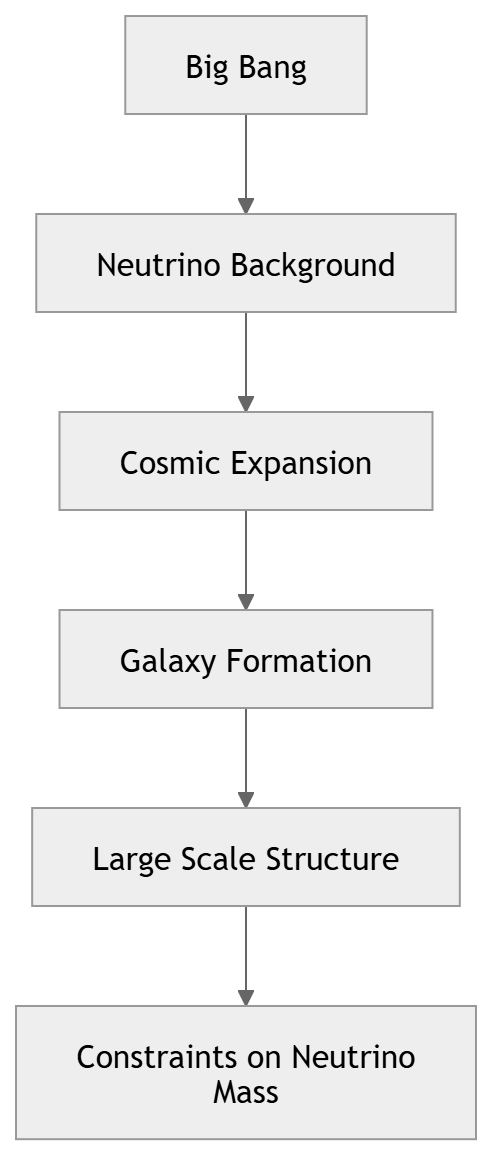
Neutrinos influence how matter clusters in the universe because their high velocity suppresses structure formation at small scales.
This relationship can be visualized as follows:
Neutrino Mass: The Latest Physics Breakthroughs Solving One of the Universe’s Biggest Mysteries
Neutrino Oscillations: Evidence for Mass
The first evidence that neutrinos have mass came from the discovery of neutrino oscillations.
If neutrinos were massless, they could not change flavor during flight.
Oscillation experiments conducted in:
-
Japan (Super-Kamiokande)
-
Canada (Sudbury Neutrino Observatory)
-
Italy (Gran Sasso)
demonstrated that neutrinos switch identities while traveling through space.
This phenomenon implies:
-
At least two neutrino types must have non-zero mass
-
The mass differences between neutrino states can be measured
However, oscillations reveal mass differences, not the absolute mass scale.
The Remaining Mystery: Absolute Neutrino Mass
Despite decades of research, scientists still seek the precise absolute mass of neutrinos.
Three main experimental strategies are being pursued:
1. Direct Kinematic Measurements
Example: KATRIN experiment
Measures energy distribution of beta decay electrons.
2. Cosmological Measurements
Uses astrophysical observations to constrain total neutrino mass.
3. Neutrinoless Double Beta Decay
Tests whether neutrinos are their own antiparticles.
Each approach offers complementary insights.
Neutrinoless Double Beta Decay: A Possible Breakthrough
One of the most exciting avenues of research involves neutrinoless double beta decay.
Normally, double beta decay emits two electrons and two neutrinos. However, if neutrinos are Majorana particles (their own antiparticles), a rare process may occur where no neutrinos are emitted.
The process would appear as:
Detecting this decay would revolutionize physics by:
-
Revealing the true nature of neutrinos
-
Providing information about their absolute mass
-
Explaining the matter–antimatter imbalance in the universe
Implications for the Future of Particle Physics
Solving the neutrino mass problem will reshape modern physics.
Key consequences include:
-
Extension or revision of the Standard Model
-
Insights into dark matter and dark energy
-
Improved models of cosmic evolution
-
Deeper understanding of fundamental symmetries
Neutrinos may also hold clues about physics beyond the Standard Model, potentially pointing toward new particles or interactions.
The Next Generation of Neutrino Experiments
Several major experiments will further refine neutrino mass measurements in the coming decade:
-
KATRIN upgrades to improve sensitivity
-
Project 8, exploring novel detection techniques
-
LEGEND, searching for neutrinoless double beta decay
-
DUNE, studying neutrino oscillations at unprecedented scale
These projects combine cutting-edge technology with global scientific collaboration.
Their discoveries may finally answer one of physics’ most persistent questions.
Conclusion: Approaching the Solution to the Neutrino Mass Puzzle
Neutrinos have challenged physicists for nearly a century. Their near-invisibility, tiny mass, and extraordinary abundance make them central to understanding the universe.
Today, advanced experiments and cosmological observations are converging on a solution. Precision beta-decay measurements, deep underground detectors, and large-scale astronomical surveys are steadily narrowing the possible mass range.
As these efforts progress, the neutrino mass mystery is moving from speculation to measurable reality, opening a new era in particle physics and cosmology.