Steven Gardiner is given an Early Career Award to further DUNE's low-energy neutrino research.
A Department of Energy Early Career Award was recently given to physicist Steven Gardiner to investigate the Deep Underground Neutrino Experiment’s potential…

A Department of Energy Early Career Award was recently given to physicist Steven Gardiner to investigate the Deep Underground Neutrino Experiment’s potential for low-energy research. He hopes to use DUNE’s enormous detector modules to investigate elusive space particles by utilizing his special expertise in neutron simulations.
When Steven Gardiner first started his scientific career, he focused on the real-world uses of nuclear physics, such as developing models that nuclear engineers use to design reactors and inventing neutron detectors for counterterrorism. Prior to considering PhD programs and learning about the Deep Underground Neutrino Experiment, which is being conducted by the U.S. Department of Energy’s Fermi National Accelerator Laboratory, he had little interest in fundamental research on neutrino physics.
After speaking to his adviser, Bob Svoboda at University of California, Davis, about the exciting science potential of DUNE, Gardiner recalled, “I became a neutrino person and never looked back.” He joined Fermilab in 2018, bringing a unique background in neutron simulations to the study of some of the most elusive particles in the universe.
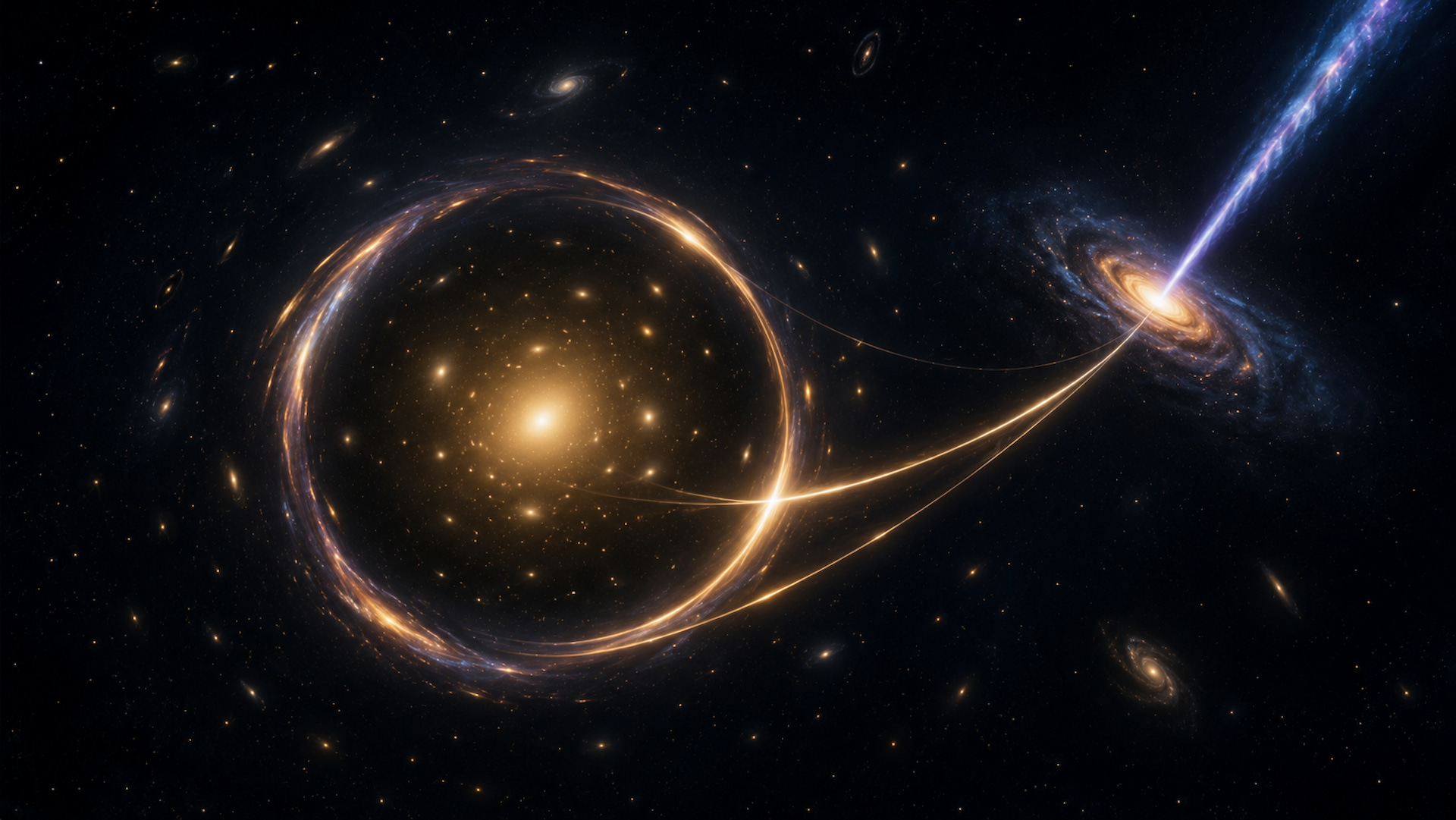
This career track recently earned Gardiner a Department of Energy Early Career Award, which provides funding to explore the low-energy research potential of DUNE. While the experiment is primarily designed for high-energy beam physics, Gardiner is advocating for its use as an unusual kind of telescope. Rather than collecting rays of light to study the universe, DUNE will be sensitive to ghostly low-energy neutrinos coming from outer space, including those from the Sun, supernovae, black holes and possibly dark matter.
“Even though DUNE is designed for beam physics, you can go way lower in energy, and it still performs,” Gardiner said. He believes his specific background allows him to make a “unique contribution due to my career trajectory,” taking him from neutrons to neutrinos.
The technical heart of this research involves upgrading a computer simulation code called MARLEY, or Model of Argon Reaction Low Energy Yields. Because neutrinos interact so weakly with ordinary matter, they are not directly visible in detectors. Instead, physicists must look for extremely rare collisions between neutrinos and atomic nuclei. Like a subatomic version of a car crash investigation, the tracks left by particles coming out of each collision provide clues about what originally happened. To put these puzzle pieces back together, scientists rely on detailed simulations of the collision physics, which is where MARLEY becomes essential. Results from these simulations will help researchers tell the difference between uninteresting noise, low-energy cosmic neutrinos and potential signals from undiscovered new particles. The ultimate goal of this work is to push the boundaries of physics. “My hope is that as a result of this project, we are thinking about new physics beyond the Standard Model,” Gardiner said.
He also emphasized science opportunities going far beyond the microscopic world. “Neutrinos reveal the inner workings of stars to us, whether it’s the core of our own Sun or the first moments of a supernova explosion,” Gardiner said. By refining the models used to interpret neutrino interactions, he is helping to open a wider view of the distant universe. “DUNE is a new window to the cosmos,” he said. “It gives us a new way of seeing into a hidden world where all kinds of crazy stuff might be going on.”
The DOE funding ensures that low-energy neutrino research may expand our understanding of the fundamental building blocks of the universe through the unparalleled sensitivity of the DUNE detectors.
The national laboratory for particle physics and accelerator research in the United States is called Fermi National Accelerator Laboratory. The U.S. Department of Energy Office of Science oversees Fermilab through Fermi Forward Discovery Group. Go to www.fnal.gov, the Fermilab website, and follow us on social media.