Tomorrow’s Energy, Engineered Today by the Neutrino® Energy Group
Modern life depends on a quiet contract. Electricity must be present before it is noticed, stable before it is questioned, affordable before it becomes…

Modern life depends on a quiet contract. Electricity must be present before it is noticed, stable before it is questioned, affordable before it becomes political. When that contract fails, the discussion usually turns to fuel prices, transmission lines, or weather dependent generation. Yet beneath those visible systems, a separate physical reality persists.
Subatomic particles and electromagnetic fields traverse every structure continuously, transferring minute amounts of momentum and energy into matter. For decades this background was measured, cataloged, and largely ignored as a power resource. Neutrinovoltaic technology begins precisely at that overlooked boundary, asking whether statistically integrated microscopic interactions can be engineered into a controlled electrical output, without violating the most basic constraint in physics: energy conservation.
A technology class defined by a ledger
Neutrinovoltaic systems are accounting devices. They are open, non-equilibrium solid state converters that couple to persistent background momentum fluxes and rectify microscopic responses into directed charge flow. The consequence is a hard inequality, not a promise: P_out ≤ ΣP_in. In that sum sit every coupled channel, solar neutrinos, cosmic muons, ambient RF and microwave fields, infrared and thermal fluctuations, and mechanical micro excitations. The output is bounded by what is actually coupled, and by what the conversion chain can retain.
This is why “amplification” must be handled with care. Here, amplification is structure induced power density aggregation, not energy creation. It arises from parallel summation across vast numbers of nanoconverters per area, resonance and quality factor concentration into selected modes, and low loss rectification with impedance matching. None of these terms, applied correctly, permit over unity behavior.
The master equation as an engineering interface
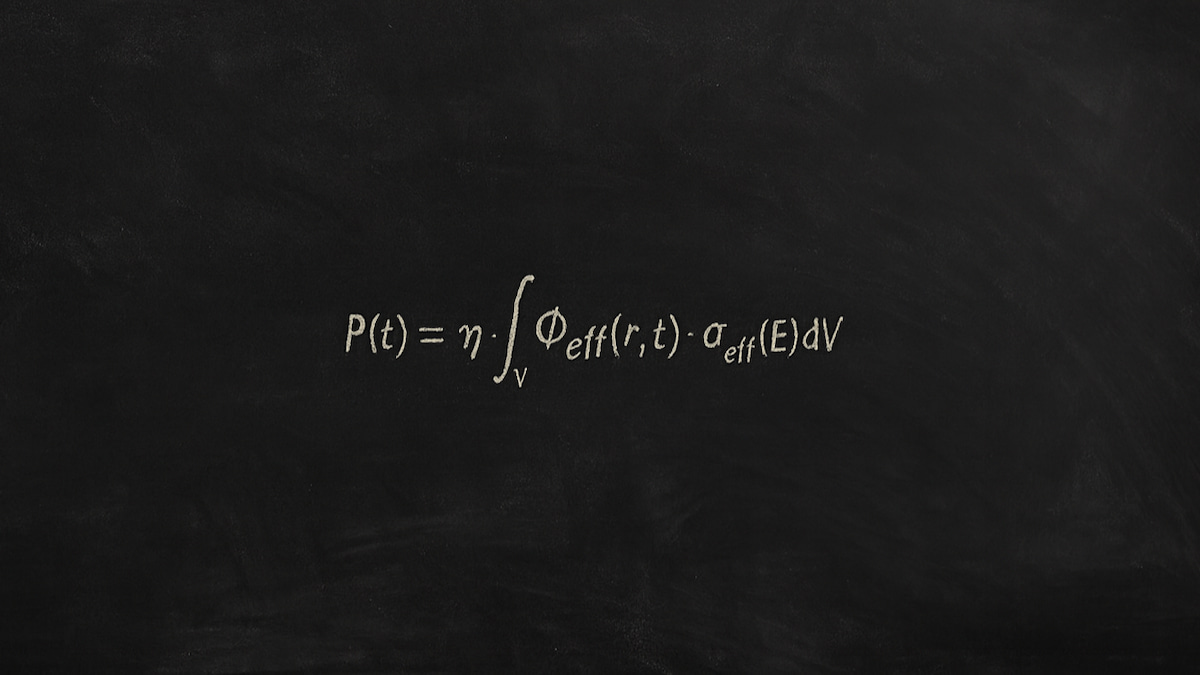
At the center sits Neutrino® Energy Group’s master equation, attributed to its CEO, the visionary mathematician and Architect of the Invisible, Holger Thorsten Schubart:
P(t) = η · ∫_V Φ_eff(r,t) · σ_eff(E) dV.
It reads like physics but functions like an engineering interface. P(t) is measured electrical output power. η is the chain efficiency, collecting transduction, rectification, impedance matching, and losses. Φ_eff(r,t) is multichannel effective flux, the part of the environment actually coupled into the device at place and time. σ_eff(E) is not the fundamental particle physics cross section, it is a device dependent coupling coefficient shaped by architecture, doping, and interfaces.
From single events to continuous accumulation
Particle physics usually hunts discrete interactions. Neutrinovoltaics treats microscopic transfers as statistical rain and designs materials that can keep score. Coherent elastic neutrino nucleus scattering, CEνNS, establishes that neutrinos can transfer measurable momentum and energy to nuclei, in the eV to keV range per scattering, depending on spectrum and target. The point is not that one event is large, it is that independent events can be integrated in parallel.
Numbers supply intuition. Solar neutrinos dominate local neutrino counts, with a surface flux around 6×10^10 cm⁻²·s⁻¹ and energies from roughly 0.1 to 10 MeV. Cosmic muons contribute a different channel, with a sea level flux near 100 m⁻²·s⁻¹ and mean energies around 4 GeV, depositing energy through ionization that can feed lattice excitation pathways.
Why graphene plus doped silicon keeps appearing
The recurring architecture is a multilayer stack of alternating graphene and doped silicon. Graphene offers very high carrier mobility, about 2×10^5 cm²/(V·s), and high mechanical stiffness, often cited near 1 TPa. Doped silicon provides built in electric fields, discussed in the 10^4 to 10^5 V/m range, biasing charge separation so microscopic motion does not average to zero.
Design discussions emphasize tolerances, because coupling is an interface game. Graphene thickness is treated in the one to three layer range, about 0.34 to 1.02 nm. Doped silicon layers are described around 50 to 80 nm, trading vibrational transfer against interaction opportunity. Layer spacing is discussed near 0.5 to 0.8 nm to keep van der Waals coupling strong. One documented stack cites 22 layers as a resonance optimized count, with a vibration amplification factor near 120 under its model.
These figures are not constants, they are a map of constraints, the reason the technology is inseparable from interface cleanliness, deposition control, and repeatable manufacturing.
The conversion chain in plain technical language
The conversion chain can be stated without mystique: momentum flux couples into a nanostructure stack, inducing micro vibration and localized deformation, which couples into charge carriers and is rectified into net DC. Technical summaries explicitly name established transduction families, piezoelectric, flexoelectric, and triboelectric, as legitimate routes for reading out micro deformation electrically. The terminology work is equally explicit about the canonical chain: momentum flux → micro vibration → electron flow.
Just as important is what the chain excludes. There is no claim that a stack “runs on neutrinos alone,” and no claim that it eliminates metrology. “Energy from neutrinos” is treated as shorthand for multichannel background momentum flux utilization.
Engineering form factors: where the narrative becomes concrete
If neutrinovoltaics is to be taken seriously, it must appear in bounded hardware. The Neutrino Power Cube is presented as a compact, fuel free generator delivering about 5 to 6 kW net power, with dimensions 800 × 400 × 600 mm and a mass around 50 kg. The modular premise is that generation and control electronics can be separated, scaled, and serviced.
The Neutrino Life Cube packages survival constraints, not just watts. It is described as three integral components, a climate control unit, a small Neutrino Power Cube in the roughly 1 to 1.5 kW class, and an air to water purifier producing about 12 to 25 liters of clean water per day, aimed at remote or underserved regions and optimized with AI in its system management.
Scaling, in this vocabulary, is neither surface chasing nor rhetorical. It is the controlled replication of active interfaces so that many weak inputs sum into one stable DC bus. A performance claim must be phrased as power density, meaning measured net DC output per active area, then scaled by parallel area or stacked volume, with conversion losses stated. Prototype discussions cite power densities on the order of 1 to 5 W/m² as consistent with the balance constraint, provided ΣP_in includes all coupled channels and η_tot stays below 1. This is baseload capable, not dispatch controlled like a generator.
Why “tomorrow” can be said without fantasy
The phrase “tomorrow’s technology exists today” is defensible only if it points to present tense work: validated interaction physics, conservative energy accounting, and manufacturable architectures. CEνNS is treated as experimentally confirmed, and flux measurement programs are treated as empirical inputs for any serious ledger. The accounting discipline is equally concrete: two consistent counting conventions prevent double counting, and communication requires stating whether one is speaking per nanostructure or per area. Those habits keep the technology inside thermodynamics and inside credibility.
A global method, not a solitary invention
Neutrinovoltaics is easy to caricature as a lone idea. The more accurate picture is a method that pulls from particle physics for interaction limits, condensed matter for excitations and transport, nanofabrication for interfaces, and power electronics for rectification and impedance matching. The collaborative footprint matters because it signals that questions are being asked in the same language that governs mainstream science.
The practical question is not whether invisible fluxes exist, they do. The question is whether a device can couple to enough of them, with enough controlled asymmetry and low loss conversion, to produce stable output at scale. In neutrinovoltaics, restraint is not caution, it is the discipline that turns an audacious idea into a product class.