The Master Equation That Turns Ghost Particles into Power
In the basement of modern physics, far from the visible glow of solar panels and the towering blades of wind farms, lies a quiet revolution defined not by…
In the basement of modern physics, far from the visible glow of solar panels and the towering blades of wind farms, lies a quiet revolution defined not by machines but by symbols. Equations have always held this power: they take what is unseen, often unfathomable, and turn it into something measurable, actionable, and eventually transformative.
Today, one particular formulation is emerging from obscurity and moving toward the center of energy science. Written in the deceptively simple language of integrals and coefficients, the Holger Thorsten Schubart–NEG Master Equation for Neutrinovoltaics is beginning to do for invisible particles what E=mc² once did for matter.
From Ghost Particles to Parameters
Neutrinos have long been called “ghost particles” for their ability to slip through planets, stars, and human bodies alike without leaving a trace. Trillions pass through every square centimeter of the Earth each second, their presence confirmed only in highly sensitive underground detectors. For decades they were considered irrelevant to energy applications, too elusive to matter.
That assumption changed in 2015, when the Nobel Prize in Physics recognized Takaaki Kajita and Arthur B. McDonald for proving that neutrinos possess mass. If they have mass, then they also carry energy. Two years later, in 2017, the COHERENT experiment at Oak Ridge National Laboratory demonstrated coherent elastic neutrino–nucleus scattering (CEνNS), directly confirming that neutrinos impart momentum to matter. With these validations, the once intangible became quantifiable.
The step from physics to engineering required a framework. The Neutrino® Energy Group, under the leadership of mathematician Holger Thorsten Schubart, consolidated scattered findings from particle physics, quantum mechanics, and materials science into a single mathematical expression. This was the Master Equation, a formula that does not merely describe neutrino behavior but translates the ceaseless flux of neutrinos and other invisible fields into projected electrical output.
The Master Equation Defined
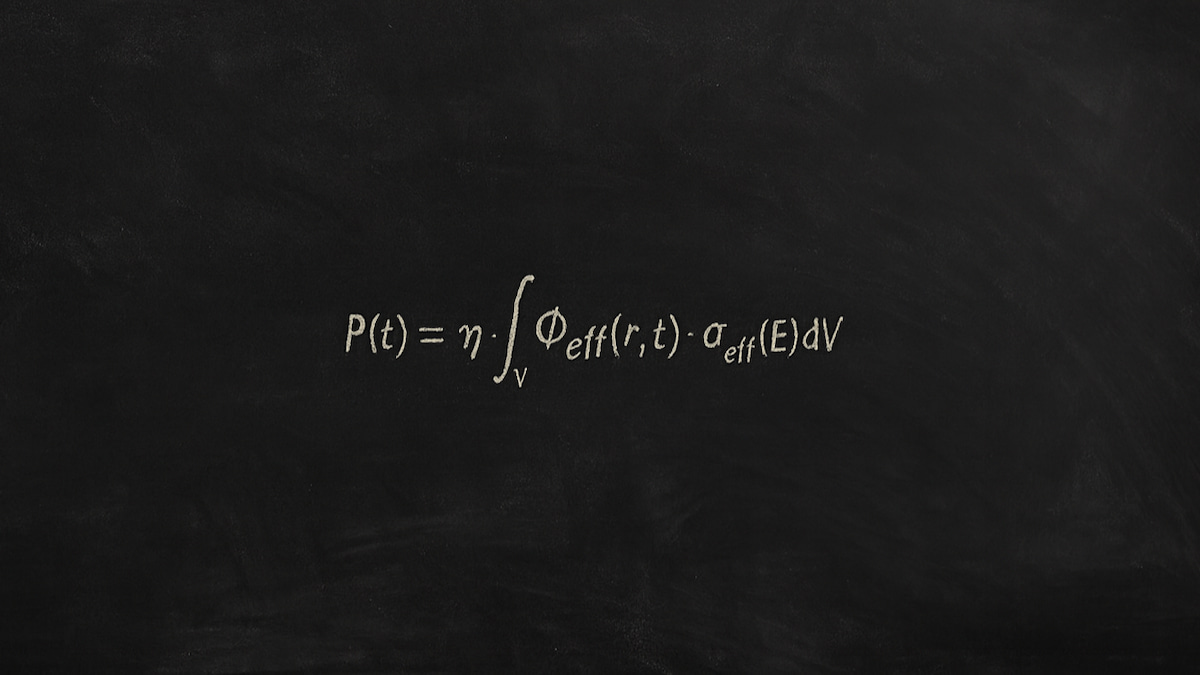
At the center lies the expression:
P(t) = η · ∫V Φ_eff(r,t) · σ_eff(E) dV
Each term compresses years of research into a symbol. η represents conversion efficiency, not as an abstract constant but as an empirically derived value determined by nanostructured materials of graphene and doped silicon. Φ_eff(r,t) designates the effective flux density of all non-visible spectra at a position and time.
This is not confined to neutrinos alone but extends to cosmic muons, secondary particles, radiofrequency fields, thermal fluctuations, and micro-vibrations that interact with matter continuously. σ_eff(E) stands for the effective interaction cross-section, accounting for neutrino–electron scattering, CEνNS, and non-standard interactions with quarks. The integration across the volume V of the nanostructured layers translates localized microscopic interactions into macroscopic current.
What distinguishes this formulation is not only its scientific rigor but its engineering orientation. It provides a calculable bridge between particle fluxes that cannot be switched off and the measurable direct current that can power devices. The equation makes visible energy not an article of belief, but a matter of quantification.
From Brownian Noise to Directed Current
The materials that enable this transformation are not passive. Graphene, with its extraordinary electron mobility, and silicon, with well-characterized semiconducting properties, are deposited in multilayer nanostructures. These layers are doped and engineered so that atomic lattices resonate when struck by neutrinos or other invisible fluxes. Importantly, the particles are not captured.
They pass through, but in doing so impart measurable impulses: vertical oscillations in graphene, horizontal oscillations in silicon. At the correct thicknesses, typically within the nanometer scale, resonance builds. These oscillations propagate into the lattice, generating an electromotive force. Electrodes connected to the structures then collect the direct current, ready for conversion or storage.
The Master Equation mathematically encodes this process. Each impulse from a particle may be infinitesimal, but the flux density is immense and unceasing. By integrating across volume and flux, the formula demonstrates why the output is continuous. It is an always-on system, independent of sunlight, weather, or geography.
Scientific Validation
The validity of the equation rests on decades of converging results. The Nobel Prize of 2015 confirmed neutrino mass. CEνNS in 2017 demonstrated that neutrinos transfer momentum to nuclei coherently, meaning all nucleons in the nucleus contribute in phase, amplifying the scattering effect. In 2025, further astrophysical observations with the James Webb Space Telescope and ALMA confirmed the overwhelming role of neutrinos in stellar energy transport during supernovae. These milestones, along with progress in condensed matter physics, underpin the interaction cross-sections encoded in σ_eff(E).
By combining these proven mechanisms with engineered nanostructures, the Master Equation is not speculation but the consolidation of established physics into a practical model. It defines energy yield not in metaphors, but in watts.
From Laboratory Precision to Engineering Scalability
Equations are only as valuable as the devices they can guide. The Neutrino® Energy Group’s development of multilayer graphene–silicon composites follows directly from the terms of the formula. Conversion efficiency η is continuously improved by artificial intelligence models that simulate how atomic vibrations evolve under different fluxes. The effective flux density Φ_eff(r,t) is characterized in laboratory setups and then scaled to environmental conditions, whether in metropolitan centers rich in electromagnetic fields or in isolated rural areas.
The proof of principle has already moved into demonstrators such as the Neutrino Power Cube, designed to provide autonomous electricity generation independent of grids. Each unit translates the Master Equation into hardware: an assembly of nanostructured layers, control electronics, and converters. Thousands of units can be aggregated, scaling outputs from household levels to the equivalent of a power plant.
Eliminating the Fragility of Centralization
The importance of a mathematically defined always-on source extends beyond efficiency. Centralized grids are vulnerable to storms, overloads, or cyber failures. By contrast, neutrinovoltaic units derive their strength from multiplication. Each operates autonomously, and the loss of one does not compromise the rest. Hospitals, data centers, or households can rely on their own baseline supply even in cases of broader grid collapse. The Master Equation guarantees that as long as invisible fluxes permeate matter, oscillations and therefore current will continue.
A Parallel to Photovoltaics
History offers a useful analogy. In 1958, photovoltaic cells were used in space applications, delivering negligible power to satellites. By the 1990s, efficiencies had improved, and solar panels began to enter homes. The governing physics, described by the Shockley–Queisser limit, set expectations for conversion efficiency.
Today, photovoltaics are mainstream, with terawatts of installed capacity. Neutrinovoltaics stand at the beginning of a similar trajectory, and the Master Equation may play for invisible spectra the same role the Shockley–Queisser limit played for sunlight. It defines parameters, expectations, and achievable ranges, setting the stage for industrial scaling.
Integration with Artificial Intelligence
A notable advance is the integration of artificial intelligence into the refinement of parameters. Traditional materials research relied on experimental trial and error. Now, machine learning models replicate atomic-scale interactions, predicting how phonon velocities, lattice geometries, and doping profiles affect η and σ_eff(E). This reduces development cycles from years to months. The Master Equation thus becomes not static but dynamic, with AI recalibrating it against continuously expanding datasets.
The Broader Implications
Equations that survive in scientific memory are those that both describe and enable. Maxwell’s equations unified electricity and magnetism. Einstein’s relativity recalibrated mass and energy. The Holger Thorsten Schubart–NEG Master Equation belongs in this category because it does not remain in the laboratory but enters the realm of usable energy systems. It redefines what is considered harvestable by integrating the constant presence of neutrinos, muons, RF fields, and thermal vibrations into a coherent model.
For the Neutrino® Energy Group, the focus is not only scientific pride but practical application. Devices like the Power Cube and Life Cube are embodiments of the equation. They show that symbols on paper can evolve into infrastructure, giving form to what was once deemed ghostly.
From Abstraction to Current
The journey from an elusive particle to a flowing current is not intuitive. It required decades of physics to establish neutrino mass, years of materials science to engineer graphene–silicon composites, and months of AI-driven optimization to refine lattice responses. At the center of this convergence sits a single formula:
P(t) = η · ∫V Φ_eff(r,t) · σ_eff(E) dV
It is neither prophecy nor speculation but a consolidation of proven phenomena into a framework that predicts output. In the same way that E=mc² revealed the energy bound in mass, this equation demonstrates the energy embedded in flux. It makes the invisible calculable, the elusive measurable, and the ghostly practical.
When history records the moment humanity learned to turn the most intangible particles into current, it will not cite only laboratories or devices. It will remember the equation that allowed engineers and physicists alike to translate ghost particles into power, and it will bear the name of those who inscribed it into the ledger of science.