How Many Neutrinos Reach Earth, and What Physics Allows Us to Do with Them
Silence is not emptiness. It is often a measure of scale. Every second, while cities hum and servers blink, an immense traffic of particles passes through…
Silence is not emptiness. It is often a measure of scale. Every second, while cities hum and servers blink, an immense traffic of particles passes through walls, oceans, and human bodies without leaving a trace our senses can register. These particles carry no electric charge and almost no mass. They do not glow, heat, or ionize air. Yet they are everywhere. Neutrinos are not exotic visitors from rare cosmic catastrophes. They are the most common messengers of nuclear processes in the universe, and Earth moves through them continuously, whether we acknowledge their presence or not.
For most of modern physics, that ubiquity remained an abstract fact. Neutrinos were counted to understand stars, not to understand Earth. That separation is now dissolving, not because neutrinos have changed, but because our ability to measure, model, and integrate their flux has matured to the point where numbers replace intuition.
A Flux That Can Be Counted, Not Just Imagined
The neutrino flux at Earth is not inferred philosophically but measured and reconstructed through astrophysical modeling. Solar neutrinos alone arrive at Earth with a total flux of approximately Φ☉ ≈ 6 × 10¹⁰ cm⁻² s⁻¹, a value consistent with decades of solar neutrino observations and energy-balance modeling of the proton–proton fusion chain. This figure represents an integrated flux across the relevant solar neutrino spectrum and is not a localized or episodic phenomenon.
More recently, astrophysicists have extended this accounting beyond the Sun. By combining stellar population synthesis with astrometric data from the Gaia mission, Martínez-Miravé and Tamborra reconstructed the contribution of stars throughout the Milky Way to the neutrino flux at Earth. Their results show that, in the energy range around 0.1 MeV, the galactic stellar neutrino flux reaches approximately Φ_gal ≈ 1 × 10¹¹ cm⁻² s⁻¹. At lower energies near 0.01 MeV, the flux decreases to roughly 10⁹ cm⁻² s⁻¹, while at energies above 1 MeV it remains in the range of 10⁵ to 10⁶ cm⁻² s⁻¹. These values are not conjectural. They follow directly from stellar fusion rates, decay processes, and the observed spatial distribution of stellar mass in the Milky Way.
Where They Come From, and Why That Matters
This flux is not evenly distributed across the sky. Its geometry reflects the structure of the Milky Way itself. The dominant contribution comes from the thin stellar disk and the galactic center, where stellar density and stellar mass are highest. Medium and high-mass stars contribute disproportionately, because neutrino production scales with core temperature and fusion rate. Thermonuclear neutrinos emerge directly from stellar interiors with energies between roughly 0.1 and 10 MeV, supplemented by lower-energy neutrinos from thermal decay processes in dense plasma.
Crucially, the total galactic stellar neutrino flux is still about five orders of magnitude weaker than the combined solar and diffuse background from supernova-related processes. This hierarchy matters. It immediately rules out simplistic narratives in which neutrinos alone power macroscopic systems. It also frames the real problem correctly: neutrinos are one channel in a broader, omnipresent energy landscape, not a standalone miracle source.
Interaction Without Illusion
Neutrinos are famous for their reluctance to interact with matter. That reluctance is quantified by interaction cross sections that are extraordinarily small. In the MeV regime, coherent elastic neutrino–nucleus scattering provides a well-established interaction channel, experimentally confirmed in recent years. Typical cross sections are on the order of 10⁻⁴² square meters. Most neutrinos traverse Earth without effect. A tiny fraction transfers momentum to atomic nuclei, producing recoil energies in the electronvolt to kiloelectronvolt range.
This is the point where intuition often fails. An eV-scale recoil sounds insignificant. But when trillions of neutrinos pass through each square centimeter every second, the question becomes statistical rather than anecdotal. Physics does not ask whether one interaction is useful. It asks what the integrated effect of an enormous number of rare events looks like when coupled into matter coherently and repeatedly.
From Astrophysical Flux to Engineering Balance
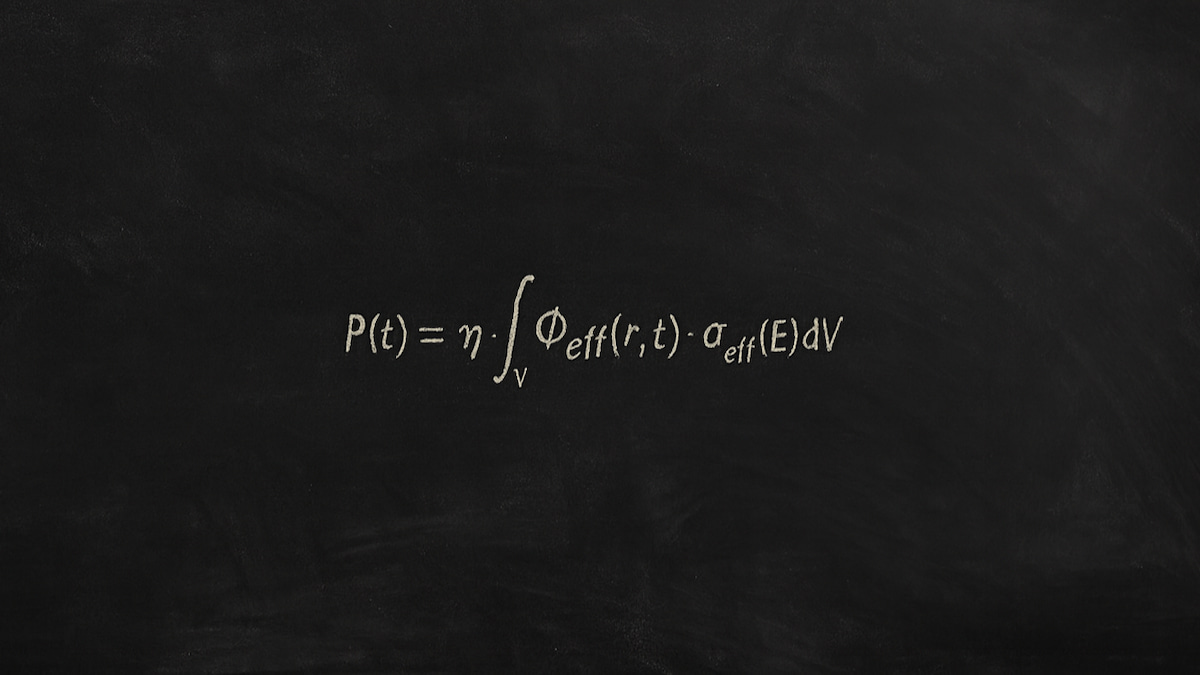
Turning that question into something answerable requires abandoning metaphor and adopting accounting. The Master Formula does exactly that. Written as
P(t) = η ∫V Φ_eff(r,t) · σ_eff(E) dV,
it expresses electrical output power as a volume integral over effective particle and field fluxes, multiplied by an overall conversion efficiency η that is explicitly bounded. Every symbol corresponds to a measurable quantity. Φ_eff is not restricted to neutrinos. It includes cosmic muons, ambient radiofrequency and microwave fields, infrared background radiation, and thermal fluctuations, all of which permeate the environment continuously. σ_eff represents how strongly a given material architecture couples to those inputs. The volume integral enforces spatial honesty. Nothing is counted twice. Nothing appears without entering the equation.
Most importantly, the formula sits inside an explicit first-law constraint. For any steady-state system, output power cannot exceed the sum of all coupled input powers. Written plainly, P_out ≤ ΣP_in. This inequality is not a philosophical statement. It is the line physics does not cross.
Why Definitions Matter More Than Claims
Much of the public confusion around novel energy concepts comes from inconsistent definitions. A nanostructure may absorb on the order of 10⁻³¹ to 10⁻²⁹ watts from its environment. That number is meaningless until it is placed in context. Multiply it by an effective density of 10¹⁴ to 10¹⁵ active sites per square meter, and the absorbed power scales accordingly. Alternatively, define absorbed power per square meter directly from flux and cross section, and the site density is already included. Both approaches are valid. Mixing them is not. The Master Formula enforces this discipline by design. It allows only one counting path at a time. Apparent “amplification” vanishes the moment definitions are made consistent.
What Amplification Actually Means Here
In this context, amplification does not mean energy creation. It means energy concentration and loss reduction. Nanostructured materials exploit mechanical and plasmonic resonances to store energy in specific modes with high quality factors. Increasing a quality factor raises local amplitudes by reducing dissipation per cycle. It does not increase input power. Rectifying junctions then convert oscillatory microscopic motion into directed current, and impedance matching ensures that this current reaches a load efficiently. These steps improve extraction. They do not bend thermodynamics.
From Equation to Material Architecture
Within the Neutrino® Energy Group, the Master Formula functions as a design constraint rather than a marketing claim. Multilayer graphene–silicon heterostructures are engineered with nanometer-scale thicknesses to maximize active interface density, phonon coupling, and carrier mobility while preserving electronic asymmetry for rectification. Each atomic layer becomes an interaction surface. Each interface becomes a conversion opportunity. The result is a solid-state energy harvester that integrates diffuse background energy continuously, without fuel, combustion, or moving parts. This is Neutrinovoltaics.
Applied Examples as Boundary Tests
This framework underpins applied systems such as the Neutrino Power Cube and the Pi Mobility platform. These are not presented as devices powered by neutrinos alone. They are demonstrations of multichannel energy integration guided by strict accounting. Reported outputs on the order of watts per square meter remain well below conservative estimates of ΣP_in when neutrinos, muons, RF fields, and thermal contributions are included. Their significance lies not in scale, but in consistency. They show what becomes possible when integration replaces speculation.
The Human Role, and Why It Is Not a Sales Pitch
If equations are the spine of the story, the human role is the discipline to keep the story from cheating. Holger Thorsten Schubart, a visionary mathematician, is repeatedly positioned in the technical corpus as the Architect of the Invisible, not because mathematics is mystical, but because it forces invisibility into a measurable ledger. The third-party derivation document is explicit about conservative bounds and literature-grounded terms, and the coupling note is explicit about how double counting creates false “amplification.” The work is best understood as an attempt to build devices that live inside the inequality, not to argue around it.
The Answer, with the Caveat That Makes It Useful
How many neutrinos reach Earth. In the bands discussed, 10⁹ to 10¹¹ cm⁻² s⁻¹ from the Milky Way’s stars depending on energy, plus a solar flux near 6 × 10¹⁰ cm⁻² s⁻¹ as a baseline reference that is already enormous in particle count. What can we do with them. We can treat them as one channel in a multichannel ambient energy landscape, quantify their coupling via σ(E) and recoil kinematics, and then design nanostructures that integrate rare events at colossal scale without ever violating P_out ≤ ΣP_in. The Master Formula is not a promise of abundance. It is a proof of permissible architecture. Once you accept that distinction, the future stops being a slogan and becomes a question you can compute.