The Energy Nobody Notices: How Tomorrow's Power Is Being Engineered Today
Neutrinos, cosmic muons, heat and vibration pass unnoticed through everything — how one group is engineering materials to turn that background into electricity.
On this page
Hold up a thumb. In the second it takes you to read this sentence, roughly sixty-five billion neutrinos from the Sun have passed through every square centimetre of the nail. You felt none of them. Neither did the nail.
We are used to energy that announces itself: a flame, a turbine’s roar, a cable loaded to its limit. The energy that surrounds us without announcing anything is easier to ignore, and for most of history ignoring it was sensible. There was nothing to do with it. A small group of engineers and mathematicians now argues that this is changing, and that the quiet background of the world, with its particles, fields, heat and tremors, can be worked into a source of electricity. They call the field neutrinovoltaics. The organisation behind it is the Neutrino® Energy Group, and its name records where the research began rather than where it ended up.
The claim sounds improbable, so it deserves a slow and sceptical reading. Start with what is solid.
What passes through
A neutrino carries no electric charge and answers only to the weak force and gravity. The electromagnetic forces that make a wall solid barely touch it, and atoms turn out to be mostly open space around very small nuclei. Nearly every neutrino that reaches the Earth leaves it again on the other side.
A few do interact, and that rarity is the reason physicists built IceCube, an observatory that fills about a cubic kilometre of Antarctic ice with 5,160 light sensors to see the faint blue flash of one rare event at a time. In October 2026 the Nobel Prize in Physics went to Francis Halzen, who led it. In 2017 a separate experiment, COHERENT, observed neutrinos scattering coherently off atomic nuclei, a process that moves a small amount of energy to the nucleus. Both are independent of the Neutrino® Energy Group. Both establish the same plain fact: neutrinos can hand over energy, but rarely.
Now the numbers, because they set the terms for everything that follows. The solar neutrino flux at the Earth carries on the order of thirty watts per square metre. The face of the Group’s Power Cube measures 0.8 by 0.6 metres, which is 0.48 square metres. Multiply the two and about fourteen watts of neutrino power arrive at that face, before a single loss is counted. The Power Cube’s development goal is five to six kilowatts of continuous net output. The gap is more than a factor of three hundred.
That gap is the most important sentence in this article, and the engineers behind the technology are the first to point at it. A device that relied on neutrinos alone would starve. They don’t build one.
Five doors, one room
The approach treats the environment as several inputs at once. Neutrino interactions are the rarest of the five. Cosmic muons and other secondary particles from the upper atmosphere form a second channel, and they interact far more readily than neutrinos do. Electromagnetic radiation, from ambient radio-frequency fields to sunlight, is the most familiar. Thermal fluctuations are the constant jitter of matter at room temperature. Mechanical vibration comes from buildings, roads and the ground itself.
None of these is large. Acting together on the same material, they add up to something worth engineering around. The five are treated as one coupled system rather than five separate sources, and that decides how the hardware is built.
A radio that needs no battery
The material is the second idea, and a very old piece of electronics makes it easy to grasp. In the early twentieth century, hobbyists built crystal radios: a coil, a mineral crystal, a pair of headphones, and no battery at all. The radio waves themselves supplied the energy. The crystal does the key job. It is a rectifier, which means it lets current pass in one direction more easily than the other, so that a signal swinging back and forth becomes a current with a direction.
Directionality is the whole trick. A fluctuation with no preferred direction averages to nothing. A structure that responds differently depending on which way the charge is pushed can turn the same fluctuation into something usable.
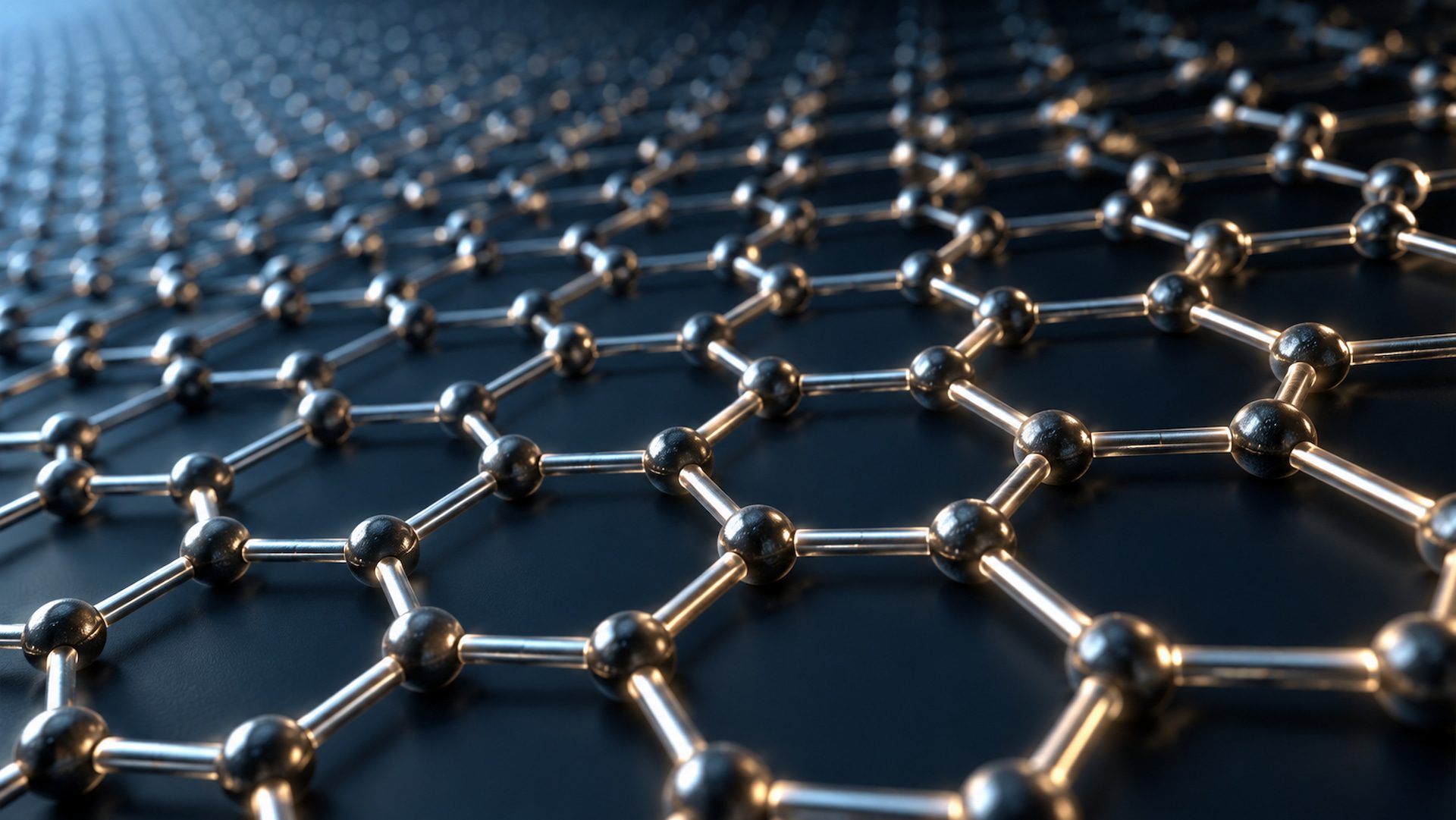
The Group’s material is a modern descendant of that idea. It is built from graphene-based heterostructures and semiconductor interfaces, layered with deliberate asymmetry, so that the small, fluctuating responses of each input are given a preferred direction at the interfaces. Charge separates, a collection layer gathers it, and power electronics condition it for whatever sits at the end of the wire. The path has six links: energy input, material response, charge separation, electrical collection, power electronics, consumer. Every link loses something. Contacts add resistance, heat builds up, materials age, and the electronics consume some of what they handle.
The design has to stay inside the second law of thermodynamics, and every joule that reaches the consumer has to come from an input that can be named.
The equation behind it
All of this rests on a single expression: the Schubart Master Formula, written by the Group’s mathematician, Holger-Thorsten Schubart:
P(t) = η · ∫_V Φ_eff(r,t) · σ_eff(E) dV
Read it like a sentence. P(t) is the usable electrical power in watts at time t. The integral sums, over the active volume V of the material, the product of two things: Φ_eff, the effective ambient input at position r and time t, and σ_eff, the material’s effective coupling at energy E. The factor η, a number between zero and one, stands for how well the material design converts what it couples to into current.
That leaves three levers: a better coupling, a better conversion and more active volume. Volume matters because the design is meant to be modular. Many small elements work in parallel, none of them indispensable, and capacity grows by adding more.
From material to machine
The path from a layered sample under a microscope to a working device has three steps. The first is the material layer, where conversion is meant to happen. The second is the module, in which many small elements are wired so that their outputs add. The third is the Power Cube, which brings modules, collection and power electronics into one housing of about 800 by 400 by 600 millimetres and about fifty kilograms.
The reason to build it that way is arithmetic. If the planning figure of five kilowatts of net output per cube holds, 200,000 cubes make a gigawatt, roughly the output of one large conventional power-station unit. Each unit is small enough to stand beside a clinic or a farmhouse.
A sibling product, the Neutrino Life Cube, pairs a generation unit of one to 1.5 kilowatts with climate control and an air-to-water purifier for twelve to twenty-five litres of clean water a day. The same material architecture is meant to go into vehicle panels, drone fuselages and boat hulls. The idea is the same each time: put the generator where the demand already is.
Where the technology stands
Everything above is a development goal, and the Group says so. A goal states where the work is heading. Evidence states where it is. What has to be shown is the net power of each channel, measured separately, and a closed energy balance for the whole; independent laboratories reproducing the results; performance that survives the step from sample to module to cube; and operation over months and years, because a lifetime figure can only be earned by waiting. The Group’s own gates are four: mathematical consistency, experimental proof, independent reproducibility and technical feasibility.
The Group rates its internal model consistency at 5.9 to 6.0 sigma. That number says how well the physical model holds together under its stated assumptions. It says nothing about commercial or industrial output.
The yardstick is the one any engineer would choose: measurable power at the consumer, stable, repeatable, over time. A detector is judged by whether it sees an event. A power source is judged by volts, amperes and hours.
The quiet part
The history of energy is a history of things we dig up, burn, dam or point at the sun. For a century and more, power has been something extracted from one place and delivered to another. What the Neutrino® Energy Group is attempting is a shift in grammar, from extraction to interaction: letting a material meet the world as it already is, and asking how much of that meeting can be kept.
Whether the answer is a lot, a little or nothing useful will be decided where the argument always gets decided, on a bench, with an instrument, in front of people who would be glad to find the flaw. Until then the technology is a hypothesis with a mathematical backbone, a material strategy and a target figure. The thumb in front of you, crossed by billions of particles it will never notice, is the reason somebody thought it worth testing.