Shadow Blaster: How a Hidden Galaxy Points Toward a New Energy Architecture
They were looking for a black hole. When a high-energy neutrino arrived at the IceCube Neutrino Observatory in Antarctica, catalogued as IC 210922A…
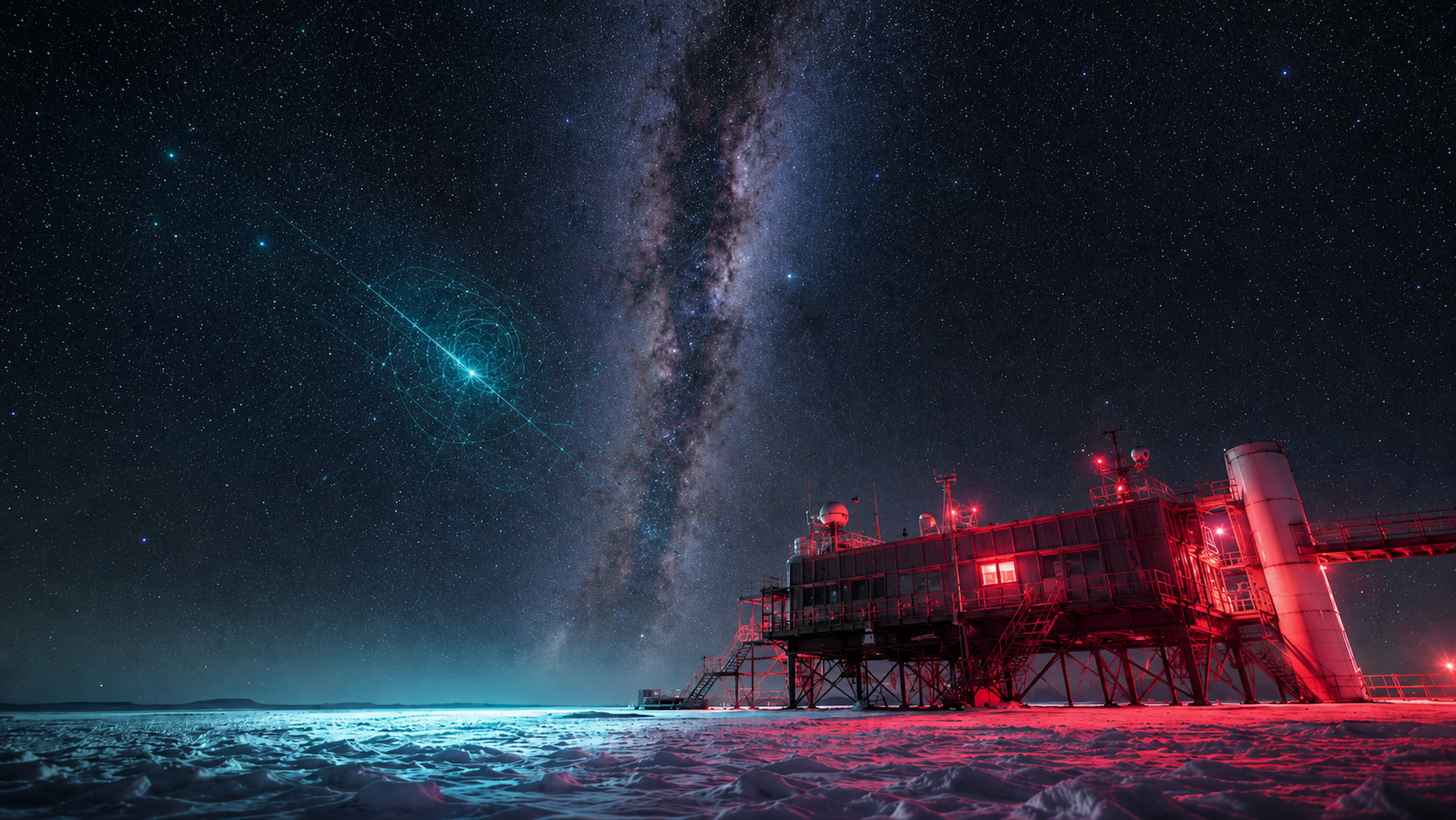
They were looking for a black hole. When a high-energy neutrino arrived at the IceCube Neutrino Observatory in Antarctica, catalogued as IC 210922A, researchers did what they’ve learned to do: they traced its trajectory backward through space and pointed radio telescopes at whatever lay along that line. The leading candidate, as almost always, was a supermassive black hole, the kind of violent, compressed engine capable of accelerating particles to energies that dwarf anything achievable in a laboratory on Earth.
What they found instead was something nobody had anticipated. At the coordinates suggested by the neutrino’s path, astronomers using the ALMA telescope array in Chile identified a galaxy invisible in ordinary light, buried behind a veil of dust so thick that optical telescopes would have passed over it without notice. It blazed at submillimetre wavelengths, the signature of a different kind of extreme: not a black hole tearing matter apart at its centre, but stars being born in numbers and at densities almost impossible to hold in the mind. A region just 1,500 light-years across, compressed into conditions so violent that the process of stellar birth itself becomes an engine of high-energy particle production.
They named it Shadow Blaster.
There’s one more detail worth holding onto before moving on. The researchers could only see inside Shadow Blaster because a second galaxy, positioned between it and Earth by pure chance, bent and amplified its light the way a lens focuses sunlight onto a single point. Gravity itself, operating across billions of light-years, became the instrument of discovery. Without that accident of cosmic geometry, Shadow Blaster would have remained invisible, and the neutrino it sent toward Earth 11 billion years ago would have passed through IceCube without anyone knowing where it came from.
That’s the kind of physics that deserves a moment of quiet before anything else is said.
What the Ghost Particle Actually Is
Neutrinos are the most abundant massive particles in the universe, present everywhere in numbers that become meaningless at human scales. Roughly 65 billion of them pass through every square centimetre of your skin every second. They arrive from the Sun, from the decay of radioactive elements in the Earth’s interior, from supernovae in distant galaxies, and, as Shadow Blaster now suggests, from the violent star-forming regions of galaxies 11 billion light-years away. They interact with matter so rarely that the entire Earth is essentially transparent to them. A neutrino travelling through lead would need a column of it stretching from here to the nearest star before it had a statistically reasonable chance of being stopped.
This is what makes the Shadow Blaster finding significant on multiple levels. First, it suggests that scientists have been looking for the primary sources of high-energy neutrinos in the wrong places. Supermassive black holes were the leading candidates. The new evidence points somewhere different: the dense, chaotic interior of intense star-forming regions, where the conditions for producing high-energy particles turn out to be more varied than the existing models predicted. Second, the discovery implies that galaxies undergoing extreme bursts of star formation may account for as much as 20 percent of the total high-energy neutrino background detected across the universe. The question of where these particles originate has sat open in astrophysics for years. The answer was hidden behind dust, waiting for a gravitational accident and a telescope pointed at the South Pole.
When the Map Gets Larger Than the Territory
Every time scientists identify a new source of high-energy neutrinos, the map of the universe’s ambient energy landscape becomes more detailed and more strange. The IceCube observatory under Antarctic ice, ALMA in the Chilean desert, the foreground galaxy that acted as an accidental lens: each of these contributed to a single data point. One neutrino event, traced back to one galaxy, which turned out to be something nobody expected. That is how this kind of science works: slowly, patiently, with instruments buried under ice and pointed across billions of light-years.
The map being built is not only of interest to astrophysicists. Every confirmed source of neutrino flux, every measurement of how these particles behave as they travel through matter, every discovery about where they originate and how they’re produced, adds to the evidentiary foundation of a physical framework that approaches these particles from a different direction entirely. Not where do they come from, but what happens when they arrive?
The Question Nobody Thought to Ask
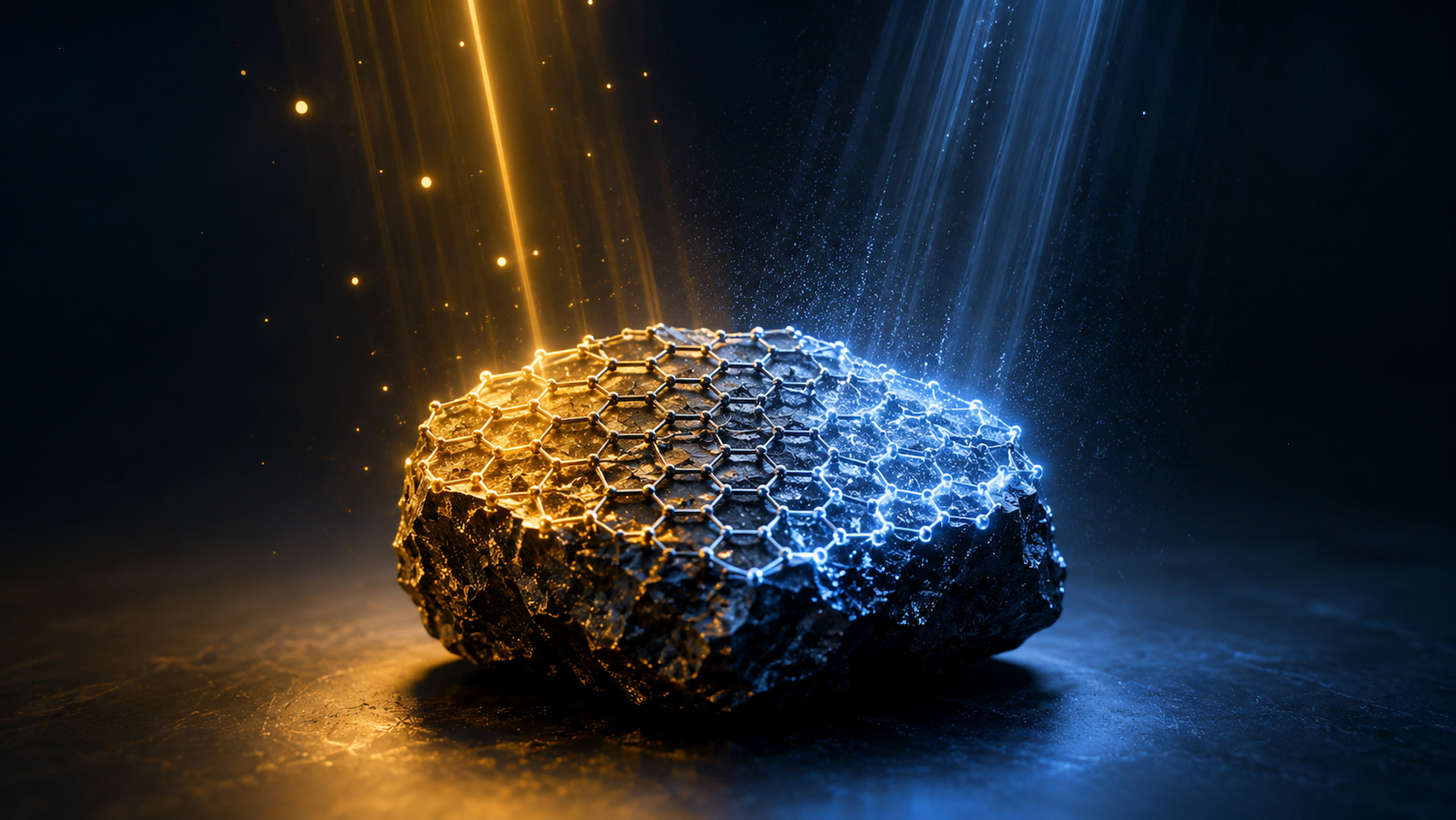
Holger Thorsten Schubart is a mathematician. His contribution to this conversation isn’t a telescope or a detector. It’s a mathematical framework for describing what happens when continuous ambient flux, neutrinos among it but far from the only component, interacts with a carefully engineered nanoscale material system.
The Schubart Master Formula: P(t) = η · ∫V Φ_eff(r,t) · σ_eff(E) dV
describes continuous electrical output from multi-channel ambient flux integrated across an active material volume. The effective flux term Φ_eff(r,t) integrates contributions from neutrinos, cosmic muons, thermal gradients, and electromagnetic background fields, all of which are present everywhere on Earth, at every altitude, in every climate, at every hour, without dependence on weather, geography, or time of day.
This is the point worth making precisely: neutrinos are one channel among several. Shadow Blaster adds richness to our understanding of where that channel originates and how it behaves across cosmic distances. But the energy conversion architecture Schubart’s work describes doesn’t depend on neutrinos alone. It draws on the totality of ambient flux surrounding every point on Earth continuously, treating each contributing channel not as a curiosity but as an input to a system designed to receive it.
Internal Monte Carlo simulations and multi-parameter evaluations of the physical model indicate statistical consistency reaching 5.9 to 6.0 sigma, above the five-sigma threshold the physics community uses to declare that a result reflects a real phenomenon rather than noise. That figure quantifies the internal consistency of the mathematical framework under applied model assumptions. It’s a statement about the physics holding together, not a commercial performance guarantee.
The organisation developing this framework, the Neutrino® Energy Group, is not a conventional energy company. It’s more accurate to describe it as a distributed innovation ecosystem: legal entities, materials scientists, engineers, manufacturing partners, and integrated AI systems working around a coherent technical direction. At its centre sits Schubart, whose role resembles that of a conductor more than a founder: he doesn’t play every instrument, but he gives the work a common score.
A Two-Way Street Between Matter and Machine
Artificial intelligence enters this story from two directions, and both deserve attention.
In one direction, AI is building the technology. Machine learning models optimise material parameters, refine coupling coefficients, and model the non-equilibrium quantum transport behaviour of graphene-silicon heterostructures at scales and precisions that human intuition can’t reach. Simplior Technologies contributes AI integration to the Pi Car platform specifically, optimising in real time the resonance conditions of active material as the vehicle operates. This is AI as instrument: precise, continuous, operating at atomic scales.
In the other direction, neutrinovoltaic technology may address AI’s most structural problem. By 2030, global data centre electricity demand is projected to reach 945 terawatt-hours annually. AI infrastructure requires power that is continuous, stable, and location-independent. Intermittent renewable sources can’t structurally satisfy that requirement, because intermittency is a property of their generation profile, not a temporary limitation.
A continuous ambient-flux conversion system deployed at the point of consumption eliminates not only the kilowatt-hours it replaces but the transmission infrastructure, storage capacity, and reserve generation that would otherwise be required. 200,000 Neutrino Power Cubes produce one gigawatt of continuous electrical output, comparable to a standard nuclear reactor, without fuel and without waste.
The relationship runs in both directions because the physics permits it. AI refines the material architecture. The material architecture frees AI from its deepest supply constraint. Neither side of that exchange is incidental.
What Shadow Blaster Actually Tells Us
The Shadow Blaster finding will be studied for years. The gravitational lens that made it visible may help reveal other hidden galaxies along other neutrino trajectories. The proportion of the high-energy neutrino background attributable to starburst galaxies will be refined as more events are traced and more observations accumulate. Each refinement adds precision to Φ_eff: the flux term in the Master Formula, which integrates all ambient contributions including those from sources scientists are still discovering.
Perhaps the most quietly important aspect of the discovery is this: researchers had built a model of where high-energy neutrinos come from, and the universe turned out to be more inventive than the model. The particles were arriving from a source nobody had anticipated, hidden behind dust, detectable only through a gravitational accident, 11 billion years old by the time they triggered a sensor buried in Antarctic ice.
The universe has been sending energy in every direction for 13.8 billion years. Shadow Blaster has been contributing to that flux from 11 billion light-years away, long before Earth existed.
For over a century, energy has been something we extract. The next era begins when energy becomes something that is simply available.