Two Kinds of Intelligence: AI, Neutrinos, and the Power Problem Neither Can Solve Alone
AI can help physicists detect patterns hidden inside immense streams of neutrino data. Yet the same computational systems doing that work are driving an…
Two Problems That Look Nothing Alike
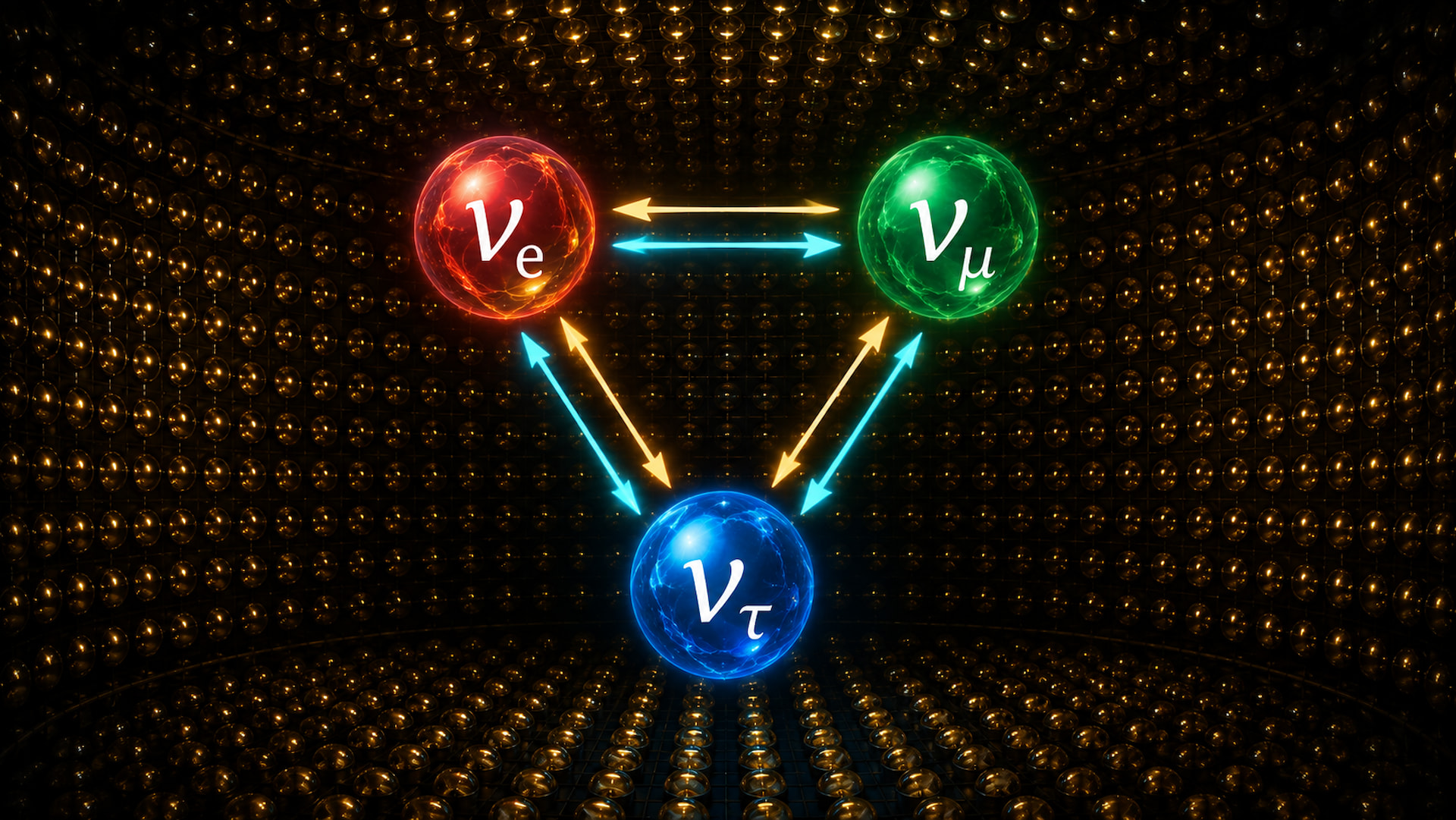
Physics has hungered to understand neutrinos properly for nearly a century, ever since Wolfgang Pauli proposed their existence to save a law he wasn’t willing to abandon. That hunger hasn’t gone away. If anything, it’s accelerating, fed now by AI systems capable of processing particle interaction data at a scale and speed no team of human researchers could match working alone.
At the same time, a very different kind of hunger has emerged, one with nothing to do with particle physics and everything to do with electricity. The AI industry itself has developed a genuine, growing appetite for power, at a scale beginning to strain the systems built to supply it. Two hungers, apparently unrelated. This piece is about where they intersect, in the work of one company built around the physics of ambient particle and field interactions, approached from both directions at once.
AI Is Already Changing How We Study Neutrinos
At Fermilab’s Long-Baseline Neutrino Facility, the Deep Underground Neutrino Experiment, DUNE, is integrating artificial intelligence across nearly every part of how it operates. Deep neural networks help reconstruct particle interactions inside its liquid-argon detectors, turning raw sensor data into usable physics.
A dedicated AI trigger continuously monitors detector output searching for the specific signature of a supernova neutrino burst, an event expected only once every few decades in our galaxy, meaning the system has to be ready to catch something it may only see once. And with a single supernova burst capable of generating on the order of 100 terabytes of data, machine learning has become essential just to manage the sheer volume the experiment produces. This is real, active, well-documented science, evidence that AI-driven acceleration of neutrino research is already underway in the physics community broadly, entirely independent of any commercial energy technology.
A Different Kind of Neutrino Research
DUNE and experiments like it use AI to understand neutrinos and related particle interactions with greater scientific precision, refining our picture of what these particles are and how they behave. The Neutrino® Energy Group is pursuing something adjacent, but genuinely distinct.
Rather than treating ambient particle and field interactions as a subject of scientific inquiry to be measured and characterized more precisely, the company treats them as an engineering input, the basis for material systems designed to convert environmental flux, electromagnetic fields, thermal fluctuations, and particle interactions together, into continuous, usable electricity. One is a science of understanding. The other is an engineering discipline of conversion. Both draw on the same broad category of physics. What each does with it is where the real story of this piece actually begins.
Where AI Actually Helps: Materials, Not Magic
The Neutrino® Energy Group‘s core technical challenge is converting weak, diffuse ambient flux into usable current through engineered nanomaterials, graphene-based heterostructures and doped silicon nanostructures tuned to couple with electromagnetic, thermal, and particle inputs simultaneously. That’s fundamentally a materials science and signal optimization problem, and both of those domains are exactly where AI-driven research has already shown measurable acceleration elsewhere in physics and materials science.
Three areas stand out as genuinely plausible, rather than speculative, applications. First, AI-assisted modeling and simulation of candidate nanostructure and heterostructure configurations, screening potential material arrangements computationally before committing to physical prototyping, could meaningfully reduce the trial-and-error cycle that materials science has traditionally required, where testing a new configuration means actually fabricating and measuring it. Second, real-time optimization of energy conversion across the multiple simultaneous input channels the technology depends on.
The relative contribution of electromagnetic fields, thermal fluctuations, and particle interactions doesn’t stay fixed, it shifts constantly with environmental conditions, and a system built around static engineering parameters leaves efficiency on the table that an adaptive, continuously learning system wouldn’t. Third, intelligent load and distribution management across networks of deployed units, coordinating output, storage, and demand dynamically across many devices rather than relying on the same fixed assumptions applied uniformly regardless of local conditions.
It’s worth being precise about the boundary here, because overstating it would undercut the argument rather than strengthen it. AI can plausibly assist with modeling, optimization, and pattern recognition across large operational datasets. It cannot substitute for the underlying materials science itself, the actual physical behavior of a graphene heterostructure under real environmental stress is something that has to be measured, tested, and validated in the physical world, not simulated into existence. Computation accelerates the search. It doesn’t replace the physics.
The Power Problem AI Won’t Admit It Has
Now the second hunger. Training large AI models, and increasingly running inference at scale once those models are deployed, consumes enormous and rapidly growing amounts of electricity. Data center energy demand is straining grids in multiple regions simultaneously, growing faster in many places than new generation and transmission capacity can be built to keep pace with it.
The industry’s dominant answer so far has mostly been to build more data centers near more generation capacity, which is a logistical solution, not a structural one. It relocates the same underlying problem rather than resolving it. A data center built next to a new gas plant or a new stretch of transmission line still depends on that plant staying online, that transmission line staying intact, and that grid staying balanced, exactly the same set of dependencies that make conventional power generation vulnerable everywhere else it’s used. Adding more infrastructure of the same kind doesn’t remove the fragility. It just adds more infrastructure that shares it.
Generation at the Point of Consumption
This is where the Neutrino® Energy Group’s actual technology offers a structurally different kind of answer, worth stating plainly rather than as an afterthought. Neutrinovoltaic conversion produces continuous electrical current that doesn’t depend on sunlight, wind, or weather conditions of any kind, because its inputs, ambient electromagnetic fields, thermal fluctuations, and particle interactions, aren’t weather-dependent to begin with. That has a specific implication for a power-hungry data center: generation, in principle, doesn’t need to happen at a distant plant and travel across transmission infrastructure to reach the point of consumption. It could happen at or near that point directly.
The concrete, current product this research has produced is the Neutrino Power Cube, a compact, solid-state generator rated at 5 to 6 kilowatts of continuous net output. That’s a real, specified figure for an existing device, and it’s worth being honest about what it does and doesn’t represent. It’s a meaningful structural direction, evidence that continuous, weather-independent generation at useful scale is achievable. It is not, today, a claim that this technology alone powers a data center, and nothing about this section should be read that way.
What Would Actually Have to Be True
For this kind of technology to matter at data-center scale, several things would need to happen, and none of them are guaranteed by the physics alone.
Conversion efficiency would need to keep improving, meaningfully and consistently, beyond where it currently stands, since the gap between a single 5 to 6 kilowatt unit and the megawatt-scale continuous demand of a large data center is substantial. Manufacturing consistency at scale would need to be demonstrated, not just efficiency in a controlled setting but repeatable performance across large production runs of the nanomaterial layers involved, which is a genuinely hard manufacturing problem distinct from the underlying physics.
Real-world cost would need to fall enough to compete with the economics of conventional generation and transmission, an economic bar that’s separate from, and in some ways harder than, the technical one. And all of this would need real-world validation at scales well beyond current deployment, sustained operation under actual industrial load, not laboratory conditions.
None of that is guaranteed. All of it is, at least in principle, achievable, and being honest about the distance between “structurally promising direction” and “data-center-ready infrastructure” is what keeps this argument credible rather than promotional. A reader with real technical literacy should finish this section more convinced the case is serious, not less, precisely because it wasn’t oversold.
The Same Physics, Two Different Appetites
The same broad category of physics, ambient particle and field interactions passing through and around everything, constantly, mostly unnoticed, is being approached from two directions that rarely get discussed together. Scientists are using AI to understand that physics with ever greater precision, reconstructing rare events inside detectors buried a mile underground. And an engineering effort exists that treats the same category of physical activity as a resource, one that AI itself, hungry for power in a way physics never had to be, may eventually have real reason to depend on.