ORCA, ARCA, and the Master Equation: Linking Neutrino Research to Global Energy Resilience
Far beneath the Mediterranean, where sunlight disappears and only pressure and silence dominate, two of the world’s most ambitious scientific instruments are…
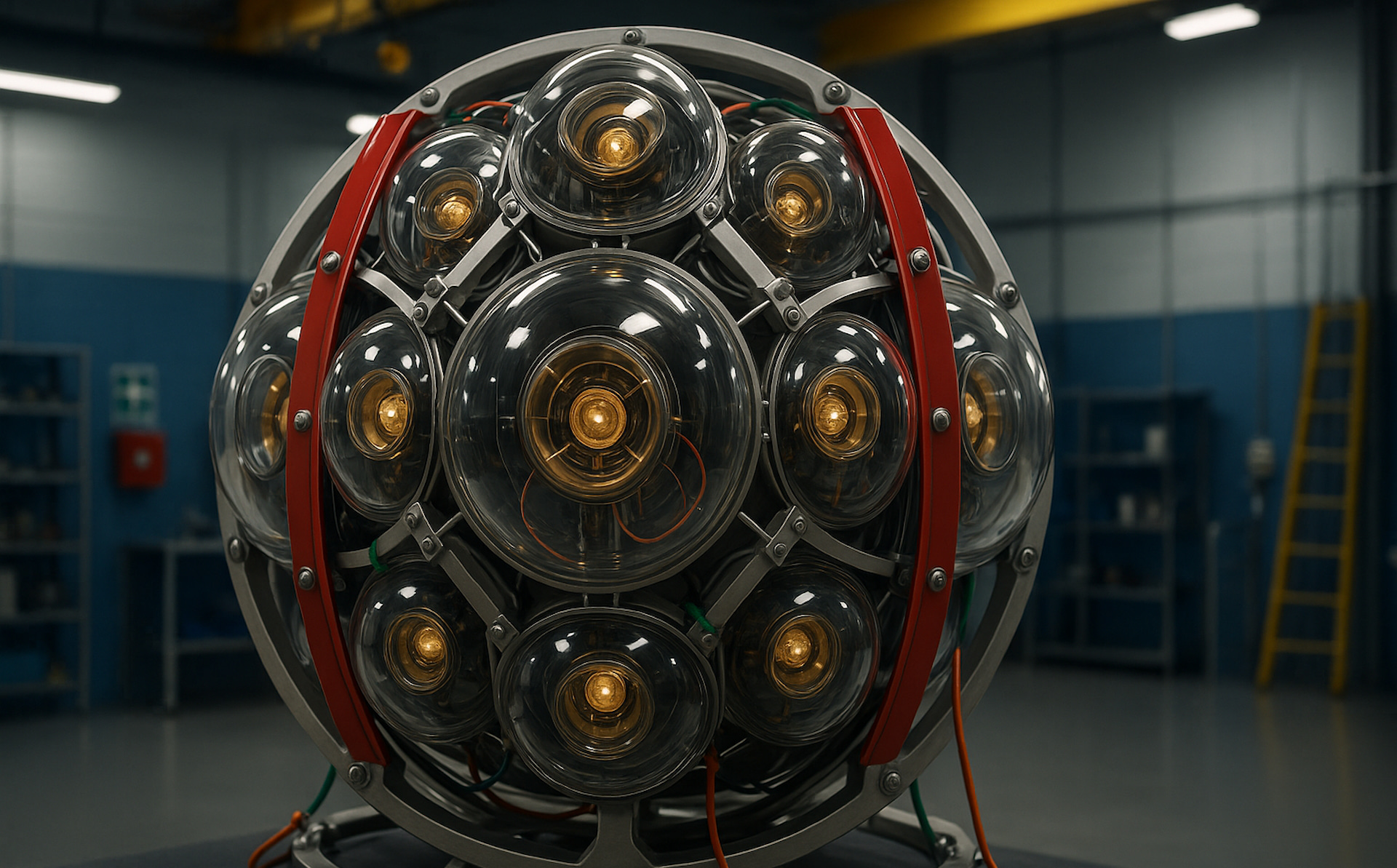
Far beneath the Mediterranean, where sunlight disappears and only pressure and silence dominate, two of the world’s most ambitious scientific instruments are slowly coming to life. Known as ORCA and ARCA, these detectors are the centerpiece of the KM3NeT project, a European effort designed to track particles so elusive that trillions pass through every human being every second without consequence. These particles are neutrinos, electrically neutral, nearly massless, and capable of traveling unhindered through stars, planets, and galaxies. To detect one is to witness a cosmic whisper, a faint trace of some of the universe’s most violent and energetic processes.
Unlike optical observatories that capture photons from distant galaxies, the Mediterranean neutrino telescopes look downward, through the Earth itself. Photodetectors suspended on cables within glass spheres wait for the rare occasion when a neutrino interacts with matter. The resulting particle shower produces a flash of Cherenkov light, a blue signature that signals the passage of energy invisible to human eyes. ORCA, situated near Toulon, France at 2.5 kilometers depth, focuses on how neutrinos oscillate between different types, probing the nature of mass. ARCA, deeper still at 3.5 kilometers off the coast of Sicily, seeks neutrinos from catastrophic cosmic events, mapping sources of high-energy radiation in the universe.
Together, these detectors embody decades of global progress in particle physics. Their existence underscores how far science has come in resolving the so-called solar neutrino problem, confirmed by experiments that earned the 2002 Nobel Prize, and extended by later breakthroughs such as the 2015 Nobel recognition of neutrino mass. Yet their mission is not confined to fundamental physics. These telescopes also remind us of a profound truth: neutrinos, once dismissed as irrelevant to human affairs, are central not only to astrophysics but also to the future of energy itself.
The Particle That Redefined Energy
For much of the 20th century, neutrinos were treated as curiosities, useful for validating theories but without practical application. That perception began to change after experimental confirmation that neutrinos possess mass, however tiny. By the logic of Einstein’s relativity, mass carries energy, and energy can be transformed.
The next leap required combining multiple findings: coherent elastic neutrino–nucleus scattering, measured in 2017 by the COHERENT collaboration, showed that neutrinos transfer measurable momentum to matter. Other studies confirmed the constant background of cosmic muons, secondary particles, and thermal vibrations, all of which together form an ever-present flux of energy. The pieces of a puzzle began to align, suggesting that invisible radiation surrounding Earth was not just a phenomenon to observe but a field of energy that could be engineered.
It is within this context that the Neutrino® Energy Group, under the leadership of mathematician Holger Thorsten Schubart, advanced neutrinovoltaics. Unlike photovoltaics, which rely solely on visible light, neutrinovoltaics operate on a wider spectrum. The core breakthrough is embodied in the Holger Thorsten Schubart – NEG Master Equation for Neutrinovoltaics:
P(t) = η · ∫V Φ_eff(r,t) · σ_eff(E) dV
This formula defines how effective flux densities (Φ_eff) interact with material cross-sections (σ_eff) within an engineered volume (V), moderated by conversion efficiency (η), to yield continuous electric power. Crucially, the equation does not assume a single radiation source. Instead, it integrates neutrino–electron scattering, CEνNS, cosmic muons, radiofrequency and microwave fields, infrared fluctuations, and micro-vibrations. When one source weakens, others sustain the output. The result is a resilient energy system defined by mathematics and verified by experiment, not by conjecture.
Engineering the Invisible
The transition from theoretical physics to engineered devices depended on material science. The Neutrino® Energy Group holds international patent WO2016142056A1 for multilayer graphene–silicon nanostructures, meticulously fabricated so that traversing fluxes set the lattice into measurable vibration. Graphene layers oscillate vertically, silicon layers horizontally, and the combined resonance induces electron flow. The process does not capture particles, as sometimes incorrectly described, but transforms momentum transfers into an electromotive force harvested as direct current.
Artificial intelligence accelerates this engineering. Machine learning models simulate countless configurations of nanolayer thickness and doping strategies, identifying optimal structures with a speed far beyond traditional laboratory iteration. AI thereby compresses the cycle from hypothesis to prototype, turning the Master Equation into a continuously refined, dynamic system. Each parameter is not static but recalibrated as new data from detectors, telescopes, and material tests feed into simulations.
This convergence of physics, nanotechnology, and computation ensures that neutrinovoltaics are not an abstraction but a functioning technology, ready to scale.
From Cubes to Cities
The first tangible embodiment is the Neutrino Power Cube, a compact generator designed to deliver between 5 and 6 kilowatts of continuous power. A single unit can sustain a household independent of sunlight, wind, or fragile distribution lines. Yet the equation reveals the deeper significance of scalability. Approximately 200,000 Power Cubes, operating in parallel, equate to a gigawatt, the baseline capacity of a nuclear power plant. This equivalence is not rhetorical. It is a direct mathematical corollary of the Master Equation, demonstrating that distributed neutrinovoltaic systems can substitute for centralized baseload infrastructure.
The Neutrino® Energy Group’s dedication to using AI to maximize and develop its ground-breaking technology is demonstrated by the Neutrino Life Cube. A climate control unit, a tiny Neutrino Power Cube with a capacity of roughly 1-1.5 kW, and an air-to-water purifier are the three essential parts of this creative system. Particularly in isolated and underdeveloped areas, this technological trifecta offers a comprehensive response to the urgent problems of water and energy scarcity.
Project 12742, named for Earth’s diameter in kilometers, integrates neutrinovoltaics into a planetary framework. By linking energy production to communication networks, it reflects a vision of global equity, where invisible flux becomes a universal resource rather than a commodity constrained by geography.
Pi Mobility completes the suite of initiatives. The Pi Car, Pi Fly, and Pi Nautic eliminate dependence on external charging or refueling. Each vehicle generates its own operating power from ambient fluxes, applying the same nanostructures in mobile contexts. Together, they exemplify how one equation governs applications across domains, from household lighting to intercontinental transport.
The Broader Scientific Continuum
None of these advances exist in isolation. The KM3NeT telescopes, the IceCube detector at the South Pole, and Japan’s Super-Kamiokande all contribute to the empirical foundation on which neutrinovoltaics rests. By mapping neutrino behavior across astrophysical and atmospheric contexts, they validate the flux terms central to the Master Equation. Likewise, Nobel-recognized breakthroughs in neutrino oscillations and mass underpin the constants within the formula. Each experiment, whether designed for cosmology or particle physics, adds a piece to the larger mosaic that the Neutrino® Energy Group has unified into an energy technology.
This interconnectedness is critical. Skeptics often demand proof of the whole without recognizing that its parts are already confirmed. The Master Equation is not a speculative leap but a consolidation of established variables. Flux densities, cross-sections, and conversion efficiencies are independently measured and peer-reviewed. When combined, their outcome is as valid as any composite model in science, from climate projections to semiconductor physics.
Resilience as Imperative
The fragility of centralized grids is increasingly evident. Heatwaves strain supply, wildfires destroy transmission lines, and cyber incidents reveal vulnerabilities. Each failure underscores the risks of dependence on monolithic systems. Neutrinovoltaics invert this paradigm. By distributing generation across countless autonomous nodes, they remove single points of failure. The resilience arises not only from physical redundancy but from the additivity of flux sources. Where solar falters at night, where wind fails in calm, the invisible spectrum persists without interruption.
This architecture aligns with global sustainability goals, recognized within the framework of the United Nations’ Sustainable Development Goals. Clean energy access, climate action, and resilient infrastructure converge in a single technology. It is a rare instance where particle physics directly addresses societal imperatives.
A Formula for the Future
Great shifts in science are often distilled into equations. Maxwell’s laws unified electromagnetism, Schrödinger’s wave function defined quantum mechanics, and Einstein’s E = mc² reframed mass and energy. To this lineage now belongs the Holger Thorsten Schubart – NEG Master Equation for Neutrinovoltaics. By demonstrating that invisible flux can be transformed into usable current, it redefines not only physics but the architecture of global energy.
The Master Equation is more than a scientific milestone. It is a societal safeguard. It ensures that when infrastructure fails, when grids collapse, and when populations demand autonomy, energy continues to flow, governed not by geography or weather but by the constants of physics itself.
From Deep Waters to Daily Lives
The Mediterranean telescopes, waiting silently in the depths, symbolize humanity’s pursuit of the almost impossible: to detect a particle that rarely leaves a trace. Their success provides knowledge of the cosmos. Yet equally profound is the realization that the same particles, together with related fluxes, can sustain the daily lives of people everywhere. What once required a cubic kilometer of water to measure can now, through the combination of mathematics and nanotechnology, generate power at the scale of a household.
This journey, from detection to application, illustrates the continuum of science. Fundamental research reveals constants, material science translates them into devices, and engineering scales them into infrastructure. At the center of this continuum stands Holger Thorsten Schubart, whose Master Equation gave form to an energy architecture rooted in the invisible spectrum.
As ORCA and ARCA continue to listen for neutrinos, their findings will deepen understanding of the cosmos. At the same time, neutrinovoltaics ensure that these ghost particles also illuminate a path to resilience and equity on Earth. The invisible has become not only visible but indispensable.