How Many Neutrinos Hit the Earth? A Comprehensive Scientific Breakdown
The Invisible Flood of Neutrinos We explore one of the most astonishing realities of modern physics: Earth is constantly bombarded by an immense flux of…
On this page
The Invisible Flood of Neutrinos
We explore one of the most astonishing realities of modern physics: Earth is constantly bombarded by an immense flux of neutrinos—subatomic particles so elusive that they pass through matter almost undisturbed. Despite their near-zero interaction with ordinary matter, their sheer number is staggering. Understanding how many neutrinos reach Earth reveals profound insights into the universe, from stellar processes to cosmic evolution.
What Are Neutrinos? Fundamental Properties Explained
Neutrinos are elementary particles belonging to the lepton family. They are characterized by:
- Extremely small mass (close to zero, but not exactly zero)
- No electric charge
- Weak interaction with matter (only via the weak nuclear force and gravity)
There are three known types (flavors):
- Electron neutrinos
- Muon neutrinos
- Tau neutrinos
These particles are produced in vast quantities in nuclear reactions, especially within stars.
The Primary Source: Solar Neutrinos
Continuous Emission from the Sun
The dominant source of neutrinos reaching Earth is the Sun. Inside its core, nuclear fusion converts hydrogen into helium, releasing enormous energy—and neutrinos.
Every second, the Sun emits approximately:
- ~10³⁸ neutrinos
By the time these neutrinos spread out across space and reach Earth, the flux becomes:
- ~65 billion (6.5 × 10¹⁰) neutrinos per square centimeter per second
Total Neutrinos Hitting Earth: The Astonishing Numbers
Global Impact on the Planet
To understand the total number of neutrinos hitting Earth, we consider Earth’s cross-sectional area:
- Earth’s cross-sectional area ≈ 1.27 × 10¹⁸ cm²
Multiplying this by the solar neutrino flux:
- Total neutrinos hitting Earth per second:
- ≈ 8 × 10²⁸ neutrinos
This means:
- Every second, tens of octillions of neutrinos pass through Earth
Neutrinos Passing Through the Human Body
A Constant Invisible Stream
We calculate the exposure at a human scale:
- Human body surface area ≈ 10⁴ cm²
Thus:
- ~6.5 × 10¹⁴ neutrinos pass through your body every second
Despite this enormous number:
- Almost none interact with your atoms
- You remain completely unaffected
Additional Sources of Neutrinos
While solar neutrinos dominate, several other sources contribute:
1. Cosmic Neutrinos
Produced by distant astrophysical phenomena such as:
- Supernovae
- Black holes
- Gamma-ray bursts
2. Atmospheric Neutrinos
Generated when cosmic rays collide with Earth’s atmosphere.
3. Terrestrial Neutrinos (Geoneutrinos)
Originating from radioactive decay within Earth’s interior.
4. Relic Neutrinos
Leftovers from the Big Bang, forming a cosmic neutrino background.
Why Neutrinos Rarely Interact with Matter
Neutrinos are extraordinarily difficult to detect due to:
- Weak nuclear force interaction only
- Tiny cross-section for interaction
To put this into perspective:
- A neutrino could pass through light-years of lead without interacting
Detection of Neutrinos: Advanced Scientific Methods
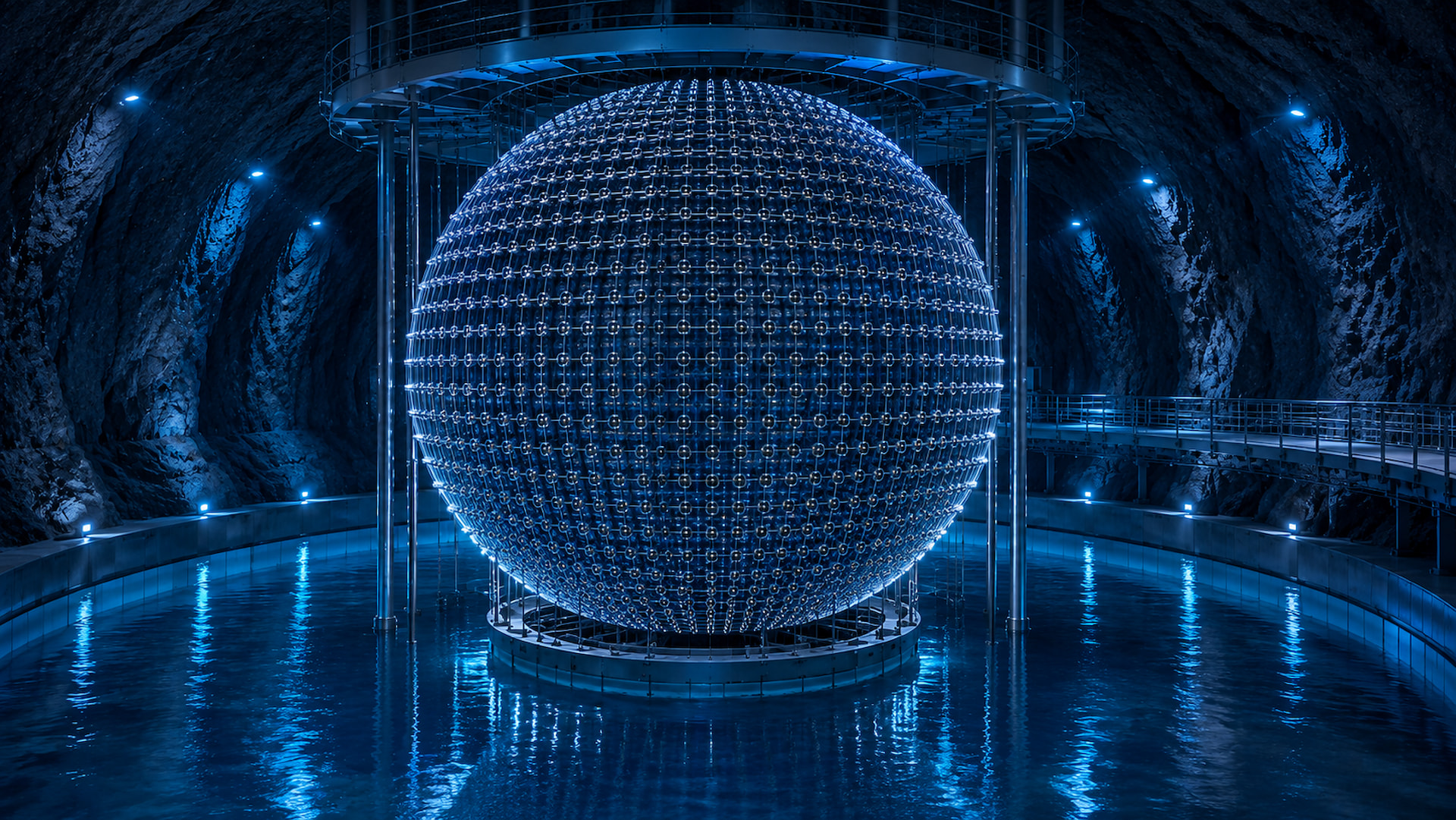
Despite their elusive nature, we detect neutrinos using massive detectors:
Key Detection Techniques
- Water Cherenkov detectors
- Liquid scintillators
- Ice-based detectors (e.g., polar observatories)
These systems rely on rare interactions between neutrinos and atomic nuclei, producing detectable light signals.
Scientific Significance of Neutrino Flux
Understanding neutrino flow allows us to:
- Probe the core of the Sun
- Study stellar evolution
- Investigate cosmic events across the universe
- Test fundamental physics beyond the Standard Model
Neutrinos act as messengers from otherwise inaccessible regions of the cosmos.
Conclusion: A Universe Passing Through Us
We exist within an invisible storm of neutrinos. Every second, unimaginable numbers pass through Earth—and through us—without leaving a trace. Yet within this silent flow lies a powerful tool for unlocking the deepest mysteries of the universe.