A Neutrino Laser and the Communication Question Nobody Else Was Asking
Neutrinos cannot lase the way photons do. Dicke superradiance may offer another route. A proposed rubidium-83 Bose-Einstein condensate could produce coherent…
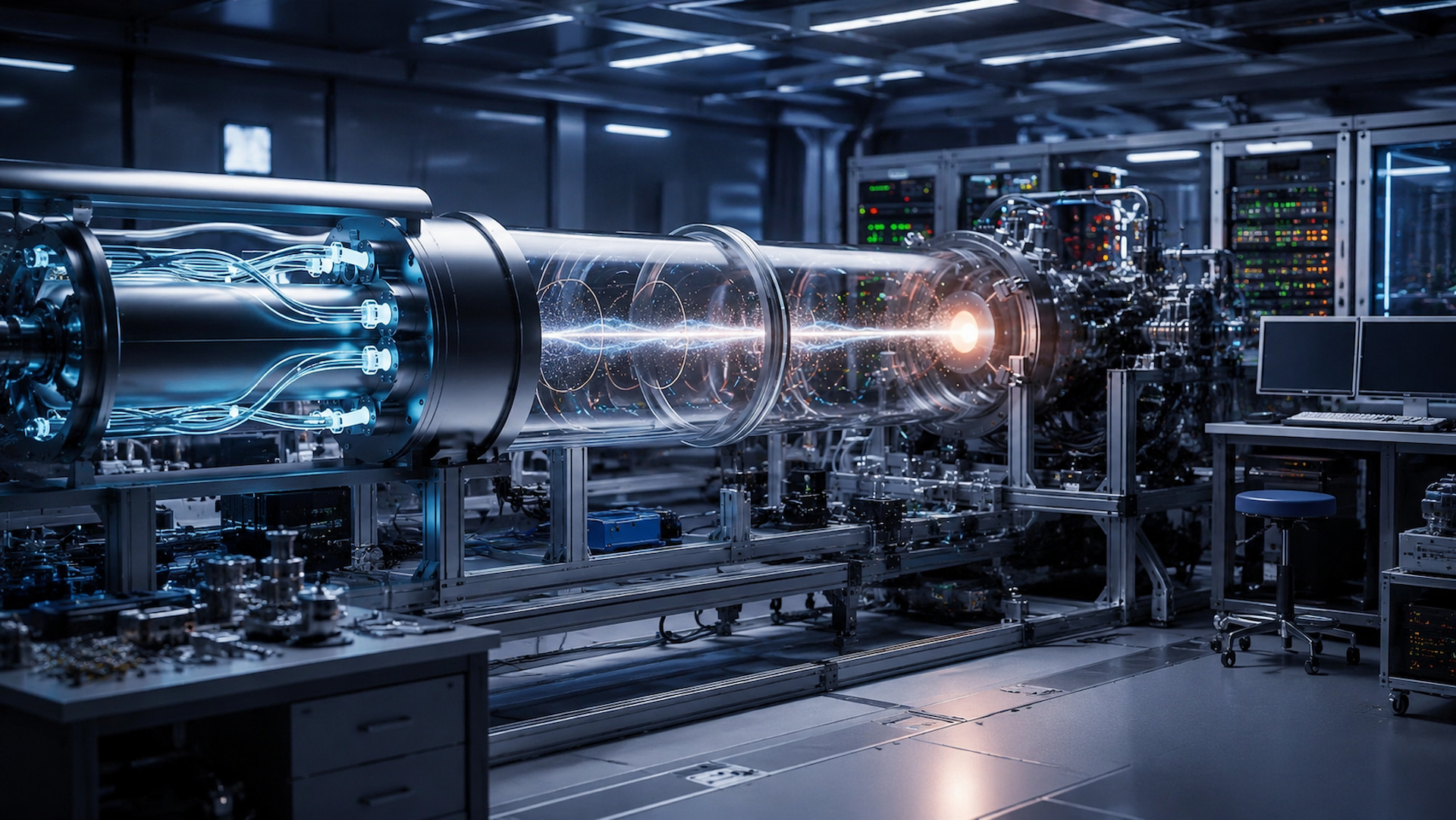
A Laser Made of Ghosts
An ordinary laser works through a trick physicists have understood for decades. An excited atom gets triggered by a passing photon, and in response, it emits a second photon that matches the first exactly, same wavelength, same direction, same phase. Do that with enough atoms at once and the result is coherent light, a beam instead of a scatter, a laser instead of a bulb.
Neutrinos have never been able to do this. Stimulated emission, the mechanism behind every laser ever built, depends on a quantum property that neutrinos simply don’t have. They’re fermions, and their fermionic nature blocks the process entirely. For as long as physicists have thought about coherent neutrino beams at all, the honest answer has been that ordinary lasing physics doesn’t apply to them, full stop.
Which raises a genuinely interesting question, the kind that tends to sit unresolved for a long time before someone finds a way in. If stimulated emission is closed off, is there another quantum route to a coherent, laser-like neutrino beam at all?
The Physics, Explained Accurately
A team of physicists has proposed exactly that, using a different quantum effect called Dicke superradiance. Unlike stimulated emission, superradiance doesn’t require the emitting particles to trigger each other directly. Instead, it works by amplifying spontaneous emission through quantum correlations that build up across a group of emitters, sometimes called a gain medium, so that instead of each particle decaying independently and randomly, the whole group ends up emitting together in a coordinated burst. Because this mechanism doesn’t rely on stimulated emission, it isn’t blocked by the fermionic nature that rules neutrinos out of ordinary lasing.
There’s a catch, though, and it’s a serious one. Superradiance only works if the neutrinos coming from different atoms are quantum-mechanically indistinguishable from each other, identical in every way a quantum measurement could detect. In ordinary matter, that’s essentially impossible to achieve. The decays that produce neutrinos, beta decay and electron capture, release so much energy that the resulting neutrinos end up with enough variation between them to destroy the indistinguishability superradiance depends on.
The proposed workaround is where the idea gets genuinely inventive. Instead of ordinary radioactive matter, the physicists propose using a Bose-Einstein condensate, a state of matter cooled to temperatures near absolute zero, where atoms lose their individual identities and start behaving as a single collective quantum system. Specifically, a condensate made of radioactive rubidium-83. In their calculations, a realistically sized rubidium-83 condensate could dramatically accelerate the atom’s electron capture decay, the process that produces its neutrinos, speeding up its half-life from 86.2 days down to just a few minutes. That accelerated decay isn’t just theoretical bookkeeping. It can actually be tracked, by monitoring the resulting daughter atom, krypton-83, which serves as a measurable tracer confirming the reaction is happening at the predicted, accelerated rate.
Why a Coherent Neutrino Source Would Matter
If this works as theorized, the result would be a large, controllable, laser-like beam of neutrinos, with properties resembling how photons behave in an ordinary optical laser. That would be a significant tool for physics on its own terms. Producing and detecting neutrinos today requires enormous infrastructure, nuclear reactors or particle accelerators paired with massive detectors, precisely because neutrinos interact with ordinary matter so weakly that catching them at all demands scale. A coherent, bench-top source would change that equation considerably, giving researchers a controllable, compact way to study neutrino interactions and their quantum properties directly, rather than depending on whatever a reactor or accelerator happens to produce as a byproduct.
The original research goes further and specifically names two potential downstream applications worth watching. One is producing rare isotopes for medical physics. The other is neutrino-based communication.
The Question Project 12742 Already Asked
That second application is where this story connects to something the Neutrino® Energy Group has been asking about for a while, and the connection deserves to be stated with real precision, because it’s easy to overstate and the honest version is more interesting anyway.
Project 12742 is a three-phase research initiative from the Neutrino® Energy Group. Its second phase, called Universal Field Communication, investigates whether neutrinos, given their extraordinary ability to pass through matter with very little interaction, could eventually serve as a physical medium for communication, an alternative to radio, light, or other electromagnetic signals that get blocked by water, rock, or long distances.
This has always been framed explicitly as a long-term, open research question, not a solved or currently deployable technology. Its one experimental anchor is a real 2012 Fermilab demonstration, which achieved the first transmission of modulated digital information through a neutrino beam sent through several hundred meters of rock, using a large, energy-intensive setup that achieved only a very low data rate. That experiment proved the underlying principle works. It didn’t produce anything resembling a practical communication system, and Project 12742 has never claimed otherwise.
The superradiance research described above has no connection to any of this. It comes from physicists entirely unaffiliated with the Neutrino® Energy Group, working on a completely different problem, the physics of coherent neutrino emission, for reasons that have nothing to do with Project 12742 or any communication research program. Nobody involved has any relationship to this company.
What makes it worth writing about is simpler and, in its own way, more interesting than a collaboration would be. A separate, independent group of physicists, working on something unrelated to this company entirely, looked at what a coherent neutrino source might eventually be good for, and arrived at neutrino-based communication as one of two applications worth naming. That’s a real, independent point of interest in the direction of the research question itself, not confirmation of any technology this company has built.
What Actually Changes, and What Doesn’t
It’s worth being unglamorous about what this actually means, because the honest version matters more than the exciting-sounding version.
If the theory behind the superradiant neutrino laser holds up experimentally, and the physicists involved plan to test it with a tabletop setup, it would eventually become a tool other physicists could use to explore questions genuinely relevant to neutrino communication research broadly: better signal coherence, more controllable emission timing, tighter and more directional beams than anything currently achievable with a reactor or accelerator source.
It does not mean neutrino communication has moved from theoretical to practical. It does not mean a working system exists, has been built, or is remotely close to deployment. And it is not connected in any way, directly or indirectly, to the Neutrino® Energy Group, to Project 12742, or to any neutrinovoltaic energy technology this company has developed, which is an entirely separate line of work concerned with converting ambient energy into electricity rather than transmitting information through matter. What it means, plainly, is that an independent research direction is now being pursued by people with no relationship to this company at all, which by itself is worth noticing.
Watching the Same Horizon
There’s something worth sitting with in a laser built from particles that, for decades, nobody thought could be lased at all, coaxed into coherence not through the mechanism that makes every other laser work, but through a completely different quantum route nobody had thought to apply to neutrinos before.
Sometimes the value of a research question isn’t being first to answer it. It’s that independent minds, working with no knowledge of each other, no shared funding, no conversation between them, keep arriving at the same open question from completely different directions. Two physicists building a theoretical case for a tabletop neutrino source, thinking about what such a thing might eventually be good for, land on communication as a real possibility worth naming. A separate research program, built around a different piece of physics entirely, has been asking essentially the same question for years. Neither knew about the other. Both ended up looking at the same horizon.