Ghost Particles, Real Power: What Neutrinos Taught Physics and What They Could Teach Energy
From Pauli’s “desperate remedy” to a Nobel Prize for ice, and the technology now being built on what the ghost particle taught us.
On this page
Hold out your hand. Something is passing through it right now, and it has been doing so since before you were born. It will leave without disturbing a single atom you’d miss. Roughly 60 billion of these particles cross every square centimetre of your skin each second, and physics needed twenty-six years just to prove they exist.
They’re called neutrinos. The story of understanding them is one of the longest tests of patience in science, and it turns out to be the first chapter of an energy story, too.
The Particle That Wasn’t Supposed to Be Seen
A neutrino carries no electric charge and answers only to the weak nuclear force and gravity. Electromagnetism, the force that makes a wall solid and a cloud opaque, barely reaches it, and atoms are mostly open space around very small nuclei. A neutrino can therefore cross the whole Earth, and most of those that arrive leave again on the far side. Its mass isn’t zero, as the 2015 Nobel Prize established, but it’s extremely small.
Three kinds exist, called electron, muon and tau neutrinos, born wherever nuclei change: in the Sun’s core, in reactors, in radioactive decay, in exploding stars, and when cosmic rays strike the upper atmosphere.
That aloofness is exactly why physicists care. Light gets absorbed, scattered and bent on its way to us. A neutrino arrives almost untouched, pointing back at where it was made, carrying news from the centre of the Sun and from stars that no longer exist. And now and then a neutrino hands a little energy and momentum to the matter it crosses. Everything we know about the particle comes from those rare handovers. Remember them. They return at the end of this story.
A Century of Milestones
In December 1930 Wolfgang Pauli had a problem. Beta decay seemed to lose energy, which would break one of physics’ firmest rules. He proposed what he called a desperate remedy: an invisible, neutral particle that carries off the missing share. He admitted it might never be detected. Enrico Fermi gave it the name neutrino, “little neutral one”, and built a theory of beta decay around it.
Proof took until 1956, when Clyde Cowan and Frederick Reines caught antineutrinos from a reactor at Savannah River in South Carolina and cabled Pauli the news. His reply: everything comes to him who knows how to wait. Reines received the Nobel Prize in Physics for it in 1995.
A second kind followed in 1962, when Leon Lederman, Melvin Schwartz and Jack Steinberger showed that the muon has a neutrino of its own, work that earned the 1988 prize. Then the Sun posed a riddle. From 1968 Raymond Davis Jr. counted solar neutrinos in a tank deep in a South Dakota gold mine and found far fewer than theory predicted. Meanwhile Masatoshi Koshiba’s Kamiokande detector in Japan gave the first glimpse beyond our own star in 1987, registering neutrinos from a supernova in a neighbouring galaxy. Davis and Koshiba shared the 2002 Nobel Prize in Physics for the detection of cosmic neutrinos.
The riddle’s answer came in 1998 and 2001. Takaaki Kajita’s Super-Kamiokande showed that neutrinos change type on their way down from the atmosphere, and Arthur McDonald’s Sudbury Neutrino Observatory showed that the Sun’s neutrinos do the same. Davis’s neutrinos hadn’t gone missing. They had changed identity, which is only possible if they have mass, and the Standard Model had said otherwise. Kajita and McDonald received the 2015 Nobel Prize in Physics “for the discovery of neutrino oscillations, which shows that neutrinos have mass.”
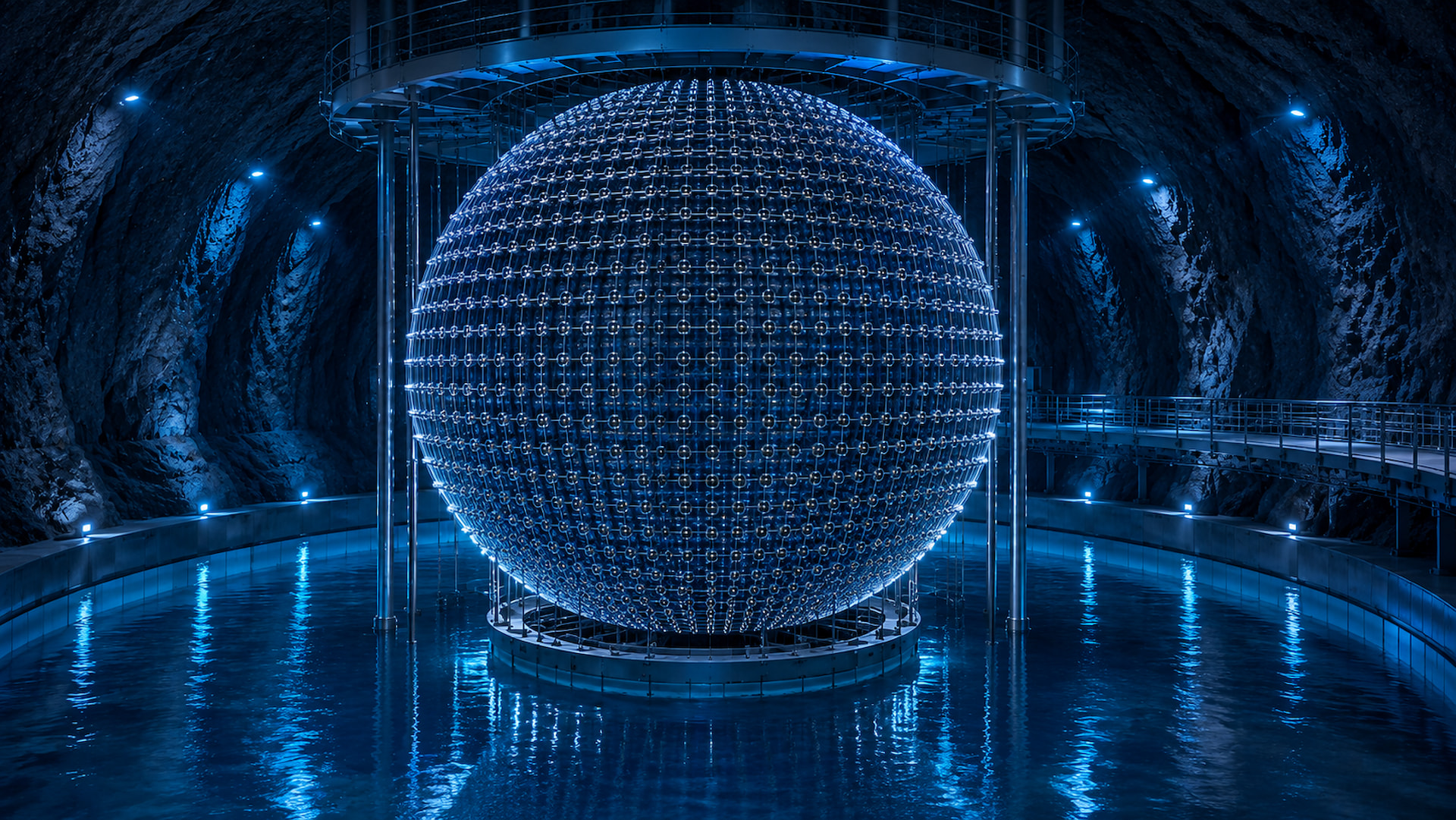
The latest chapter is written in ice. IceCube hangs about 5,160 light sensors on 86 strings in a cubic kilometre of Antarctic ice, between 1,450 and 2,450 metres down. When a neutrino interacts, the charged particles it creates trail a faint blue Cherenkov glow, and the sensors time it to billionths of a second. In 2013 the collaboration reported the first high-energy neutrinos from beyond our solar system. In 2018 it traced one to a flaring galaxy called TXS 0506+056. In 2023 it saw the Milky Way glowing in neutrinos. Along the way, in 2017, the COHERENT experiment watched a neutrino nudge a whole atomic nucleus at once, an effect predicted in 1974. On 6 October 2026 the Nobel Prize in Physics went to Francis Halzen, who was among the first to argue that the polar ice itself could be the detector and who led the project that proved it. It is the fifth Nobel Prize in Physics to honour neutrino research, after 1988, 1995, 2002 and 2015, and it rests on a large international collaboration.
From Ghost Particle to Working Material
IceCube reads each rare handover as light. The Neutrino® Energy Group asks what happens when a material is built to read it as electric charge.
About 6 × 10¹⁴ solar neutrinos cross a square metre each second: 60 billion per square centimetre, times 10,000 square centimetres. Solar neutrinos carry a few tenths of a megaelectronvolt each, so take a round 0.3 MeV, or 4.8 × 10⁻¹⁴ joules. That makes about 29 watts per square metre, an estimate and not a measurement. The largest face of a Neutrino Power Cube measures 800 × 600 millimetres, or 0.48 square metres. If every neutrino crossing it gave up all its energy, which cannot happen, the ceiling would be 29 × 0.48, about 14 watts. Real interactions are far rarer, so the concept couples five inputs instead of one.
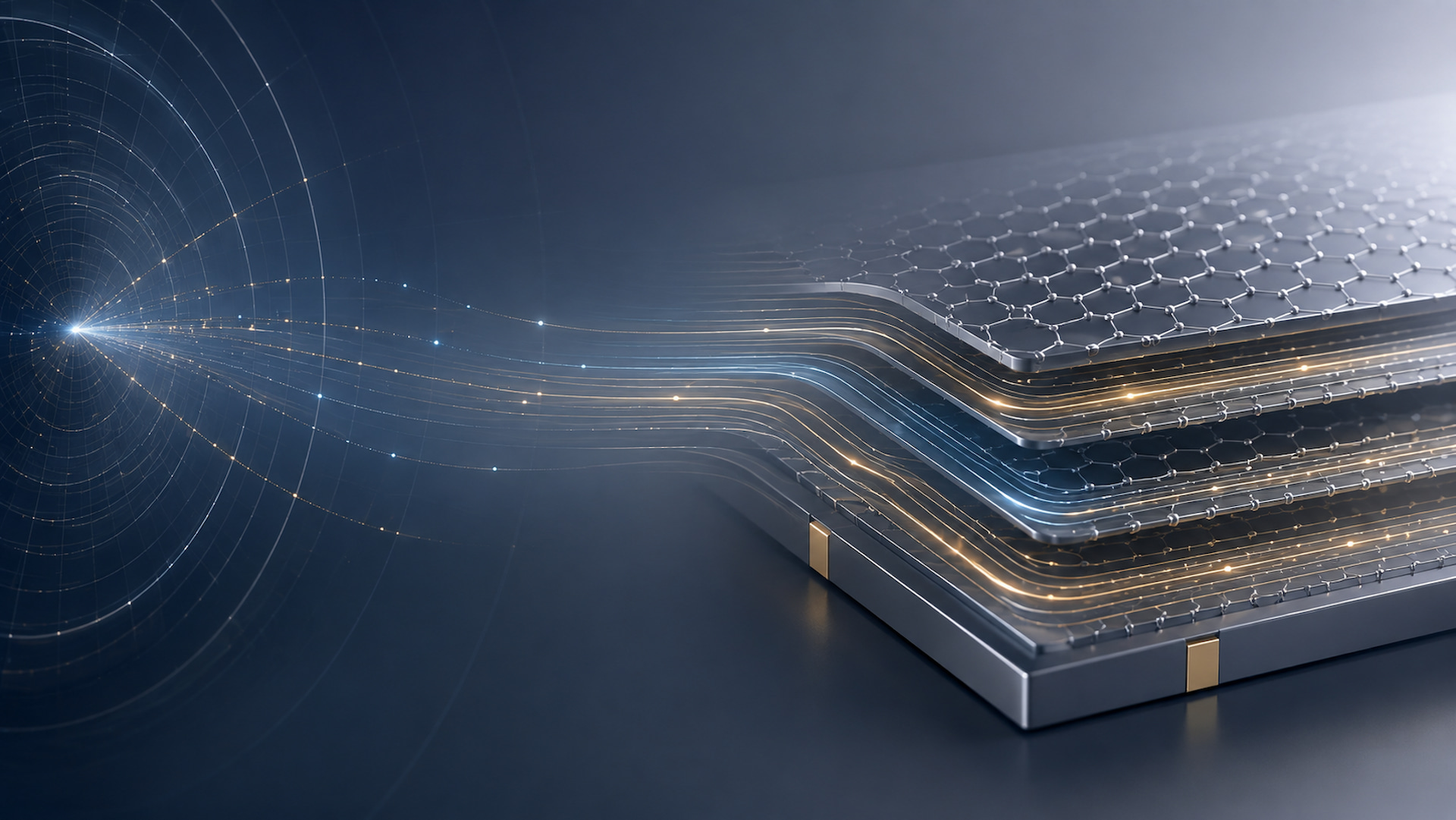
The name invites a comparison with photovoltaics, so precision matters. A solar cell absorbs photons, usually from sunlight, and when the light goes, so does the output. Neutrinovoltaics is multichannel. Five ambient inputs act together on one layered material: neutrino interactions, cosmic muons and other secondary particles, ambient electromagnetic radiation (light is one part of it, never the whole), thermal fluctuations and mechanical vibrations. The material combines graphene-based heterostructures with semiconductor interfaces, asymmetric by design. Asymmetry gives small, random responses a preferred direction, and that is how a flicker becomes a current. A collection layer gathers the charge, and power electronics deliver it to a load.
Paul Thibado’s group at the University of Arkansas has shown how the thermal ripple of freestanding graphene induces a current that can be coupled into a circuit with diodes, research independent of the Group’s. Stacking such effects into one engineered structure and measuring what comes out is the work.
The Mathematician Behind It
At the centre stands Holger Thorsten Schubart, a mathematician by training, CEO of the Neutrino® Energy Group and known inside it as the Architect of the Invisible. Nearly two decades ago he noticed that the universe is saturated with measurable particle and field fluxes, yet almost every energy technology was designed as if they weren’t there. In 2024 he formulated The Schubart Master Formula:
P(t) = η · ∫_V Φ_eff(r,t) · σ_eff(E) dV
Here, P(t) is the usable electrical output power in watts. η is a conversion factor between 0 and 1. Φ_eff is the effective ambient input at position r and time t. σ_eff is the material’s effective coupling at energy E. The integral sums the response over the active material volume V.
Schubart works like a conductor: he doesn’t play every instrument, he decides how independent players make something none of them could alone. Partners include the Centre for Materials for Electronics Technology (C-MET) in Pune for materials, SPEL Technologies for storage and Simplior Technologies for AI. Inside the Neutrino Engineering District, two AI personalities keep laboratory and industry talking: Avery Laurent speaks for the science, Morgan Elian for turning it into industry. Both are introduced as exactly what they are.
Where the Work Stands, and Where It Leads
The processes behind neutrinovoltaics are established physics. What the Group has to show is the net contribution of each channel and a closed energy balance for the whole unit: isolated measurements, independent reproduction, then long runs of months and years rather than hours. The yardstick is measurable power at the consumer.
The Neutrino Power Cube, about 800 × 400 × 600 millimetres and 50 kilograms, is designed for 5 to 6 kilowatts of continuous output. Energy supply has had two familiar shapes: Fuel → Power Plant → Grid → Consumer, and Renewables → Storage → Grid → Consumer. The Group is working on a third: Ambient Energy → Local Conversion → Consumer, the Energy Architecture Transition. The grid stays what it’s good at, connection, reserve and balancing layer, and stops being the precondition for every kilowatt-hour.
Pauli waited twenty-six years to be proved right. The engineers building on his ghost particle don’t plan to wait that long.
The question is no longer if energy systems will change, but who will adapt first, and who will be forced to follow.