Chasing the Invisible: The Extraordinary Machines Built to Capture Neutrinos
Few scientific pursuits have demanded as much ingenuity as the effort to observe the neutrino, a particle so elusive that trillions pass through every person…
Few scientific pursuits have demanded as much ingenuity as the effort to observe the neutrino, a particle so elusive that trillions pass through every person each second without leaving a trace. Unlocking its secrets has required generations of physicists to think beyond conventional laboratories, constructing enormous underground observatories, filling caverns with thousands of tons of specialized materials, and waiting patiently for interactions that may occur only a handful of times over many years.
The story began with a mystery rather than a discovery. During studies of beta decay in the early twentieth century, physicists realized that the energy emerging from radioactive reactions refused to balance. The numbers simply did not add up. Existing theories offered no convincing explanation, leaving researchers with an uncomfortable gap in their understanding of one of nature’s most fundamental processes.
In 1930, Austrian physicist Wolfgang Pauli proposed a bold answer. He suggested that an unknown particle was quietly carrying away the missing energy. The idea seemed almost absurd because the proposed particle interacted so weakly with matter that detecting it appeared impossible. Pauli himself famously admitted that he had committed a terrible act by introducing a particle no experiment could realistically observe. That hypothetical particle would eventually receive the name neutrino.
The challenge remained unresolved until the mid-1950s, when physicists Clyde Cowan and Frederick Reines set out to prove that Pauli’s invisible messenger truly existed. Working near the nuclear reactor at the Savannah River Plant in South Carolina, they assembled a custom detector weighing roughly ten tons. Thick lead shielding and layers of wet sandbags protected the instrument from unwanted radiation. The project earned the fitting nickname “Project Poltergeist,” reflecting the team’s attempt to capture what seemed little more than a scientific ghost.
Their perseverance paid off. In June 1956, Cowan and Reines announced that they had successfully detected neutrinos. The achievement marked one of the defining milestones of modern experimental physics. A particle once believed forever beyond human observation had finally revealed itself through an exquisitely designed experiment.
With detection established, scientists turned their attention to a much larger question. Since nuclear reactions generate neutrinos, perhaps these particles could provide a direct window into processes taking place deep inside stars, including the Sun itself. Unlike light, neutrinos escape almost immediately from stellar interiors, carrying information from regions that no telescope can observe directly.
Turning that idea into reality proved exceptionally difficult. Neutrinos interact with matter so rarely that the only practical solution was to build detectors on an unprecedented scale. These facilities also had to be isolated from cosmic rays and other background radiation capable of overwhelming the tiny neutrino signals. As a result, researchers began moving their experiments deep underground, where thick layers of rock naturally filtered out unwanted interference.
One of the earliest and most influential examples emerged during the 1960s beneath the Homestake Mine in South Dakota. Led by Raymond Davis Jr. and colleagues from Brookhaven National Laboratory, the experiment relied on nearly 400,000 liters of perchloroethylene, a chlorine-rich cleaning fluid stored approximately 1.5 kilometers below the surface. Every so often, a solar neutrino would strike a chlorine nucleus, converting it into radioactive argon that researchers could isolate and count with extraordinary care.
After decades of measurements, the results presented a puzzle. The detector consistently recorded only about one-third of the solar neutrinos predicted by theoretical calculations. This discrepancy became famous as the solar neutrino problem and remained one of particle physics’ greatest unresolved questions for many years.
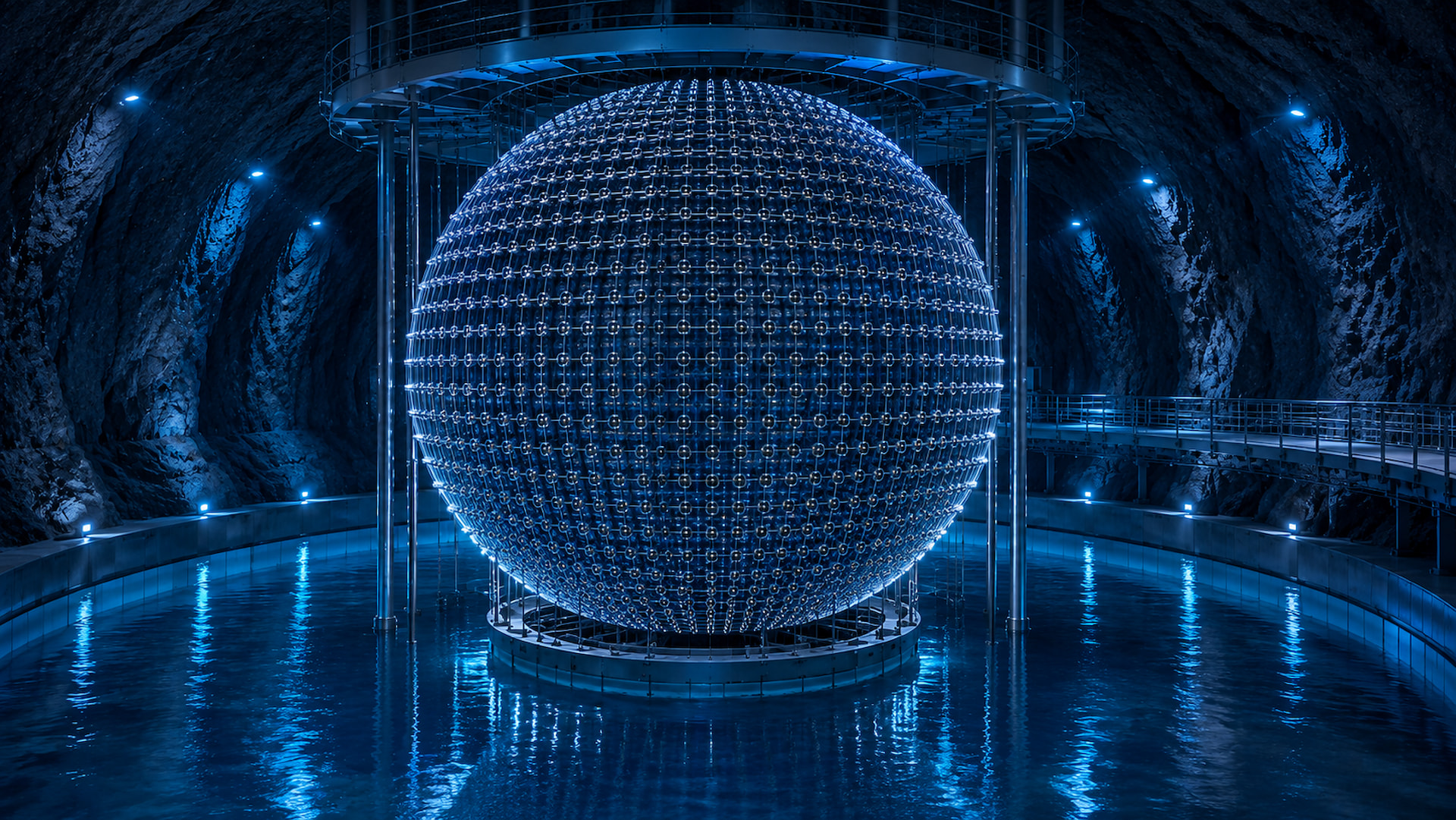
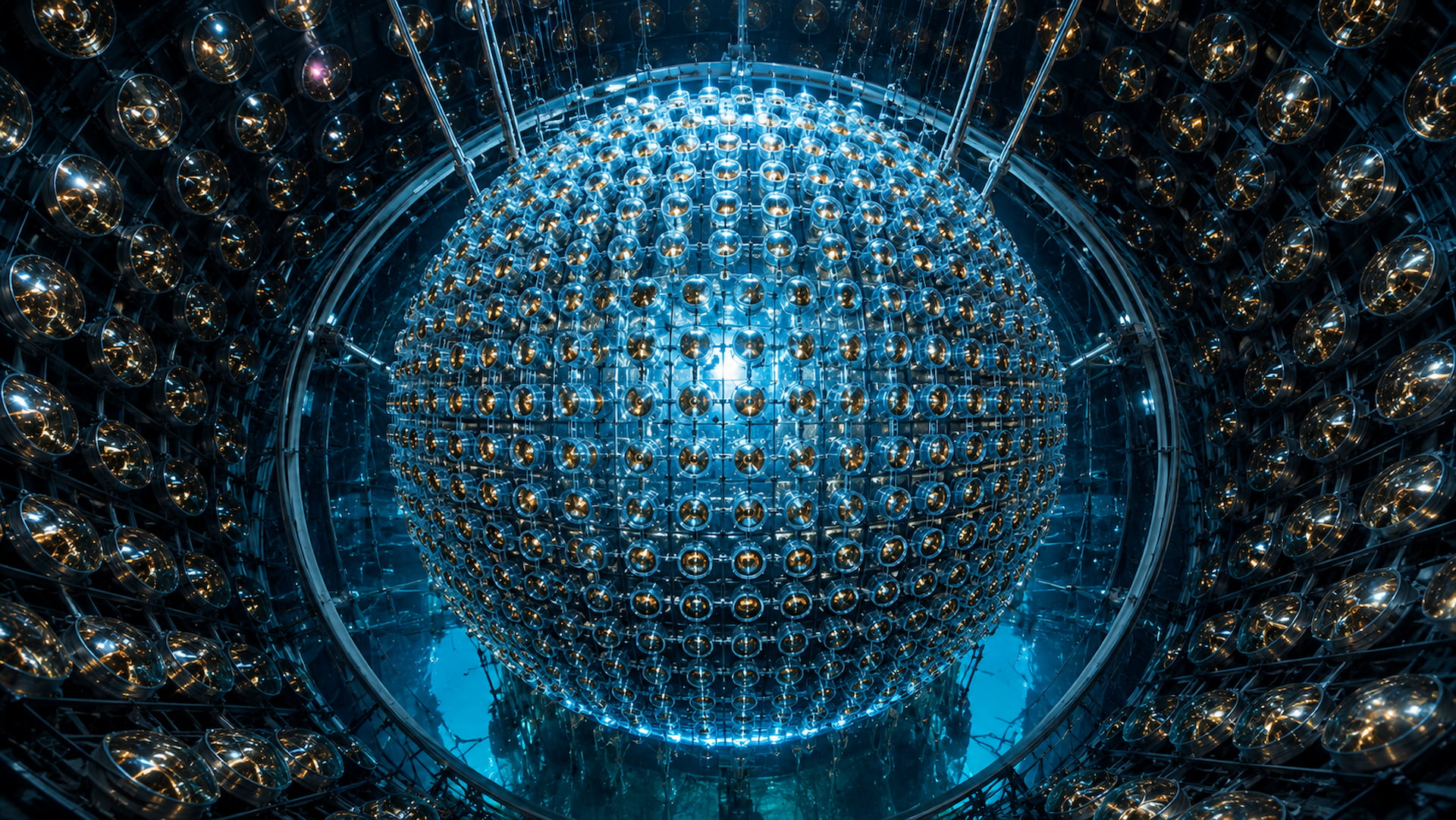
A solution eventually emerged from an entirely different generation of detectors. Deep inside Japan’s Kamioka Mine, physicist Masatoshi Koshiba constructed the Kamiokande experiment using approximately three million liters of ultrapure water. Occasionally, a neutrino colliding with matter inside the detector would produce an energetic electron moving faster than light can travel through water. The resulting flash of Cherenkov radiation could then be recorded by arrays of highly sensitive photodetectors surrounding the tank.
Kamiokande confirmed the missing neutrino observations reported by the Homestake experiment. Even larger facilities soon followed. Japan’s Super-Kamiokande and Canada’s Sudbury Neutrino Observatory ultimately demonstrated that neutrinos were not disappearing at all. Instead, they were transforming between three distinct varieties known as electron, muon, and tau neutrinos while traveling through space. These oscillations revealed something even more remarkable. Neutrinos possess mass, a property absent from the original formulation of the Standard Model and still not fully explained by contemporary particle physics.
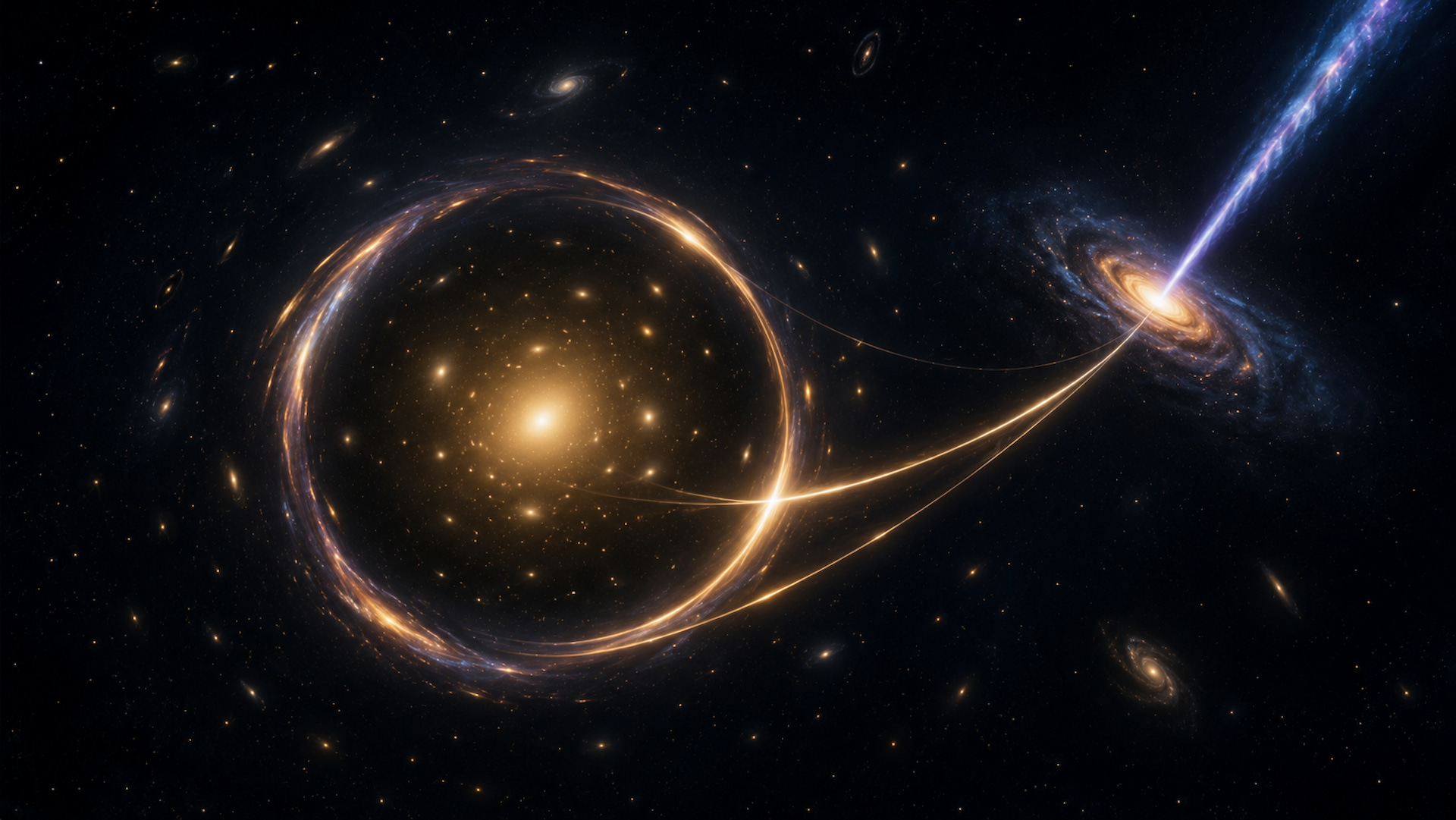
Modern neutrino research continues to push experimental engineering into extraordinary territory. Beneath Antarctica, the IceCube Neutrino Observatory transforms a cubic kilometer of crystal-clear ice into an immense particle detector. Rather than relying on artificial tanks, the experiment uses the Antarctic ice sheet itself to identify flashes of Cherenkov light produced by rare neutrino interactions. IceCube has mapped high energy neutrino sources across the Milky Way and traced several cosmic neutrinos back to active galaxies hosting supermassive black holes.
Another remarkable observatory operates in an entirely different environment. The KM3NeT detector rests on the floor of the Mediterranean Sea, where the surrounding seawater provides the conditions needed to observe energetic particles arriving from distant regions of the universe. Among its achievements is the detection of the most energetic cosmic neutrino ever recorded, although the object responsible for producing it remains unknown.
The next generation of experiments is focused on answering even deeper questions about neutrino behavior. China’s Jiangmen Underground Neutrino Observatory, known as JUNO, entered operation in 2025 and released its first major scientific results during 2026, delivering the most precise measurements of neutrino oscillations achieved so far. Additional flagship facilities, including Japan’s Hyper-Kamiokande and the United States’ Deep Underground Neutrino Experiment, are expected to expand this field significantly as they begin scientific operations later in the decade.
Each successive detector has grown larger, more sophisticated, and more sensitive than its predecessors, reflecting the extraordinary difficulty of studying a particle that barely interacts with ordinary matter. Yet these ambitious experiments have steadily transformed neutrinos from hypothetical curiosities into powerful tools for exploring stellar interiors, violent cosmic events, and the fundamental laws governing the universe.
The formula for success has remained remarkably consistent across generations of researchers. Build on an immense scale. Shield experiments from every possible source of interference. Accept that meaningful signals may arrive only after years of observation. Above all, remain patient enough to catch one of nature’s most elusive travelers in the brief instant when it finally decides to leave its mark.