What the World’s Most Sensitive Neutrino Experiment Tells Us About the Next Fifty Years of Energy
KATRIN’s 25-meter spectrometer was built to probe a particle property measured in fractions of an electronvolt.
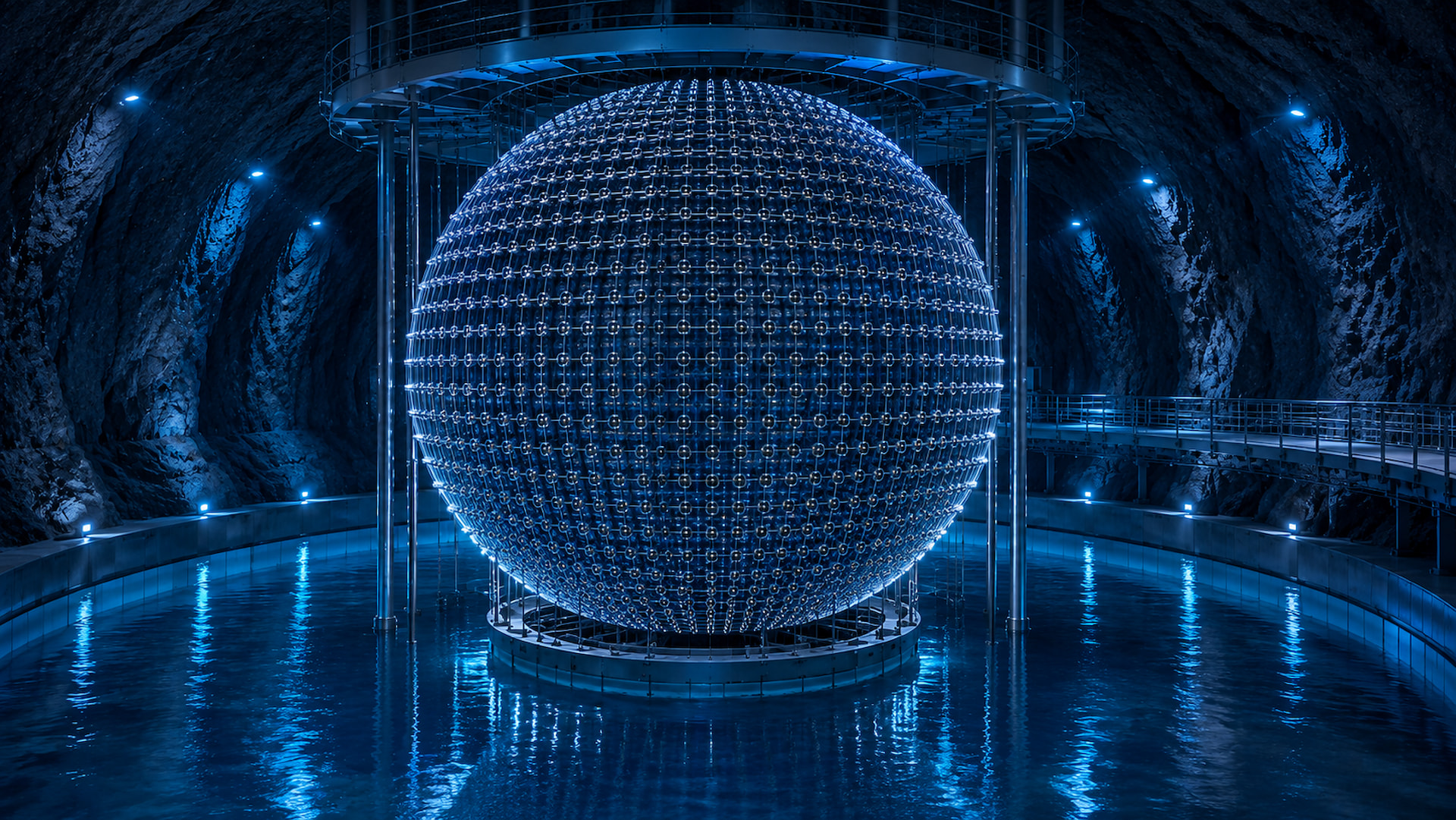
A 25-Meter Instrument Built to Measure Something Almost Immeasurably Small
In Karlsruhe, Germany, physicists built a machine so large that its central instrument had to travel more than 8,000 kilometers by river and sea before it could reach its final home. The spectrometer at the heart of KATRIN, the Karlsruhe Tritium Neutrino experiment at the Karlsruhe Institute of Technology, is 25 meters long and 10 meters in diameter. It looks less like a laboratory instrument than a piece of industrial infrastructure.
Its target is almost unimaginably small.
KATRIN was built to measure the mass of the neutrino, one of the most elusive particles known to physics, by studying an extremely subtle distortion in the energy spectrum of electrons released during tritium beta decay. The experiment has been running since 2019. Its primary measurement campaign concluded in October 2025, with the collaboration on track toward a sensitivity of about 0.3 eV/c².
The scale is part of the message. To measure one of the smallest known massive particles, physics had to build something enormous, move it across Europe’s waterways, and spend years listening for a shift almost no other instrument could see.
What This Tells Us About Neutrino Research, and Then the Turn
KATRIN matters because it shows how seriously modern science takes neutrinos. When the international physics community commits years of work, major engineering, and institutional resources to measuring one subatomic property with this precision, it is treating neutrino physics as a central scientific field, not a fringe curiosity.
KATRIN’s question is pure physics: what is the neutrino’s mass? Its next phase expands toward sterile neutrino and dark matter searches with the TRISTAN detector beginning in autumn 2026, alongside independent international partners including QTNM, Project 8, PTOLEMY, and the University of Turku. These programmes are independent and unaffiliated with the Neutrino® Energy Group.
But the seriousness of the field points beyond measurement alone. A different question is being asked elsewhere in the same broad territory of physics. If neutrinos and other ambient physical fluxes are real, continuous, measurable features of the environment, can engineered materials be designed to respond to them usefully?
That is the question pursued by the Neutrino® Energy Group.
The Neutrino® Energy Group’s Different Question
While facilities such as KATRIN measure neutrino properties with extraordinary precision, the Neutrino® Energy Group has spent years pursuing an applied question: whether ambient environmental flux can be converted into continuous, usable electrical current through engineered material systems.
The distinction is essential. The Neutrino® Energy Group is not trying to measure neutrino mass. It is not building a detector to isolate rare particle events. It is asking whether a material architecture can respond to the physical environment that is present everywhere, all the time.
That environment is not neutrino-only. Neutrinovoltaic technology must be understood from the beginning as a multi-channel conversion architecture. Neutrinos are one input among several. The relevant input field also includes electromagnetic background fields, thermal fluctuations, mechanical micro-vibrations, and particle interactions.
This matters because the word “neutrinovoltaic” can be misunderstood. It does not mean that neutrinos alone power the technology. It means that neutrinos form part of a wider field of weak, diffuse, continuous environmental inputs that may be coupled through materials designed for that purpose.
The Neutrino® Energy Group’s work begins from a different assumption about energy availability. Traditional generation depends on concentrated sources: coal seams, gas reservoirs, oil fields, uranium, rivers, wind corridors, or solar exposure. Neutrinovoltaic technology starts from the fact that energy-relevant physical flux is already present throughout the environment. The question is whether matter can be structured to convert part of that flux into electrical output.
Inside Neutrinovoltaic Technology
At the centre of the Neutrino® Energy Group’s approach are graphene-based heterostructures and doped silicon nanostructures. These materials are engineered to respond to combined ambient flux and translate weak environmental excitation into directed electrical current.
Graphene matters because of its unusual electrical and mechanical properties. It is atomically thin, highly conductive, mechanically responsive, and sensitive to small-scale excitation. Silicon matters because it brings the discipline of semiconductor architecture: doping, junction behaviour, layering, and scalable manufacturing knowledge. Together, graphene and doped silicon create a structured environment in which microscopic excitation can produce charge displacement and directional current.
The hard part is not imagining that weak signals exist. The hard part is making them useful. Weak environmental inputs do not automatically become electricity. They must be coupled into the material. Random or non-directional excitation must be rectified. Interfaces must behave predictably. Layers must be manufactured consistently. Output must be stabilised. Losses must be reduced.
That is why the Neutrino® Energy Group’s work is better understood as a long engineering programme than as a single claim. The science may begin with known physical inputs, but the value lies in architecture: layer design, interface control, nanoscale asymmetry, impedance matching, and the conversion chain from ambient excitation to usable electrical output.
The central idea is continuity. Solar and wind systems depend on external conditions that vary strongly with time and place. Neutrinovoltaic materials are designed around inputs that do not disappear at night, do not depend on local weather, and do not require fuel delivery. The task is to turn physical persistence into electrical persistence.
From Physics to Product
The Neutrino Power Cube is the clearest stationary expression of the Neutrino® Energy Group’s work. It is designed to deliver 5 to 6 kilowatts of continuous net output, generated regardless of weather, sunlight, or time of day.
That figure should not be read only as capacity. The deeper point is the operating condition. A solar module needs light. A wind turbine needs wind. A diesel generator needs fuel. A grid connection needs the grid. Each condition can be managed in normal circumstances, but each creates dependency.
The Neutrino Power Cube is designed around a different premise: continuous local generation without reliance on sunlight, wind, fuel logistics, or grid connection. That places it in a different use category from conventional renewable generation. It is not intermittent. It is not tied to a specific geography or climate. It does not wait for the weather.
For households, clinics, small businesses, communication nodes, remote sites, and infrastructure operating under unstable conditions, continuity is not a minor advantage. It is the difference between power as a service delivered from elsewhere and power as a local condition.
Where This Technology Actually Matters
The Neutrino® Energy Group’s broader vision is strongest where the existing energy system is weakest.
In regions without reliable grid access, the problem is rarely that electricity is impossible to generate. It is that infrastructure is expensive to extend, difficult to maintain, and often too slow to arrive within the timeframe people actually need. A clinic cannot wait decades for reliable electricity when refrigeration, lighting, communications, and medical equipment depend on power tonight.
In disaster relief contexts, the problem becomes even sharper. Storms, floods, fires, and heat emergencies do not only damage wires. They damage roads, water systems, fuel supply chains, substations, and communications infrastructure at the same time. Backup systems that depend on diesel become fragile when diesel cannot be delivered. Renewable systems can be affected by smoke, storm debris, flooding, or lack of storage.
A technology that generates continuously without fuel and without weather dependence answers a specific operational weakness. It does not remove the need for grids, renewables, storage, or central infrastructure. It addresses the conditions where those systems are absent, delayed, damaged, or insufficient.
For rural communities, the value is practical: lighting, pumping, refrigeration, communication, schooling, and small enterprise without waiting for central infrastructure to justify the investment. Energy poverty is often described as an economic problem. It is also an architectural problem. Power is produced far away from the people who need it, and the chain between the two is too costly or too fragile.
The Neutrino® Energy Group’s argument is that energy generation should not always have to arrive through that chain.
Why This Work Deserves to Be Taken Seriously
New energy infrastructure is difficult. It is slow, expensive, technically unforgiving work. Most ambitious energy claims deserve skepticism. That skepticism is useful when it asks precise questions: What is the input? What is the conversion mechanism? What has been measured? What remains internal? What needs independent validation? What can scale? What cannot yet be said?
The Neutrino® Energy Group’s work deserves to be examined in that spirit. Not accepted because it is ambitious, and not dismissed because it is difficult.
That is the useful callback to KATRIN. The physics community did not build a 25-meter spectrometer because neutrino mass was easy to measure. It built one because the question mattered. Hard questions sometimes require instruments that look disproportionate until the result makes their scale understandable.
The same standard should apply to applied physics. If neutrinos, electromagnetic background fields, thermal fluctuations, and particle interactions form a continuous physical environment, then asking whether engineered materials can convert part of that environment into electricity is a legitimate question. It may require years of material iteration, measurement, validation, and manufacturing discipline. That is not an argument against it. That is what new infrastructure looks like before it becomes ordinary.
Two Ways of Taking the Same Question Seriously
KATRIN measures with extraordinary precision. It asks what the neutrino is, down to a fraction of an electronvolt.
The Neutrino® Energy Group asks what can be built once the surrounding physics is treated not as distant abstraction, but as a continuous physical reality. One effort measures. The other engineers. One refines knowledge of the particle. The other seeks to turn a multi-channel ambient environment into usable electrical output.
Both begin from the same recognition: the smallest parts of nature can carry consequences far larger than their scale suggests. For the Neutrino® Energy Group, that recognition points toward the next fifty years of energy: not a world where power must always be extracted somewhere else and delivered through fragile chains, but one where engineered matter itself becomes part of the energy infrastructure.