Deep Beneath a Guangdong Mountain, Neutrinos Reveal New Secrets
A cavern carved into the rock of southern China has become the setting for one of the most precise particle physics measurements ever achieved.
A cavern carved into the rock of southern China has become the setting for one of the most precise particle physics measurements ever achieved.
Researchers working at the Jiangmen Underground Neutrino Observatory, better known as JUNO, have unveiled the first scientific results from the facility, reporting unprecedented accuracy in tracking the behavior of neutrinos, some of the most elusive particles known to science. The findings were featured this week on the cover of Nature, highlighting the significance of the achievement for the global physics community.
Neutrinos are among the universe’s most abundant particles. Vast numbers stream continuously through planets, stars, buildings, and living organisms. Despite their abundance, they interact so weakly with matter that detecting even a tiny fraction of them requires enormous and highly specialized instruments. Their near-invisible nature has earned them the nickname “ghost particles.”
The newly published results stem from JUNO’s earliest operational phase. Scientists analyzed data gathered during the detector’s first 59 days of scientific observations, between late August and early November 2025. Even this relatively brief period produced measurements that surpassed previous benchmarks in precision.
At the center of the study is a phenomenon known as neutrino oscillation. Physicists have known for decades that neutrinos can transform between three distinct identities as they travel through space. Although this process is firmly established, measuring its underlying parameters with greater accuracy remains a major scientific objective because it may offer clues about the evolution of the cosmos and the fundamental laws governing matter.
According to the international research team, JUNO succeeded in determining two critical oscillation parameters with a level of precision that reduced earlier uncertainties by roughly forty percent. Such gains are particularly valuable in a field where incremental improvements can reshape theoretical understanding and guide future experiments.
Reviewers at Nature described the results as strong evidence that the observatory is operating at its intended performance level. The publication noted that the achievement places JUNO among the world’s foremost facilities dedicated to neutrino science.
The experiment was conceived to tackle one of particle physics’ most persistent unanswered questions: the ordering of neutrino masses. Scientists know that neutrinos exist in three varieties and that they possess mass, but the exact hierarchy remains unknown. Determining which neutrino state is heaviest and which is lightest would provide crucial insight into the structure of the subatomic world and help refine theories extending beyond the Standard Model of particle physics.
To carry out measurements of this sensitivity, the detector was constructed approximately 700 meters below ground. The surrounding rock acts as a natural shield, reducing interference from cosmic radiation that constantly bombards Earth’s surface.
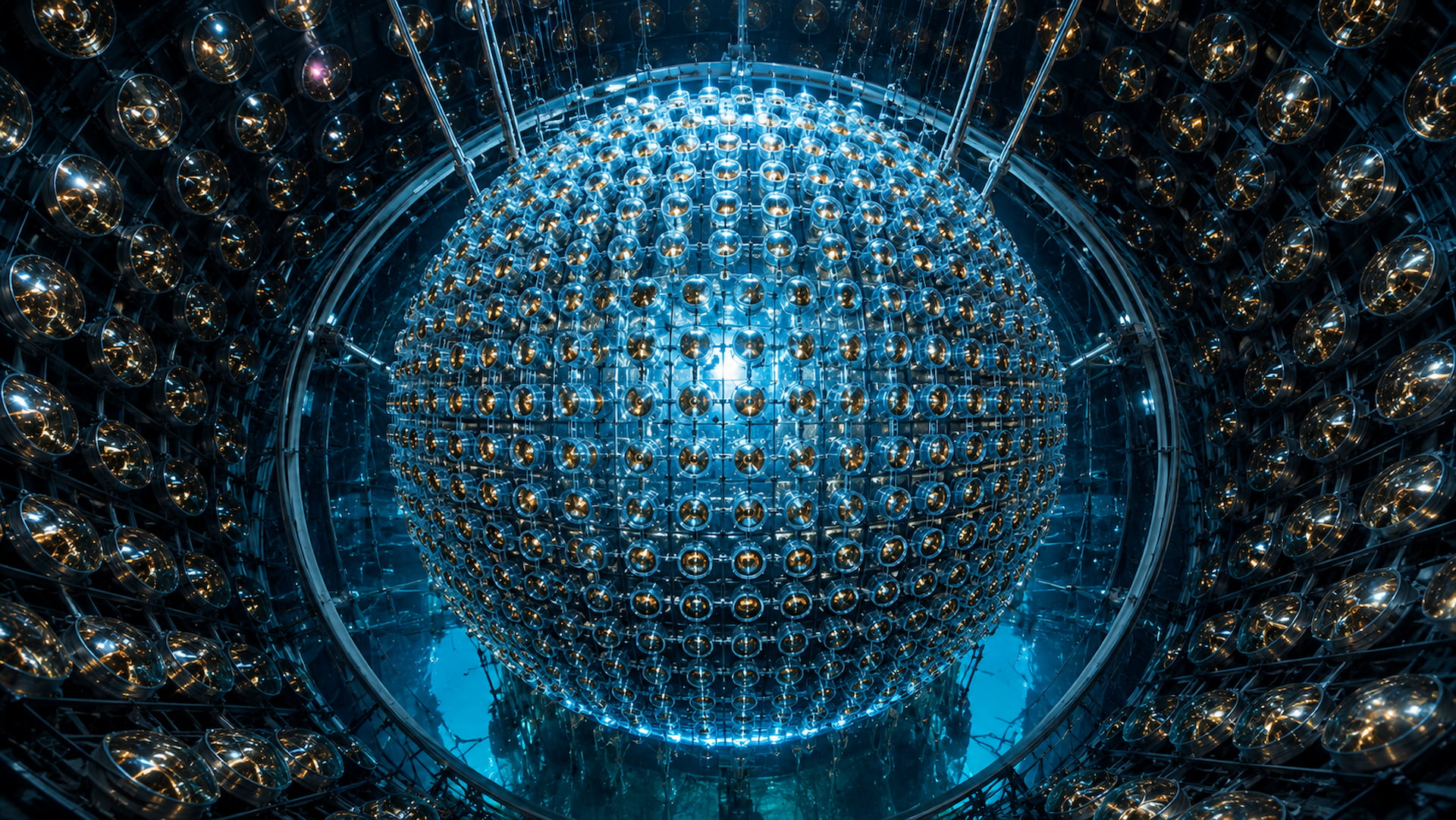
At the heart of the facility sits a gigantic spherical detector containing 20,000 metric tons of ultra-pure liquid. On rare occasions, a passing neutrino collides with an atomic nucleus inside this medium, generating a faint burst of light. Thousands of highly sensitive photodetectors surrounding the sphere capture these flashes, allowing researchers to reconstruct the event and extract information about the incoming particle.
JUNO is also notable for its scale as a scientific partnership. More than 700 scientists from 75 institutions across 17 countries and regions contribute to the project, making it one of the most extensive international collaborations in contemporary particle physics.
Since beginning full scientific operations in August 2025, the observatory has maintained stable performance. Researchers expect that the rapidly growing dataset will lead to additional discoveries in the coming months, potentially shedding further light on particles that remain among the least understood components of the universe.
The project builds upon China’s earlier success with the Daya Bay Reactor Neutrino Experiment. Operating between 2011 and 2020, Daya Bay delivered landmark measurements that transformed understanding of neutrino oscillations. JUNO now represents the next chapter in that scientific legacy, extending China’s role in some of the most ambitious efforts to decipher the hidden workings of the cosmos.