When Neutrinos Fade Away: A New Route Through a Cosmological Puzzle
One of modern physics' smallest particles has become the center of a surprisingly large disagreement.
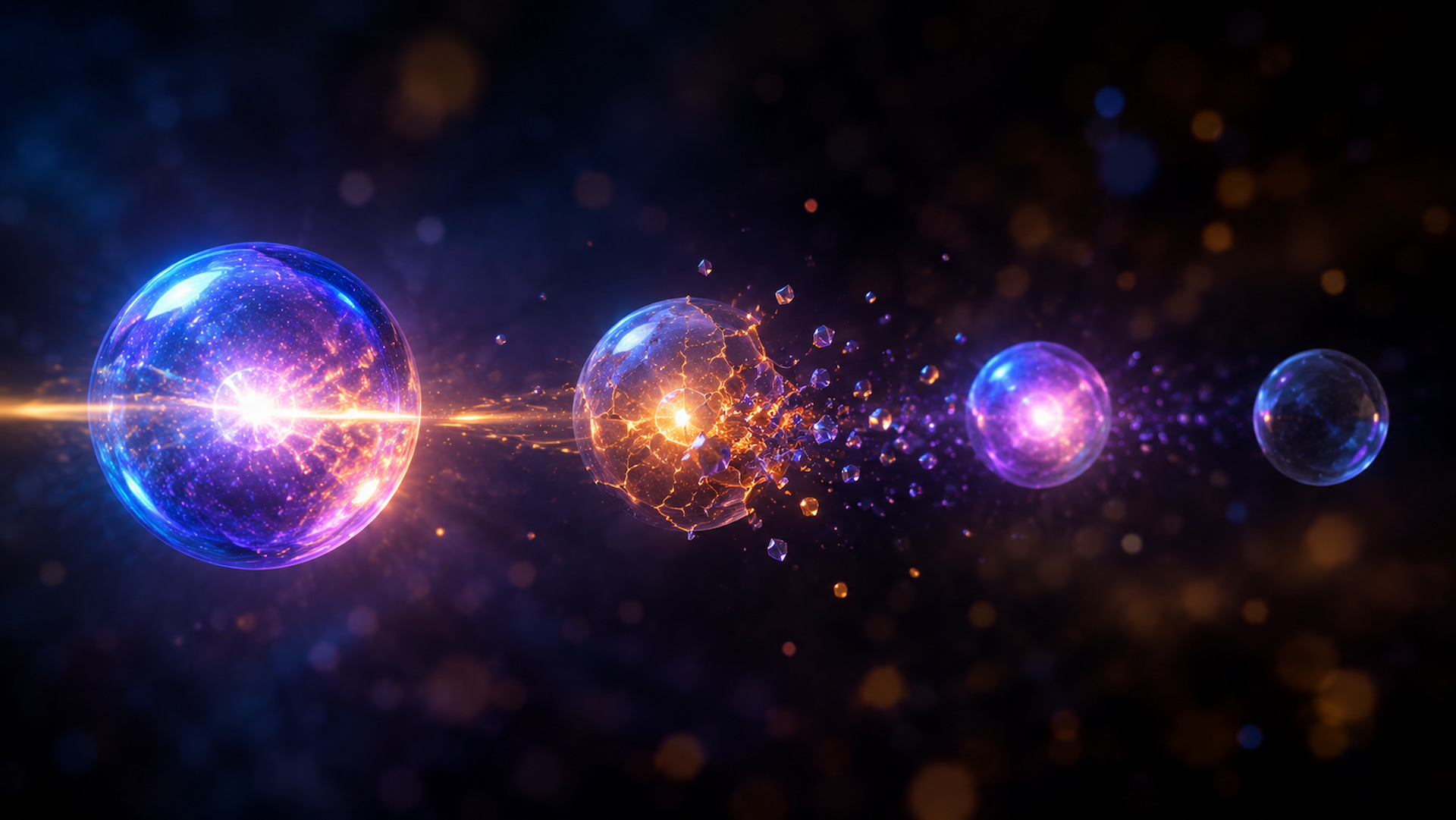
One of modern physics’ smallest particles has become the center of a surprisingly large disagreement. Measurements made in particle laboratories and observations of the Universe on its grandest scales appear to be telling different stories about neutrino mass. A new theoretical study suggests that the discrepancy may not require exotic revisions of cosmology at all. Instead, the answer could lie in the possibility that neutrinos gradually disappear.
For decades, neutrinos were believed to be entirely massless. These elusive particles, produced in enormous numbers by stars, nuclear reactions, and other energetic processes, seemed to fit comfortably within that assumption. The picture changed dramatically in the late twentieth century when experiments revealed that neutrinos can transform from one type into another while traveling through space.
This phenomenon, known as neutrino oscillation, is only possible if neutrinos possess mass. Although that mass is extraordinarily small, roughly ten million times lighter than an electron, the discovery reshaped particle physics and established a minimum combined mass for the three known neutrino varieties: electron, muon, and tau neutrinos.
Yet what appears settled in particle experiments becomes far less straightforward when viewed through the lens of cosmology.
Neutrinos played an important role during the evolution of the Universe, influencing the growth of cosmic structure over billions of years. Because of this influence, astronomers can estimate their collective mass by studying how galaxies are distributed across space. Recent observations from the Dark Energy Spectroscopic Instrument, known as DESI, have tightened those estimates considerably. The resulting upper limit on neutrino mass sits uncomfortably close to, and potentially below, the minimum value indicated by oscillation experiments.
The mismatch is subtle, but it has attracted significant attention. If both sets of measurements are correct, then an ingredient may be missing from the standard cosmological picture.
Several proposals have been put forward to ease the tension. Some researchers have explored modifications to dark energy, while others have examined alternative cosmic histories. However, many of these ideas introduce new assumptions without offering a clear connection to the underlying physics of neutrinos themselves.
A different possibility comes from theoretical work by Guillermo Franco Abellán of the University of Valencia. Rather than altering the evolution of the Universe, his approach changes the fate of neutrinos.
The proposal assumes that neutrinos are not perfectly stable particles. Over immense periods of time, on the order of a billion years, they could decay into currently undetected massless particles. Such decays are not arbitrary inventions. They emerge naturally in several theoretical frameworks that attempt to explain how neutrinos acquired mass in the first place.
When these decay processes are incorporated into cosmological simulations, the apparent conflict softens considerably. The upper limit derived from galaxy observations increases to approximately 0.23 eV/c², creating much more room for compatibility with laboratory measurements and neutrino oscillation data.
For now, the idea remains speculative. Yet it offers something physicists value highly: a mechanism rooted in particle theory that produces measurable consequences.
The next opportunity to test the concept may come from a new generation of astronomical surveys. Observatories such as the Vera C. Rubin Observatory in Chile and the Euclid space mission are expected to map cosmic structure with unprecedented precision. If neutrinos truly decay over cosmic timescales, traces of that process could become visible in the way galaxies grow and evolve across the Universe.
What began as a disagreement over an almost unimaginably small mass may therefore point toward an entirely new chapter in neutrino physics. Instead of merely weighing these particles more accurately, future observations could reveal whether some of them have been quietly vanishing throughout cosmic history.