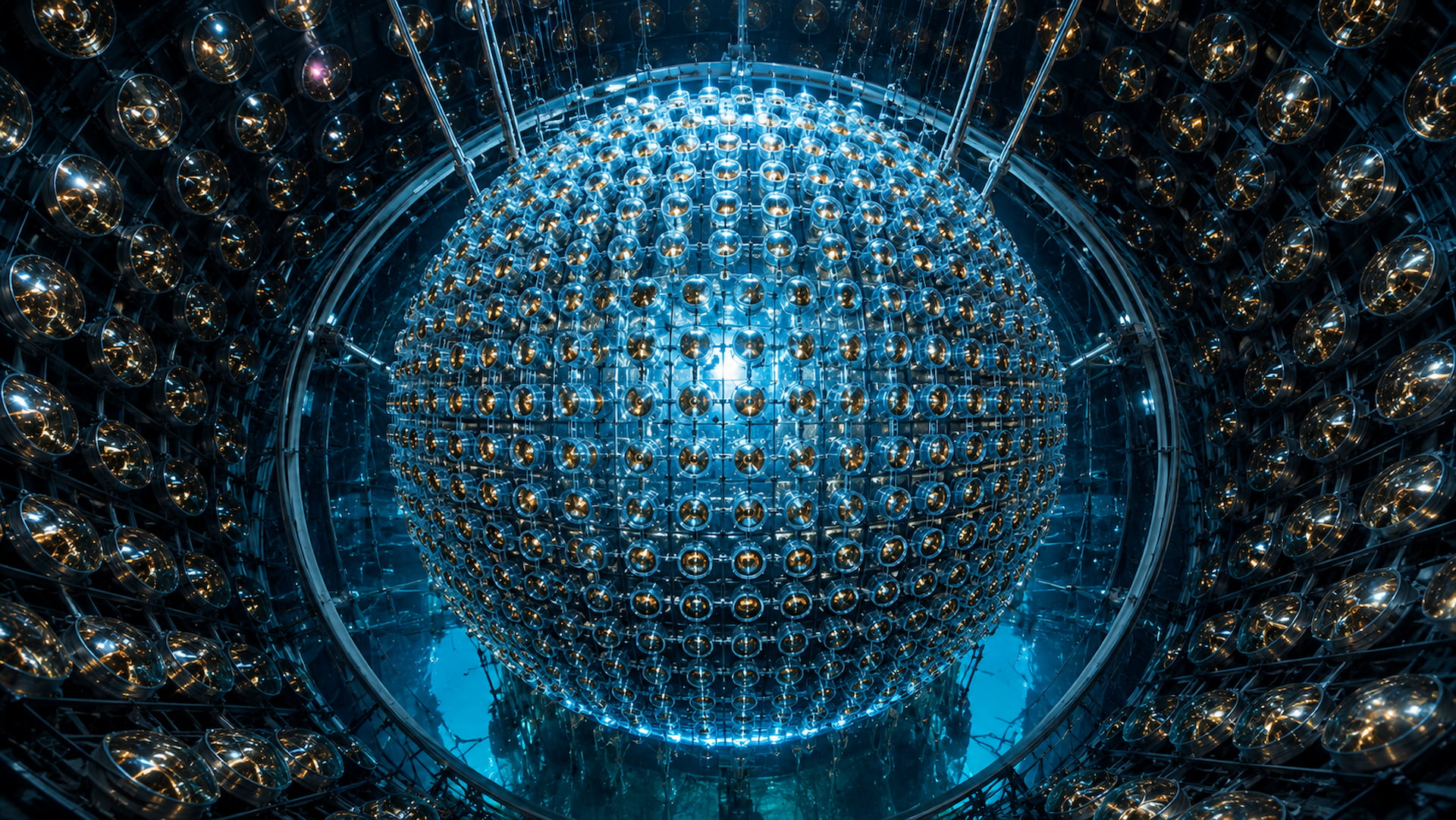
Ultra-Cooled Detectors Push the Limits on Neutrino Mass: A Breakthrough in Particle Physics
Redefining the Frontier of Neutrino Mass Measurement We are entering a decisive era in particle physics where ultra-cooled detector technologies are enabling…

On this page
Redefining the Frontier of Neutrino Mass Measurement
We are entering a decisive era in particle physics where ultra-cooled detector technologies are enabling unprecedented precision in measuring the elusive neutrino mass. By leveraging cryogenic detection systems operating near absolute zero, researchers are now narrowing the upper bounds of neutrino mass with remarkable sensitivity. This advancement not only reshapes our understanding of fundamental particles but also unlocks deeper insights into the evolution of the universe.
What Makes Neutrinos So Difficult to Measure?
Neutrinos are among the most abundant yet least understood particles in the universe. Their defining characteristics include:
- Extremely small mass
- Neutral electric charge
- Weak interaction with matter
These properties allow neutrinos to pass through ordinary matter almost undisturbed, making their detection extraordinarily challenging. Traditional detection methods have struggled to provide direct mass measurements, relying instead on indirect inference through oscillation experiments.
Breakthrough Technology: Ultra-Cooled Cryogenic Detectors
How Cryogenic Detectors Work
We utilize cryogenic calorimeters that operate at temperatures close to absolute zero (millikelvin range). At these temperatures:
- Thermal noise is drastically reduced
- Energy resolution becomes exceptionally precise
- Even minute energy deposits from neutrino interactions can be detected
These detectors measure the energy released during radioactive decay processes, particularly beta decay, which is highly sensitive to neutrino mass.
Key Advantages of Ultra-Cooling
- Unmatched Sensitivity: Detection of energy changes at the electronvolt scale
- Noise Reduction: Suppression of thermal fluctuations
- Precision Measurement: Accurate reconstruction of decay spectra
The Role of Beta Decay in Neutrino Mass Determination
The most effective method for directly probing neutrino mass involves analyzing the endpoint spectrum of beta decay. When a nucleus undergoes beta decay:
- An electron and a neutrino are emitted
- The energy distribution of the electron depends on the neutrino mass
By precisely measuring the highest energy electrons (near the endpoint), we can infer the upper limit of neutrino mass.
Experimental Setup and Methodology
We employ a combination of:
- Cryogenic microcalorimeters
- High-purity radioactive sources (e.g., Holmium-163)
- Advanced signal processing algorithms
These components work together to produce highly accurate spectral data.
Data Acquisition Process
- Radioactive decay occurs within the detector
- Energy is absorbed and converted into a temperature rise
- Sensitive thermometers detect the change
- Signals are digitized and analyzed
Current Results: Tightening the Upper Bound
Recent experiments using ultra-cooled detectors have significantly improved the upper limit of neutrino mass. The results indicate:
- A substantially lower maximum mass than previously estimated
- Increased confidence in the standard model extensions
- Strong constraints on cosmological models
These findings align with and refine previous measurements, marking a major step forward in precision physics.
Implications for Cosmology and Fundamental Physics
Understanding the Universe’s Evolution
Neutrinos played a crucial role in the early universe. Precise mass measurements help us:
- Model large-scale structure formation
- Understand cosmic background radiation
- Refine dark matter and dark energy theories
Impact on the Standard Model
While the Standard Model initially assumed massless neutrinos, current findings necessitate extensions. Ultra-cooled detector results provide critical input for:
- Neutrino mass hierarchy determination
- Beyond-Standard Model physics
- Grand unified theories
Future Directions in Neutrino Research
We are advancing toward:
- Larger detector arrays for increased statistics
- Even lower operating temperatures
- Integration with quantum sensing technologies
These developments promise even tighter constraints and potentially a direct measurement of neutrino mass.
Conclusion: A New Era of Precision Physics
We are witnessing a transformative leap in our ability to measure one of nature’s most elusive parameters. Ultra-cooled detectors have redefined experimental sensitivity, bringing us closer than ever to determining the true mass of neutrinos. This progress not only advances particle physics but also deepens our understanding of the universe at its most fundamental level.