Supernova may be triggered by neutrino flavor flips
Neutrinos are produced in large quantities during some of the universe’s most explosive events, despite their elusiveness.
On this page
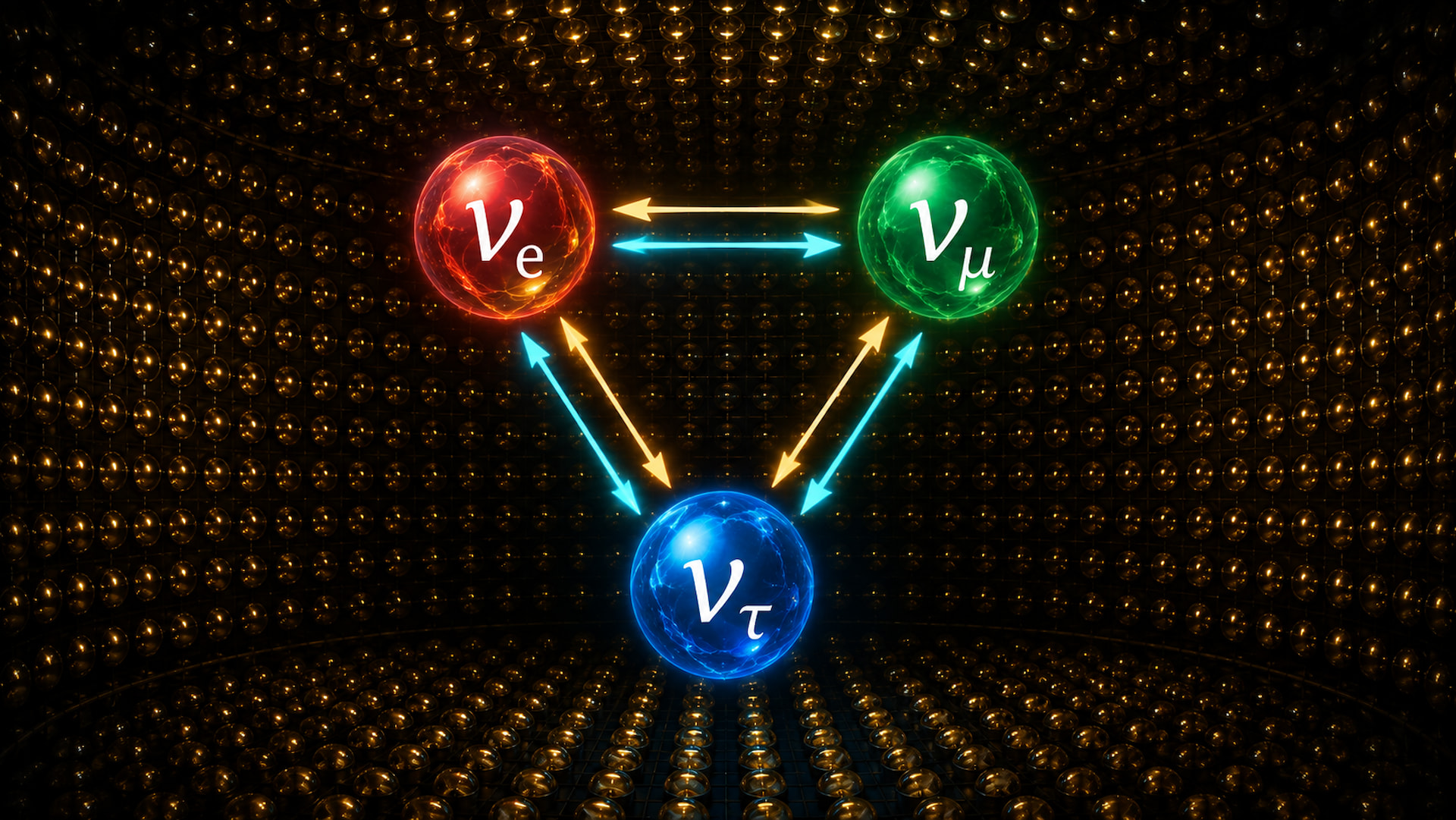
Neutrinos are produced in large quantities during some of the universe’s most explosive events, despite their elusiveness. Their ability to spontaneously flip between three types, or “flavors,” is one of their most peculiar characteristics. This phenomena is called neutrino oscillation, and it is still poorly understood in severe astrophysical conditions.
A team led by Ryuichiro Akaho at Waseda University in Tokyo and colleagues has discovered strong evidence through new research published in Physical Review Letters that a particularly fast form of this switching, known as “fast flavor conversion,” is crucial to whether or not a collapsing star explodes as a supernova.
Quick taste transformation
A proto-neutron star is a hot, dense object created when a large star runs out of nuclear fuel and its core collapses due to gravity. If the shockwave from the collapse is powerful enough, it can blow the star apart in a core-collapse supernova.
The primary source of this energization is the neutrinos created in the collapsing core, but only specific flavors will interact with the surrounding matter sufficiently to heat it up. Neutrino oscillation is therefore crucial to the process; if neutrinos change their flavors at the wrong time, the heating may falter and the explosion would fail.
Modeling collapse
To investigate, Akaho’s team built theoretical models of collapsing stars across a range of masses. Within their models, they incorporated a detailed treatment of fast flavor conversion into simulations that track how neutrinos travel and interact in all directions.
This approach was far more computationally demanding than standard methods—but it allowed the team to capture the distribution of neutrinos in much greater detail, and with fewer assumptions baked in.
Through their calculations, the researchers found that the outcome was closely tied to how quickly material is falling inward onto the proto-neutron star: a quantity called the “mass accretion rate.” When the accretion rate is low, fast flavor conversion boosts the energy deposited by neutrinos and helps drive an explosion. In contrast, when it is high, the conversion reduces the overall neutrino output enough to suppress an explosion instead.
A cautionary message
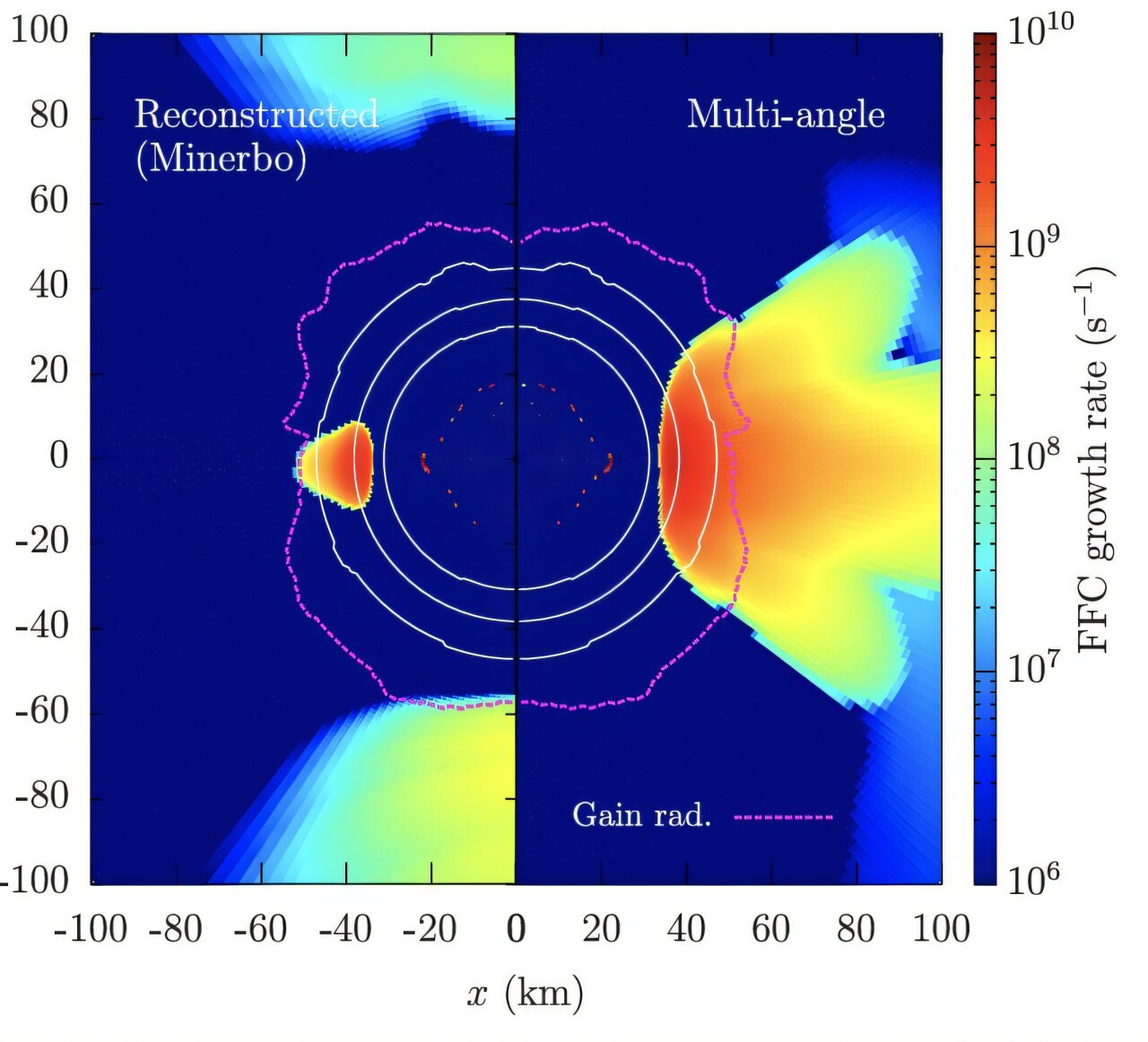
Akaho’s team found that simpler, less detailed treatments of neutrino behavior can both miss genuine fast flavor conversion, and predict its generation where it doesn’t actually occur—potentially distorting predictions of whether a star explodes or quietly collapses.
For astronomers, the findings suggest ultimately that capturing the true role of neutrino oscillation in stellar explosions will demand more sophisticated models, even at considerable computational cost.
IMAGE: Modeling fast flavor conversion following a core-collapse supernova. Credit: Ryuichiro Akaho et al