How Neutrino Oscillation Teaches Us Energy Is Never Lost
One of physics' longest-running mysteries began with a simple mismatch between prediction and observation.
In the 1960s, a chemist named Ray Davis and a theoretical physicist named John Bahcall set out to test something that seemed, on paper, like it should have been straightforward. Physicists understood, in reasonable theoretical detail, how the Sun generates its energy: nuclear fusion in its core, hydrogen fusing into helium, releasing energy and, as a byproduct, neutrinos, ghostly particles that stream outward from the Sun in staggering numbers. Bahcall’s models produced a specific, confident prediction for how many of these solar neutrinos should be detectable at Earth. Davis built an experiment to check that number directly.
The setup was unusual by any standard. A hundred thousand gallons of cleaning fluid, sitting in a tank nearly a mile underground in a South Dakota mine, shielded from the cosmic ray interference that would otherwise swamp the signal. When a neutrino from the Sun struck a chlorine atom in that fluid the right way, it would convert into a detectable atom of argon, and counting those argon atoms would tell you how many neutrinos had actually passed through.
The count came back at roughly one-third of what Bahcall’s models predicted. Not close. Not within any reasonable margin of experimental error. Two-thirds of the neutrinos the Sun should have been producing simply weren’t showing up.
This became known as the solar neutrino problem, and it sat there, essentially unresolved, for decades. There were only two plausible explanations, and both carried real weight. Either Bahcall’s solar models, built on a well-established and carefully tested understanding of stellar physics, contained some significant error nobody had caught. Or Davis’s detector, painstakingly built and calibrated, was missing something in its design. Physicists spent years testing both possibilities against each other, refining the models, cross-checking the experimental method, and neither side backed down. The solar physics kept holding up under scrutiny. The detector kept performing exactly as it should. And still, year after year, only a third of the expected neutrinos ever arrived.
As it eventually turned out, both sides had been right all along. Neither the models nor the detector was flawed. The neutrinos themselves were doing something nobody had anticipated.
The Explanation: How Oscillation Actually Works
The next real clue came from a completely different direction. Instead of looking at neutrinos from the Sun, physicists studied atmospheric neutrinos, produced when cosmic rays from deep space slam into Earth’s upper atmosphere and trigger cascades of particle decay. These cascades produce a different flavor of neutrino, called muon neutrinos, distinct from the electron neutrinos that dominate solar output.
Detectors built to study atmospheric neutrinos found a similar deficit, though not an identical one. Roughly two-thirds of the predicted rate showed up rather than the full amount, a different ratio than the solar case, but unmistakably related in shape. Two independent shortfalls, from two completely different sources, both pointing at something structural rather than a mistake specific to one experiment.
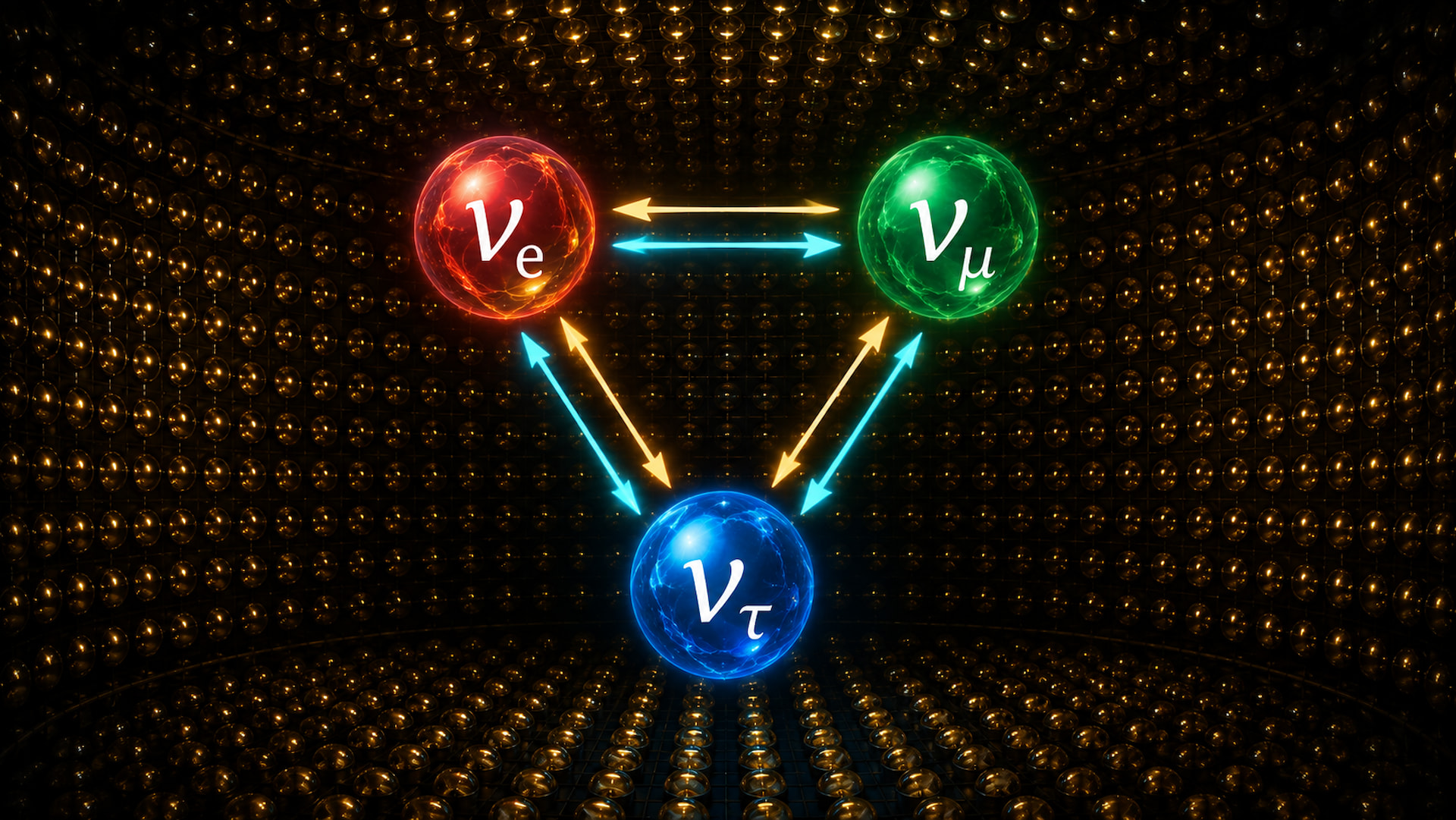
The resolution, confirmed decisively around the turn of the millennium through major detectors including Japan’s Super-Kamiokande and Canada’s Sudbury Neutrino Observatory, rewrote something physicists had long assumed to be settled. Neutrinos are not massless, as the original Standard Model of particle physics had held. They carry real, if extremely small, mass. And because they have mass, they can oscillate, shifting between three distinct flavors, electron, muon, and tau, as they travel through space.
A neutrino generated in the Sun’s core as an electron neutrino doesn’t necessarily arrive at Earth still identifiable as one. By the time it reaches a detector, it may have partially become a muon or tau neutrino instead, a flavor the original chlorine-based detector wasn’t built to catch. The neutrinos hadn’t disappeared. They’d changed identity along the way, and account for all three flavors together rather than just one, and the numbers finally line up correctly.
Here’s where the physics asks for real care, because the resolution depends on a distinction that’s genuinely subtle. A neutrino’s mass and a neutrino’s flavor are not quite the same property, even though it’s tempting to treat them as interchangeable labels. In quantum mechanical terms, what’s called a flavor eigenstate, the electron, muon, or tau identity a neutrino displays when it interacts with something, is actually a superposition of three separate mass eigenstates, each corresponding to a distinct, fixed mass value. As a neutrino propagates through space, its mass stays constant, unchanging for the entire journey.
What shifts is the relative quantum phase between the three mass components underlying its flavor identity, and that shift changes the probability of which flavor an observer will measure if they intercept the particle at any given point along the way. A neutrino is created with a specific flavor, travels with a fixed mass, and can be detected as any of the three flavors, with the odds evolving continuously over distance and time. And critically, this oscillation is only permitted between flavor states when there’s enough energy available in the interaction to cover whatever mass difference is involved. Nature doesn’t hand out flavor transitions for free. It checks the balance first, every time.
This discovery, that neutrinos have mass and oscillate between flavors, remains one of the only confirmed experimental results pointing to physics beyond the Standard Model, a genuinely significant marker in a field not known for easy answers.
Why This Matters Beyond the Detector
Step back from the specific mechanics of oscillation for a moment, and consider something that’s easy to lose track of in the middle of an explanation this technical: neutrinos aren’t some rare phenomenon confined to the Sun’s core, upper-atmosphere cosmic ray showers, and a handful of specialized underground detectors built specifically to catch them.
They are constant, and they are everywhere. Billions of neutrinos pass through every square centimeter of Earth, of buildings, of oceans, and of human bodies, every single second, almost entirely without interacting with anything they pass through. That’s not a rounding error or a figure of speech. It’s a literal, physically accurate description of the environment every person and every object on this planet exists inside, all the time, without exception.
It’s worth sitting with that for a moment, because it raises a genuinely strange question once you actually absorb it. Physicists spent the better part of a century developing increasingly elaborate methods just to detect neutrinos at all, building detectors buried in mines, filled with tons of specialized fluid, shielded from every conceivable form of interference, all in pursuit of catching a vanishingly small fraction of a phenomenon that is, by any reasonable measure, one of the most common physical events happening anywhere in the universe at any given moment. Something this constant, this universal, and this thoroughly documented by mainstream physics has mostly stayed confined to the world of particle detectors and research papers. It hasn’t, historically, been treated as something with any broader relevance to how energy moves through the world.
Introducing the Idea: What If Something This Present Could Be Useful?
That gap is worth asking a real question about. Neutrino physics isn’t limited to oscillation and mass. In 2017, the COHERENT experiment at Oak Ridge National Laboratory achieved the first confirmed observation of a related but distinct phenomenon called coherent elastic neutrino-nucleus scattering, a process theoretically predicted decades earlier but never directly observed until that point.
Unlike oscillation, which concerns how a neutrino’s flavor identity shifts over distance, coherent elastic scattering describes how a neutrino can interact with an entire atomic nucleus at once, rather than with an individual proton or neutron inside it, producing a small but measurable recoil. The result gave physicists a genuinely new, confirmed way to think about how neutrinos couple to ordinary matter, distinct from the oscillation story but part of the same broader picture of neutrinos as physically real, interacting, energy-carrying particles rather than purely theoretical constructs.
Put these pieces together, and an honest question starts to form. If a physical phenomenon this constant, this well-documented, and this thoroughly confirmed by independent experiments exists absolutely everywhere, all the time, is there any principled reason it couldn’t serve as one input, among several, in new approaches to energy conversion? Not a claim that it already does. Just a question worth taking seriously, given everything the physics above has established.
The Answer: Introducing the Neutrino® Energy Group
This is the question a company called the Neutrino® Energy Group has spent years working on, and it’s worth being precise about exactly what their answer is and isn’t.
The Neutrino® Energy Group is a global innovation ecosystem developing what it calls neutrinovoltaic technology, an approach to converting ambient environmental energy into continuous, usable electrical current. The key detail, and the one that matters most for scientific accuracy here, is that this technology doesn’t rely on neutrinos alone. It draws on a broader multi-channel ambient flux, electromagnetic field fluctuations, thermal gradients, and high-energy particle interactions collectively, of which neutrino activity is one contributing factor among several, not the sole mechanism. The conversion itself happens through graphene-based heterostructures paired with doped silicon nanostructures, engineered to couple with this combined ambient environment rather than attempting to isolate and capture any single particle interaction on its own.
To be clear about what this technology is not claiming: it isn’t harvesting neutrino oscillation energy directly, and oscillation itself isn’t the mechanism at work here. The physics explained in the first half of this piece, mass eigenstates, flavor oscillation, the resolution of the solar neutrino problem, is the scientific backdrop that makes clear just how real and constant neutrino activity actually is. The engineering in the second half is a separate, distinct effort, built on the broader premise that ambient energy in multiple forms, including but not limited to particle interactions, is present everywhere and worth taking seriously as a conversion target.
The company’s flagship device, the Neutrino Power Cube, is a compact, solid-state generator producing 5 to 6 kilowatts of continuous net output, with no fuel input and no dependence on sunlight or wind to keep running. It’s presented, appropriately, as a genuine engineering approach grounded in real physics, not as a device that has somehow “solved” neutrino capture in any dramatic or final sense. The honest framing is closer to this: given how much we now know is constantly happening in the space around us, largely unused, building serious engineering around that reality seems like a reasonable thing for someone to be trying.
What the Physics Actually Teaches Us
There’s a thread connecting everything in this piece, from Pauli’s reluctant hypothesis to the underground tanks in South Dakota to the graphene stacks inside a modern generator, and it has less to do with any specific technology than with a habit of mind. The same universe that conserves energy with extraordinary precision during neutrino oscillation, down to fractions of an electron-volt, checking the balance sheet at every single interaction without exception, is also, apparently, delivering usable energy flux to every point in space, constantly, whether or not anything happens to be built to make use of it.
For decades, an entire field of brilliant, careful scientists looked directly at a measurable phenomenon and concluded that something was simply missing. It wasn’t. It had just changed form in a way nobody had yet built the right instrument to see. That’s a genuinely humbling lesson about the limits of what we notice, and it applies well beyond particle physics. The universe rarely runs short. Most of the time, it’s simply been running on a frequency we hadn’t yet learned to tune in to.