Every Neutrino Carries the Story of a Dying Star
Somewhere within the Milky Way, another massive star is moving toward its final moments. Astronomers estimate that our galaxy experiences roughly two or three…
Somewhere within the Milky Way, another massive star is moving toward its final moments. Astronomers estimate that our galaxy experiences roughly two or three supernova explosions every century, making such an event statistically likely every 30 to 50 years. Yet the night sky has remained unusually quiet. The last Galactic supernova seen with the naked eye was observed by Johannes Kepler in 1604. Another explosion, now known as Cassiopeia A, occurred around 1680 but left no historical record, most likely because thick clouds of interstellar dust concealed its light.
This cosmic dust is one of astronomy’s greatest obstacles. The most massive stars live fast and die young, forming inside dense molecular clouds rich in gas and dust. When they explode, much of the visible light can be absorbed before it ever reaches Earth, leaving the event hidden from optical telescopes. Fortunately, light is not the only messenger produced during a stellar collapse.
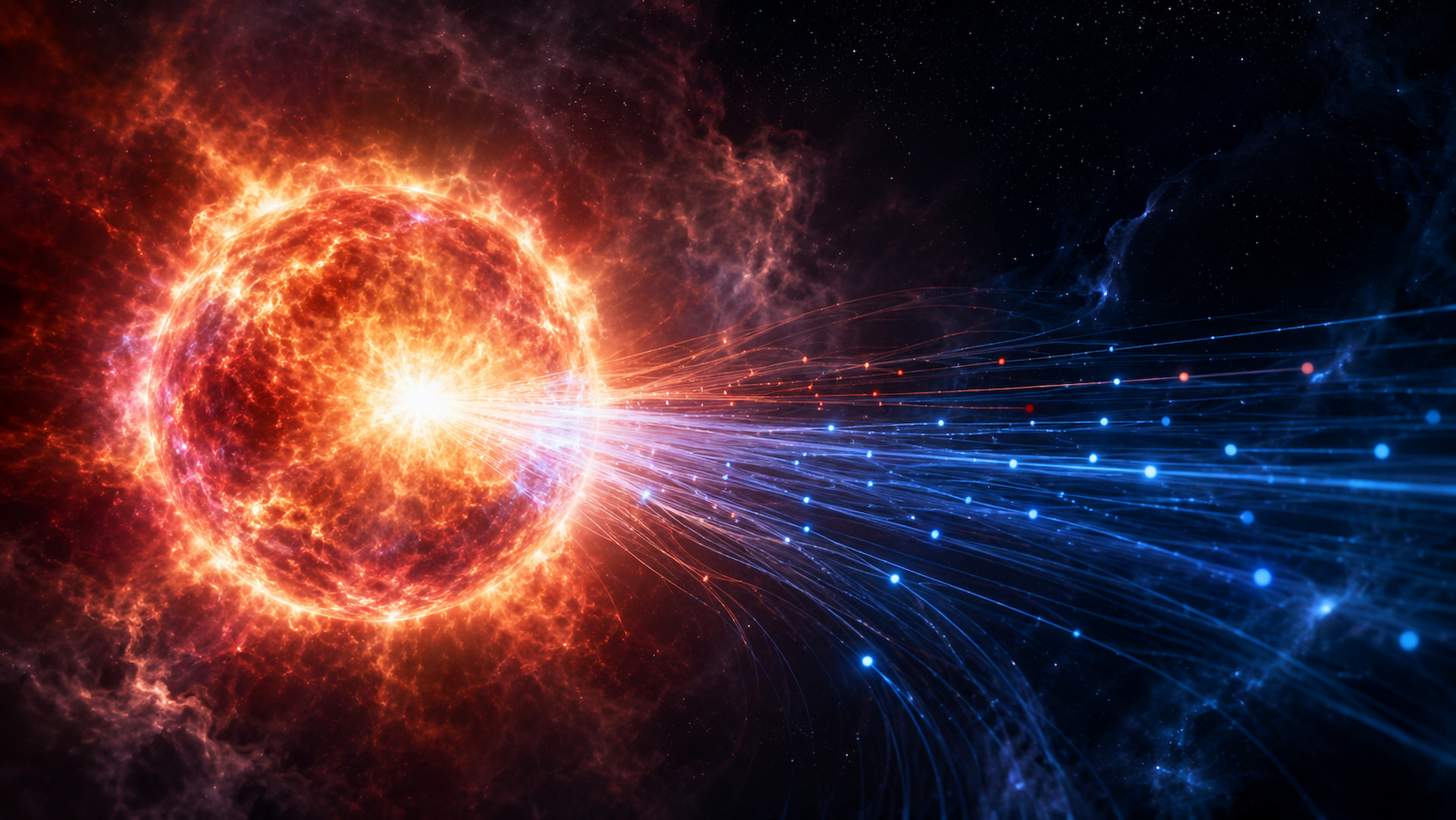
As a massive star’s core implodes, it creates an enormous burst of neutrinos. These nearly massless particles interact so weakly with matter that they travel through entire galaxies almost unhindered. Unlike visible radiation, neutrinos pass through dust without significant attenuation, making them remarkably effective signals of supernovae that would otherwise remain invisible. In many cases, they provide humanity’s earliest and clearest evidence that a star has died and a neutron star has been born.
The scientific value of supernova neutrinos became dramatically clear in 1987. That year, Supernova 1987A erupted within the Large Magellanic Cloud, a satellite galaxy orbiting the Milky Way approximately 168,000 light years from Earth. For me personally, those neutrinos marked the beginning of my research career. Their detection became the foundation of my first publication in astrophysics nearly four decades ago.
On February 23, 1987, detectors around the world recorded just 24 neutrinos from the explosion, almost all belonging to the electron flavor. Although the number seems remarkably small, it transformed astrophysics. Kamiokande II in Japan observed 11 events, the Irvine-Michigan-Brookhaven detector in the United States recorded 8, and Russia’s Baksan Observatory detected 5. These particles arrived within only 13 seconds. From this brief burst, researchers reconstructed the total energy released during the collapse, estimated the cooling timescale of the newborn neutron star, inferred its effective surface temperature and radius, and placed an upper limit on the mass of the electron neutrino by examining the arrival times of neutrinos with different energies.
The next Galactic supernova promises an entirely different scale of observation. Modern neutrino observatories are dramatically more capable than those operating in 1987, and the next explosion is expected to occur much closer than the Large Magellanic Cloud. Since neutrino intensity increases rapidly as distance decreases, even a typical supernova within the Milky Way would generate an enormously stronger signal at Earth.
Super-Kamiokande in Japan already possesses approximately ten times the fiducial detector volume of Kamiokande II. A core collapse occurring near the Galactic Center is expected to produce roughly 10,000 detected neutrino interactions instead of only 11. The Jiangmen Underground Neutrino Observatory, or JUNO, completed construction in China during 2025 and is designed to measure several thousand events with outstanding energy resolution. Its liquid scintillator technology provides information that complements water Cherenkov detectors by achieving greater precision in reconstructing neutrino energies.
Far beneath the Antarctic ice, IceCube contributes in an entirely different way. Rather than identifying individual neutrino interactions, it continuously monitors more than 5,000 optical sensors embedded throughout a cubic kilometer of ice. A Galactic supernova would cause a sudden collective increase in the detector’s background light rate, producing an unmistakable statistical signature within seconds.
Another major addition is close at hand. Hyper-Kamiokande, currently under construction in Japan, is expected to begin scientific observations after completion. With a detector volume exceeding eight times that of Super-Kamiokande, it should record tens of thousands of neutrino events from a supernova occurring within our galaxy, providing an unprecedented view of the collapse process.
The Deep Underground Neutrino Experiment, known as DUNE, adds yet another perspective. Unlike water and scintillator detectors, DUNE employs liquid argon, making it primarily sensitive to electron neutrinos instead of electron antineutrinos. This complementary detection channel allows scientists to reconstruct different aspects of the neutrino emission and greatly improves the overall scientific return when combined with observations from the global detector network. Its underground detector modules are currently being commissioned as the experiment advances toward full operation.
What could such a remarkable dataset reveal?
One of the most important measurements comes from comparing the arrival times of neutrinos spanning different energies. Because particles with finite mass travel at slightly different speeds, even tiny differences accumulated over thousands of light years can place stringent limits on neutrino masses or potentially measure them directly. At the same time, the total number of detected neutrinos provides an estimate of the energy released during the collapse, which corresponds to the gravitational binding energy liberated as the neutron star forms.
This binding energy depends on both the mass and the radius of the newborn neutron star. Meanwhile, the measured neutrino energy spectrum reflects the temperature of the emitting surface, which is itself determined by the star’s gravitational potential. Combining these independent observables enables astronomers to infer two of the most fundamental physical properties of the collapsed object: its mass and its radius.
The neutrino signal also carries information about particle physics. Neutrinos exist in three known flavors, electron, muon, and tau, and they continuously oscillate between these identities while traveling through space. Measuring how the flavor composition evolves over time allows researchers to refine models of neutrino oscillations, improve constraints on mixing parameters, and deepen our understanding of the extreme nuclear physics governing collapsing stellar cores.
A question that remained unresolved for decades concerned the fate of the compact remnant inside Supernova 1987A. Had the newly formed neutron star survived, or had it collapsed into a black hole?
Observations from the James Webb Space Telescope have now provided compelling evidence in favor of the neutron star scenario. Shortly after Webb began scientific operations in 2022, astronomers identified excess emission originating from the center of the expanding debris. The observations pointed to ionized argon within the ejecta, a signature consistent with the presence of a young neutron star. Subsequent Webb observations revealed shifts in the emission lines that indicate the compact object likely received a substantial recoil velocity during the asymmetric collapse, a phenomenon known as a natal kick.
The next Galactic supernova will be far more than an extraordinary astronomical spectacle. It will produce a torrent of neutrinos carrying information that no telescope observing visible light can provide. Those elusive particles will arrive before the explosion becomes visible, pass effortlessly through the dust that conceals the event, and deliver a detailed physical record of one of nature’s most violent transformations. In only a few fleeting seconds, they could answer questions that have challenged astrophysics for decades.