Massive Underground Water Tank 600 Meters Below Ground: How Scientists Detect Ghost Particles
Introduction: The Hidden World of Neutrinos Beneath the Earth Deep beneath the Earth’s surface, scientists have constructed enormous underground water…
On this page
Introduction: The Hidden World of Neutrinos Beneath the Earth
Deep beneath the Earth’s surface, scientists have constructed enormous underground water detectors designed to observe one of the most elusive particles in the universe: neutrinos, often referred to as ghost particles. These particles pass through ordinary matter almost undisturbed, making them extraordinarily difficult to detect.
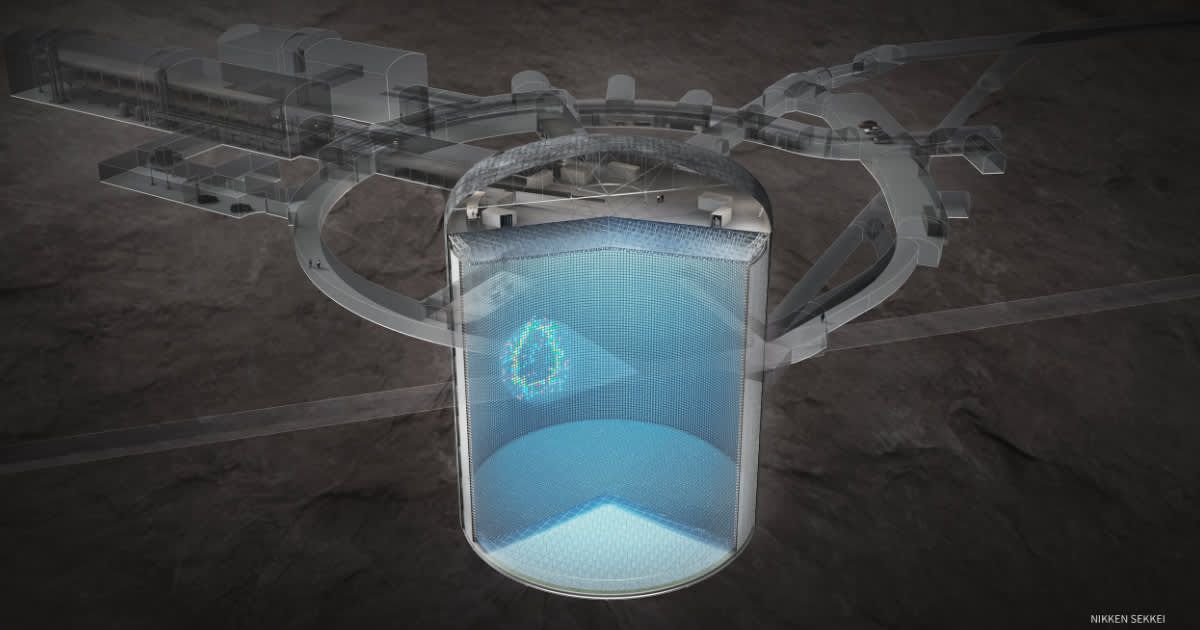
To solve this challenge, researchers built a massive water tank located roughly 600 meters underground, shielded by layers of rock that block cosmic radiation. Inside this detector, ultra-pure water and highly sensitive photodetectors allow scientists to observe the rare interactions of neutrinos with matter.
This facility represents one of the most sophisticated experimental environments in modern physics and plays a crucial role in advancing our understanding of the universe, from stellar explosions to the fundamental laws governing matter.
Why Scientists Place Neutrino Detectors Deep Underground
Shielding From Cosmic Radiation
At the Earth’s surface, detectors are constantly bombarded by cosmic rays and background radiation. These signals can overwhelm the faint traces left by neutrinos.
By placing the detector 600 meters underground, the surrounding rock acts as a natural shield that absorbs most of this unwanted interference. This dramatically improves the signal-to-noise ratio and allows physicists to isolate the extremely rare events caused by neutrino interactions.
Benefits of Underground Placement
-
Reduces background radiation by several orders of magnitude
-
Eliminates interference from cosmic-ray particles
-
Creates a stable environment for ultra-sensitive instruments
-
Enables long-duration particle observation experiments
Without this underground protection, detecting neutrinos would be nearly impossible.
The Massive Water Tank: Engineering a Detector for Ghost Particles
Ultra-Pure Water as the Detection Medium
The heart of the facility is a gigantic cylindrical tank filled with ultra-pure water. The water must be purified to an extraordinary level so that light signals from neutrino interactions are not scattered or absorbed.
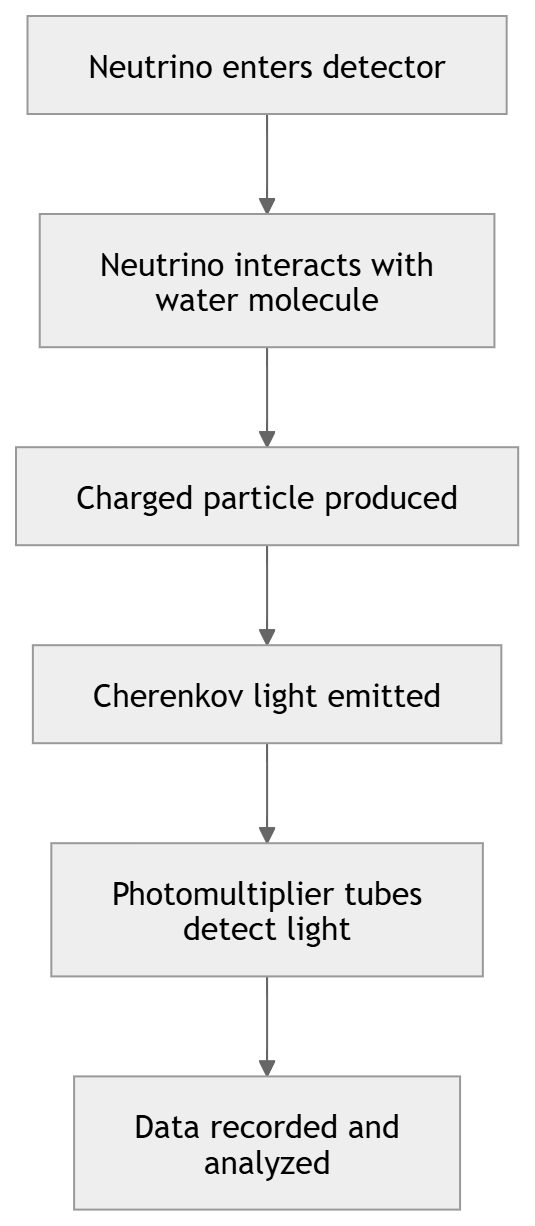
When a neutrino collides with a water molecule, it occasionally produces a charged particle that travels faster than light can move through water (though still slower than light in a vacuum). This phenomenon generates a faint flash of blue light known as Cherenkov radiation.
Thousands of ultra-sensitive detectors mounted along the tank walls capture these flashes.
Key Specifications of the Underground Water Tank
-
Located approximately 600 meters underground
-
Contains tens of thousands of tons of purified water
-
Equipped with thousands of photomultiplier tubes (PMTs)
-
Designed to detect extremely rare neutrino interactions
These components transform a simple water reservoir into one of the most advanced particle detectors ever built.
How Neutrinos Interact Inside the Detector
The Cherenkov Light Detection Process
Neutrinos normally pass through Earth without interacting. However, when a neutrino does collide with a nucleus in water, the interaction produces charged particles that emit Cherenkov light.
Massive Underground Water Tank 600 Meters Below Ground: How Scientists Detect Ghost Particles
This process allows researchers to reconstruct the energy, direction, and type of neutrino that caused the event.
Understanding Ghost Particles: What Are Neutrinos?
The Most Elusive Particles in Physics
Neutrinos are fundamental particles produced in enormous quantities by natural processes across the universe. Despite their abundance, they interact so weakly with matter that trillions pass through the human body every second without leaving a trace.
Primary Sources of Neutrinos
-
Nuclear reactions inside the Sun
-
Supernova explosions
-
Cosmic ray collisions in the atmosphere
-
Nuclear reactors
-
Particle accelerators
Because neutrinos rarely interact with matter, they carry pristine information about the environments where they were created.
Why a 600-Meter-Deep Detector Matters for Physics
Unlocking the Secrets of the Universe
Deep underground neutrino detectors allow scientists to investigate some of the most fundamental questions in physics.
Major Scientific Goals
1. Understanding Neutrino Oscillations
Neutrinos change identities as they travel, switching between three known types. Studying these oscillations helps reveal their masses and properties.
2. Studying Supernova Explosions
When a massive star collapses, it releases a burst of neutrinos. Detecting these signals helps scientists study stellar death and element formation.
3. Searching for Proton Decay
Some grand unified theories predict that protons can decay over extremely long timescales. Massive water detectors are ideal tools for observing such rare events.
4. Exploring Physics Beyond the Standard Model
Neutrino experiments may reveal phenomena not explained by current particle physics theories.
The Technology Behind Photomultiplier Tubes
Detecting the Faintest Light Signals
The walls of the water tank are lined with photomultiplier tubes, sophisticated sensors capable of detecting individual photons.
These devices amplify extremely faint light signals produced by Cherenkov radiation.
How Photomultiplier Tubes Work
-
Incoming photons strike a photosensitive surface
-
Electrons are released via the photoelectric effect
-
Electrons are multiplied through a series of dynodes
-
A measurable electrical signal is produced
This amplification allows scientists to detect incredibly weak flashes of light from neutrino interactions.
Data Analysis: Reconstructing Neutrino Events
Turning Light Signals Into Particle Physics
When Cherenkov light reaches the photomultiplier tubes, the timing and intensity of each signal are recorded.
Using advanced computational algorithms, researchers reconstruct the particle event.
Key Data Extracted From Each Detection
-
Direction of incoming neutrino
-
Energy of the interaction
-
Type of particle produced
-
Interaction location inside the detector
Large datasets accumulated over years allow physicists to identify patterns and discover new phenomena.
Global Importance of Deep Underground Neutrino Experiments
A Cornerstone of Modern Astroparticle Physics
Massive underground detectors are part of a worldwide network of neutrino observatories. Together, they form a global infrastructure for studying the universe using particles rather than light.
These facilities help scientists:
-
Observe cosmic events invisible to telescopes
-
Study the inner workings of stars
-
Test fundamental physical laws
-
Explore the earliest moments of the universe
The underground water tank located 600 meters below ground is therefore far more than a scientific instrument—it is a window into the deepest mysteries of nature.
Conclusion: A Hidden Laboratory Exploring the Universe
Deep beneath layers of rock, the massive underground water tank serves as one of humanity’s most powerful tools for studying ghost particles. By shielding detectors from cosmic interference and using ultra-pure water to capture faint flashes of Cherenkov radiation, scientists can observe neutrinos that travel across galaxies.
These underground observatories are reshaping our understanding of particle physics, astrophysics, and the evolution of the universe. As detection technologies improve and data accumulates, the insights gained from these hidden laboratories will continue to push the boundaries of modern science.