The Hidden Decision Behind a Star’s Final Moments
Across the universe, massive stars spend millions of years forging elements in their fiery interiors.
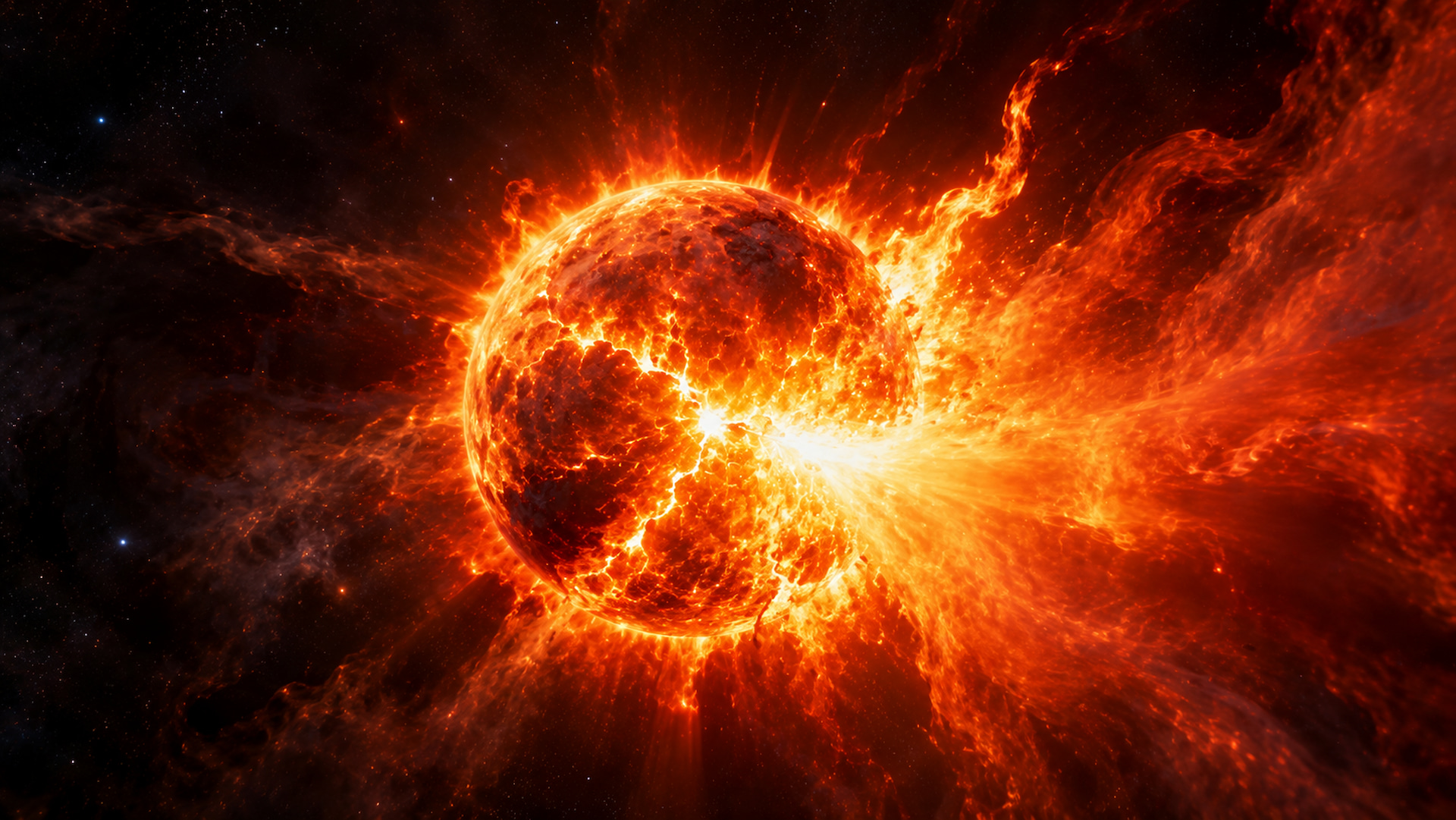
Across the universe, massive stars spend millions of years forging elements in their fiery interiors. Yet when their nuclear fuel is exhausted, their endings diverge dramatically. Some unleash titanic supernova explosions that outshine entire galaxies. Others collapse into darkness with surprisingly little fanfare. For decades, astronomers have searched for the mechanism that separates these two destinies.
A growing body of research points toward an unlikely arbiter: the neutrino.
Tiny Particles, Enormous Consequences
Neutrinos are among the most elusive particles known to science. They pass through planets, stars, and even human bodies almost without interaction. Despite their ghostlike nature, they play a central role during the death of massive stars.
These particles exist in three distinct forms, known as electron, muon, and tau neutrinos. Remarkably, they are not locked into a single identity. As they travel, they can transform from one type into another through a process physicists call flavor oscillation.
Inside a collapsing star, these transformations may influence whether a supernova is born or extinguished before it begins.
A Delicate Balance of Energy
When the core of a massive star collapses, an outward-moving shock wave is created. In theory, this shock should trigger the stellar explosion. In practice, however, the shock often loses momentum and begins to stall.
Neutrinos help determine whether it can recover.
Only certain neutrino flavors transfer energy efficiently to the dense matter surrounding the stellar core. If enough energy is deposited into this region, the shock wave can regain strength and continue outward. If that energy transfer falls short, the collapse may proceed without producing a successful explosion.
The timing of flavor transformations therefore becomes critically important.
A Process Faster Than Current Models Can Track
Researchers led by Ryuichiro Akaho of Waseda University investigated an especially extreme form of neutrino behavior known as rapid flavor conversion.
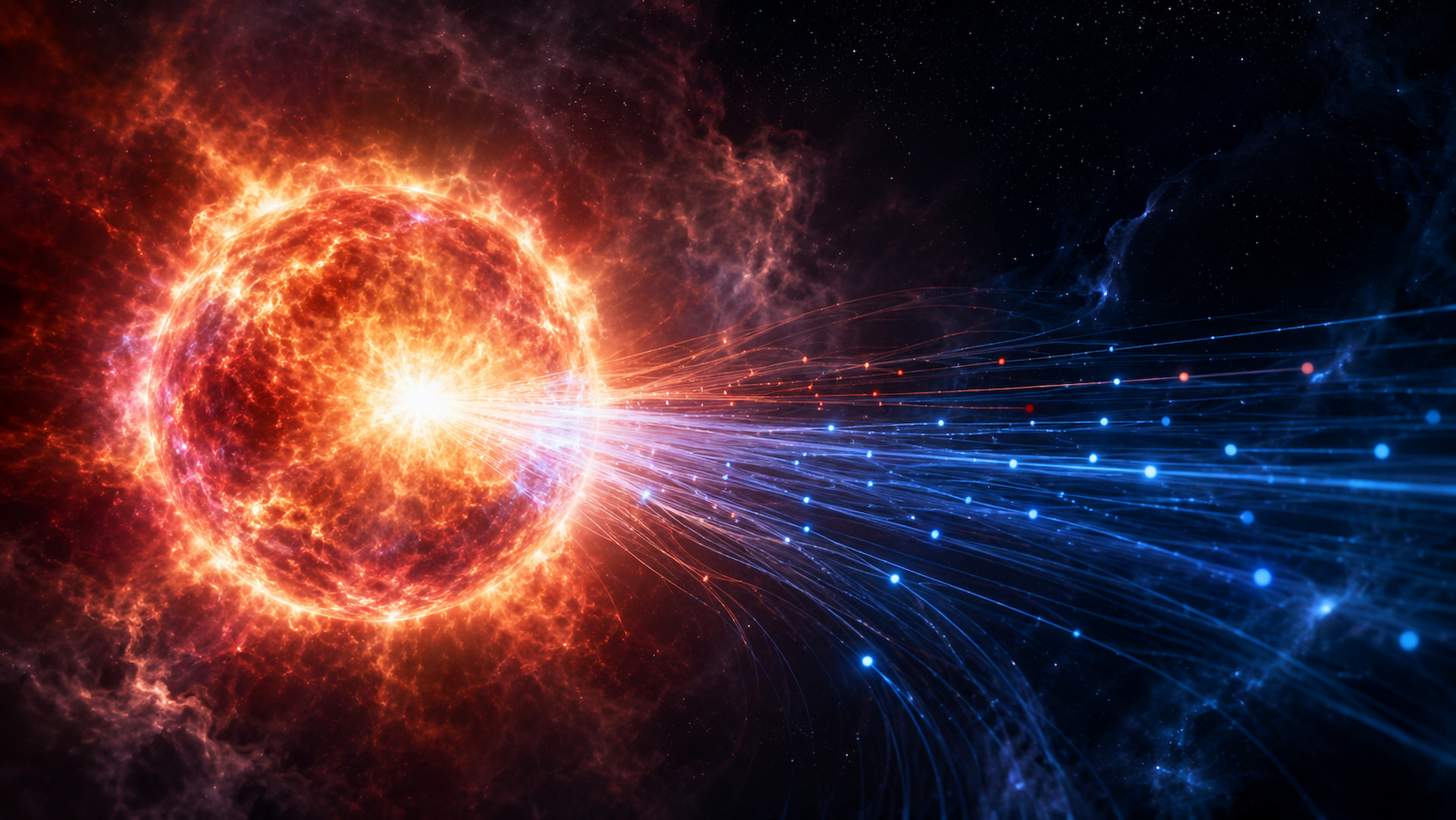
Under the extraordinary conditions present during core collapse, immense numbers of neutrinos stream away from the stellar interior. Rather than oscillating independently, these particles can begin changing flavor collectively, creating a highly synchronized transformation process.
The phenomenon unfolds at astonishing speed. It occurs over distances measured in centimeters and on timescales of mere nanoseconds. Such scales remain beyond the reach of most existing supernova simulations, making the process exceptionally difficult to study directly.
When Mass Changes Everything
To explore the problem, the research team constructed detailed theoretical models representing stars with different masses. Their calculations incorporated sophisticated treatments of neutrino transport and flavor conversion, allowing them to examine how these effects evolve throughout the collapse.
The results, published in Physical Review Letters, reveal that the rate at which matter falls onto the newly formed protoneutron star plays a decisive role.
When accretion rates are relatively low, rapid flavor conversion increases heating behind the shock wave, improving the chances that a supernova will emerge. Under heavier accretion conditions, however, the same mechanism can reduce the available neutrino energy and make an explosion less likely.
In other words, the very process that can rescue one dying star may doom another.
Why Precision Matters
The study also exposed a significant weakness in many simplified computational approaches. Approximate models can misrepresent neutrino behavior, sometimes predicting flavor conversions that never occur and sometimes overlooking transformations that are actually present.
Such inaccuracies can fundamentally alter predictions about stellar explosions.
The findings suggest that future supernova research will require substantially more detailed simulations and far greater computational power. Capturing the true behavior of neutrinos may be essential for understanding one of the universe’s most spectacular events.
As astrophysicists continue refining their models, the message is becoming increasingly clear: the difference between a brilliant cosmic explosion and a silent collapse may depend on the fleeting transformations of particles so small that they are almost impossible to detect.