Ghostly Particles Revealed: How Dark Matter May Have Masqueraded as Neutrinos
A Breakthrough in Particle Physics and Cosmology We are entering a transformative era in modern physics, where long-standing mysteries surrounding dark matter…
On this page
A Breakthrough in Particle Physics and Cosmology
We are entering a transformative era in modern physics, where long-standing mysteries surrounding dark matter and neutrinos are converging into a single, compelling narrative. Recent research suggests that what we once confidently identified as neutrinos—those elusive, nearly massless particles—may in fact conceal signals from dark matter itself. This revelation reshapes our understanding of the universe’s invisible architecture and opens new frontiers in experimental physics.
Understanding Neutrinos: The Universe’s Most Elusive Messengers
Neutrinos are fundamental particles known for their incredibly weak interactions with matter. Produced in vast quantities by nuclear reactions in stars, supernovae, and even human-made reactors, they pass through ordinary matter almost undisturbed.
Key Properties of Neutrinos
- Extremely low mass
- No electric charge
- Interact only via the weak nuclear force and gravity
- Exist in three known flavors: electron, muon, and tau
For decades, neutrinos have been detected in underground observatories designed to shield sensitive instruments from background noise. These detectors rely on rare interactions between neutrinos and atomic nuclei, producing faint but measurable signals.
Dark Matter: The Invisible Mass Shaping the Cosmos
Dark matter constitutes approximately 27% of the universe, yet it remains undetectable through direct electromagnetic observation. Its presence is inferred through gravitational effects on galaxies, galaxy clusters, and cosmic microwave background radiation.
Characteristics of Dark Matter
- Does not emit, absorb, or reflect light
- Interacts primarily through gravity
- Essential for galaxy formation and structure stability
The challenge has always been detection. Despite decades of effort, dark matter particles have evaded direct observation—until now, possibly hidden in plain sight.
The Overlap: When Dark Matter Mimics Neutrinos
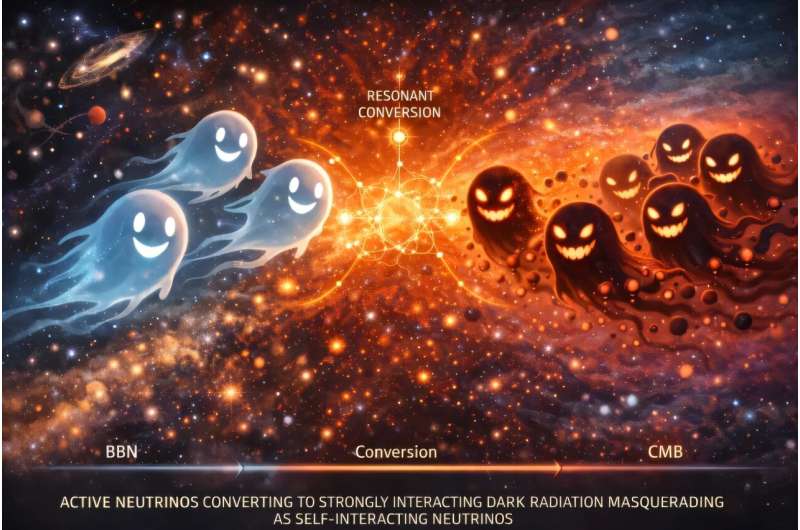
Recent theoretical and experimental developments indicate that certain dark matter candidates can produce signals indistinguishable from neutrinos in detectors. This phenomenon, often referred to as the “neutrino floor,” represents a sensitivity threshold where neutrino interactions become a dominant background noise in dark matter searches.
Mechanism of Masquerading
Dark matter particles, particularly weakly interacting massive particles (WIMPs) or lighter candidates, may scatter off nuclei in ways that closely resemble neutrino interactions. As detectors become more sensitive, distinguishing between these two becomes increasingly difficult.
Why This Matters
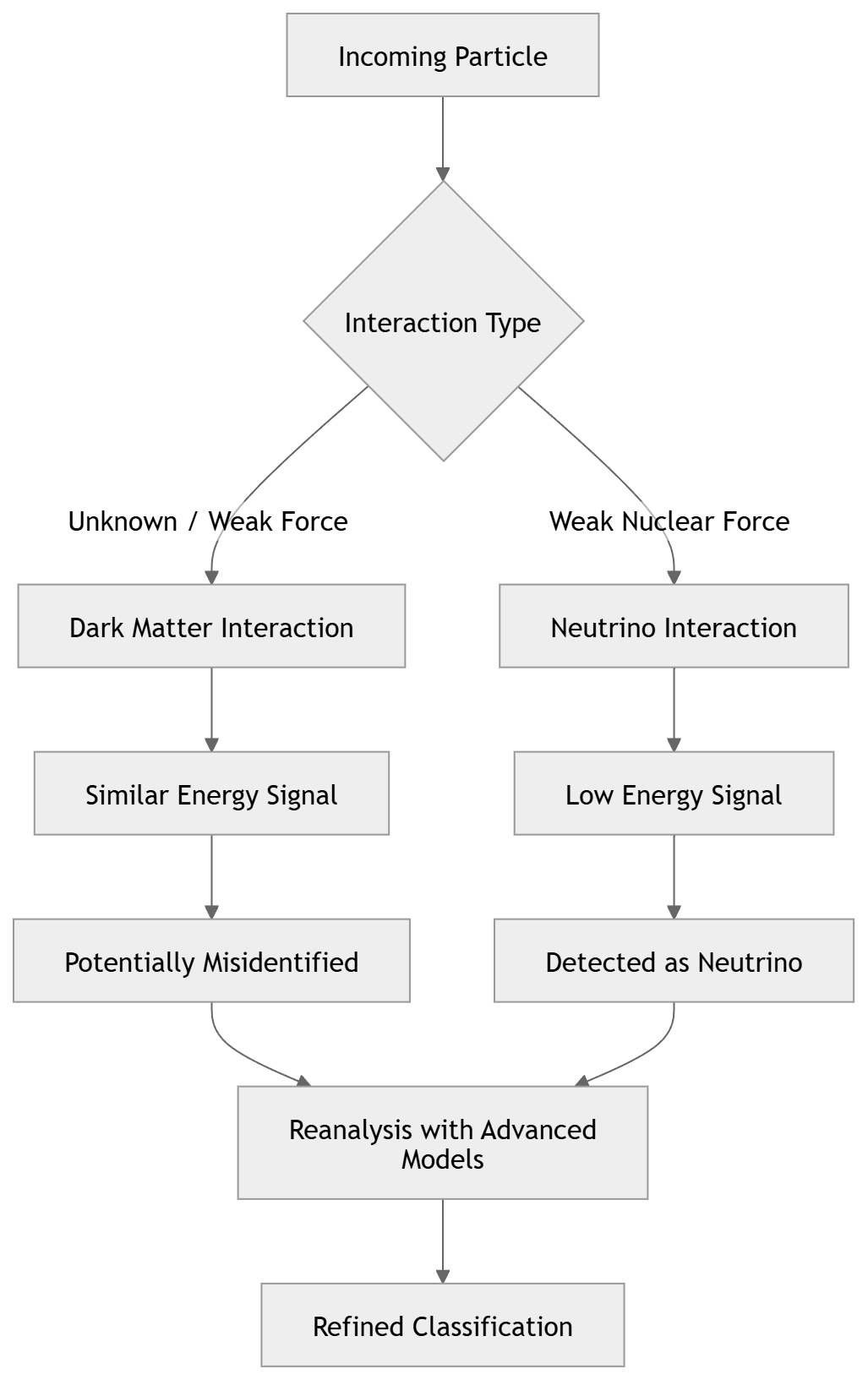
- Past neutrino detections may include hidden dark matter signals
- Existing data requires reanalysis with new models
- Future detectors must incorporate advanced discrimination techniques
Experimental Evidence and Detector Implications
Cutting-edge experiments using ultra-sensitive detectors have begun to observe anomalies that cannot be fully explained by standard neutrino models. These include unexpected energy distributions and interaction rates.
Leading Detection Technologies
- Cryogenic detectors measuring phonon and ionization signals
- Liquid xenon time projection chambers
- Scintillation-based neutrino observatories
These systems are now being recalibrated to account for potential dark matter overlap.
A New Framework for Particle Identification
To resolve the ambiguity between neutrinos and dark matter, researchers are developing hybrid detection models combining directional sensitivity, timing resolution, and multi-channel data analysis.
Key Innovations
- Directional detectors to trace particle origin
- Machine learning algorithms for signal classification
- Cross-correlation between multiple detector types
Diagram: Interaction Pathways of Neutrinos vs Dark Matter
Implications for Cosmology and Fundamental Physics
This paradigm shift has far-reaching consequences:
- Reevaluation of neutrino data archives
- Redefinition of dark matter detection strategies
- Potential discovery of new particle classes
The boundary between known and unknown physics is becoming increasingly blurred, suggesting that our current models are only approximations of a deeper, unified framework.
Future Directions: Toward Definitive Detection
We are now focusing on next-generation detectors with enhanced sensitivity and discrimination capabilities. These include:
- Deep underground laboratories with reduced background interference
- Space-based observatories for cosmic particle detection
- Global collaborations integrating data across experiments
The goal is not just to detect dark matter, but to definitively distinguish it from neutrino backgrounds.
Unmasking the Universe’s Hidden Particles
We stand at the threshold of a major scientific breakthrough. The possibility that dark matter has been masquerading as neutrinos challenges decades of assumptions and compels us to rethink the very fabric of the cosmos. By refining our detection methods and embracing new theoretical models, we move closer to uncovering the true nature of the universe’s most enigmatic components.