Breakthroughs in Neutrino Mass: Precision Physics at the Edge of the Universe
Advancing the Frontier of Neutrino Physics We are entering a decisive era in particle physics, where the elusive neutrino—once thought to be massless—has…

On this page
Advancing the Frontier of Neutrino Physics
We are entering a decisive era in particle physics, where the elusive neutrino—once thought to be massless—has become central to understanding the fundamental structure of the universe. Recent experimental and theoretical advances are sharpening our ability to determine the neutrino mass scale with unprecedented precision. These developments are not incremental; they represent a convergence of cutting-edge instrumentation, cosmological observation, and quantum theory.
Why Neutrino Mass Matters for Modern Physics
Neutrinos are among the most abundant particles in the universe, yet they interact so weakly that they pass through ordinary matter almost undetected. Determining their mass is essential because it:
- Challenges the Standard Model of particle physics
- Influences large-scale cosmic structure formation
- Provides clues about physics beyond known frameworks
- Affects the evolution of galaxies and dark matter distribution
Even a tiny neutrino mass has profound cosmological implications.
Experimental Breakthroughs in Measuring Neutrino Mass
Direct Measurement via Beta Decay Experiments
State-of-the-art beta decay experiments are pushing sensitivity limits to directly measure neutrino mass. These experiments analyze the energy spectrum of electrons emitted in nuclear beta decay, particularly near the endpoint.
Key advancements include:
- Ultra-high resolution spectrometers
- Cryogenic detector systems
- Reduced background noise through vacuum isolation
The precision achieved now approaches sub-electronvolt (eV) levels, narrowing the possible mass window significantly.
Neutrinoless Double Beta Decay: A Gateway to Majorana Physics
The search for neutrinoless double beta decay is redefining our understanding of neutrino identity. If observed, this process would confirm that neutrinos are Majorana particles—identical to their antiparticles.
Implications include:
- Direct constraints on absolute neutrino mass
- Insight into matter-antimatter asymmetry
- Evidence for lepton number violation
Experiments are now reaching sensitivities capable of probing half-lives beyond 10²⁶ years.
Cosmological Constraints from Large-Scale Structure
Cosmology provides complementary constraints on neutrino mass through observations of:
- Cosmic Microwave Background (CMB)
- Galaxy clustering
- Weak gravitational lensing
Massive neutrinos suppress the growth of cosmic structures on small scales. Precision cosmological datasets now constrain the sum of neutrino masses to fractions of an electronvolt.
Theoretical Framework: Beyond the Standard Model
Neutrino mass cannot be explained within the original Standard Model. We rely on extended frameworks such as:
Seesaw Mechanism
The seesaw mechanism introduces heavy right-handed neutrinos, explaining the small observed masses through a natural suppression effect.
mν≈mD2MRm_\nu \approx \frac{m_D^2}{M_R} mν≈MRmD2
Where:
- mνm_\numν: light neutrino mass
- mDm_DmD: Dirac mass term
- MRM_RMR: heavy Majorana mass scale
Flavor Oscillation and Mass Eigenstates
Neutrinos exist in flavor states (electron, muon, tau) but propagate as mass eigenstates. Oscillation experiments measure differences in squared masses, not absolute values.
This leads to two possible hierarchies:
- Normal hierarchy (lighter electron neutrino)
- Inverted hierarchy (heavier electron neutrino)
Resolving this ordering remains a top priority.
Integrated Experimental Strategy
We now operate within a multi-pronged strategy combining direct detection, rare decay searches, and cosmological observation.
Unified Measurement Pipeline
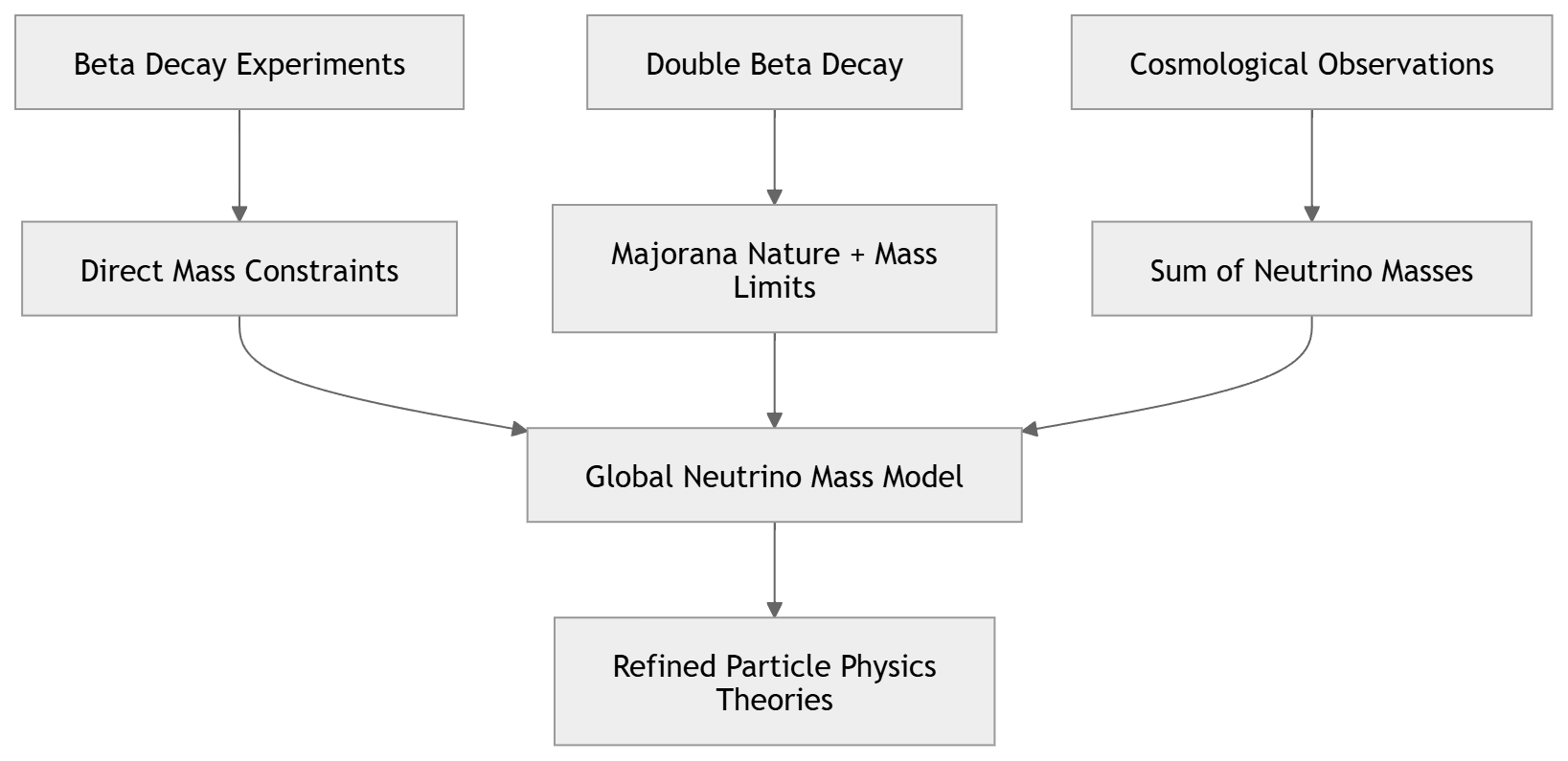
This integrated approach ensures cross-validation and eliminates systematic bias across methods.
Technological Innovations Driving Progress
Recent progress is driven by breakthroughs in:
- Superconducting sensor arrays
- Quantum-limited amplifiers
- Ultra-low temperature cryogenics
- High-performance data analysis using AI
These innovations enable detection of extremely rare events with remarkable fidelity.
Implications for Cosmology and Particle Physics
As neutrino mass constraints tighten, we refine our understanding of:
- Dark matter composition
- Early universe thermodynamics
- Inflationary models
- Baryon asymmetry mechanisms
Neutrinos act as a bridge between quantum physics and cosmology, linking the smallest and largest scales in nature.
Future Outlook: Toward Definitive Measurement
The next generation of experiments aims to:
- Achieve sensitivity below 0.1 eV
- Determine the mass hierarchy conclusively
- Detect neutrinoless double beta decay
- Integrate astrophysical neutrino observations
Global collaborations and next-generation observatories will push the limits further, transforming neutrino physics into a precision science.
Precision Era of Neutrino Science
We are witnessing a paradigm shift in how neutrino mass is measured and understood. Through coordinated experimental and theoretical advances, we are closing in on one of the most fundamental parameters in physics. The resolution of the neutrino mass problem will not only complete a missing piece of the Standard Model but will also unlock new physics that reshapes our understanding of the universe.
CREDIT: KNOWABLE MAGAZINE