Vitamin N: The One Thing Your Body Gets Whether You Want It or Not
The wellness world already has a language for invisible necessities. Vitamin D comes from sunlight.
The wellness world already has a language for invisible necessities. Vitamin D comes from sunlight. Vitamin N, in its usual meaning, is time in nature: trees, air, soil, water, a walk long enough to quiet the nervous system. The advice is familiar. Go outside. Let the world touch you.
But there is another kind of contact that does not wait for permission, weather, daylight, mood, season, or lifestyle. It reaches you indoors. It reaches you underground. It reaches you at midnight, in winter, through concrete, through the walls around you, and even through the Earth from the other side.
Neutrinos are passing through you right now. Many billions cross every square centimetre each second. Across the area of a human body, the number rises into the trillions. They come from the Sun, from radioactive decay inside the Earth, from cosmic processes, and from stars that died before the solar system existed. They pass through your neurons, blood, lungs, bones, and skin without asking anything of you. You do not need to go outside to receive them. You cannot go anywhere to avoid them.
Call it Vitamin N if the joke helps. The serious question is better than the joke: does any of this matter to you biologically?
The honest answer is that we do not know. More precisely, we do not know because the question has hardly been asked in a way modern physics would consider precise. That is the interesting part.
The Particle That Cannot Be Excluded
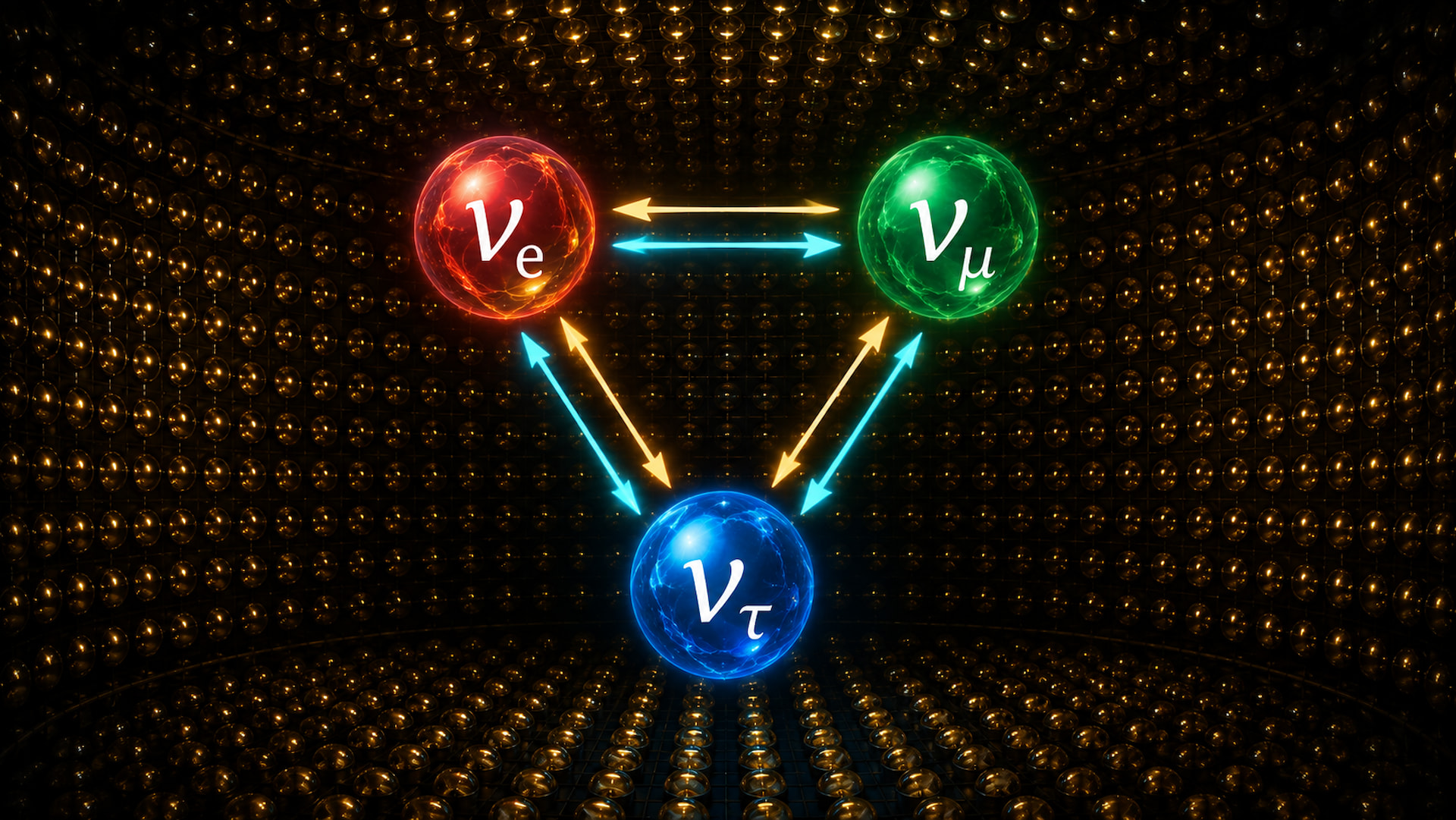
Neutrinos are among the most abundant particles in the universe and among the most difficult to notice. They carry no electric charge, interact only through gravity and the weak nuclear force, and pass through ordinary matter with almost theatrical indifference. The 2015 Nobel Prize in Physics recognised the discovery of neutrino oscillation, which showed that neutrinos have mass. It is a tiny mass, but mass matters. Mass means momentum. Momentum means that when an interaction occurs, something physical is transferred.
The difficulty is that interactions are extraordinarily rare. Hans Bethe and Rudolf Peierls estimated in the 1930s that the cross-section for a low-energy neutrino process was below about 10^-44 square centimetres. That number helped establish the ordinary intuition that neutrinos pass through matter as if matter were not there.
That formulation is almost true. Almost.
Statistically, a solar neutrino may interact with an atom in your body on timescales often described in years rather than seconds. Depending on the assumptions used, one can find estimates on the order of one interaction every several years to a few decades for a human body. That sounds close to nothing. But it is not literally nothing. Across a lifetime, a person may host several genuine neutrino interactions, each involving a real particle, a real transfer of momentum, and a real atomic nucleus inside living tissue.
This is not a health claim. It is a physics claim. The difference matters. A physical event inside a cell does not automatically become a biological effect. Cells are full of physical events: thermal motion, chemical reactions, ion movements, molecular collisions, radiation backgrounds, electrical gradients. Biology is the art of ignoring almost all of them until a pathway, threshold, or feedback loop makes one matter.
The neutrino question sits exactly there. Not whether neutrinos are raining down in great numbers. They are. Not whether they can interact with matter. They can. The question is whether any biological system has ever developed any relationship, however small, with this permanent flux. At present, the answer is not yes. It is also not a well-earned no.
What COHERENT Changed
For decades, the story of neutrino interaction rested on a reasonable but limited picture. The neutrino was usually imagined as interacting with individual particles inside matter, with probabilities so small that practical consequences seemed negligible. That picture was not foolish. It was mathematically grounded and experimentally reinforced by the difficulty of detecting neutrinos at all.
In 2017, the COHERENT collaboration at Oak Ridge National Laboratory confirmed coherent elastic neutrino-nucleus scattering, CEνNS, at 6.7 sigma statistical significance. The result had been predicted long before, but it had taken decades to observe because the nuclear recoil is so small.
CEνNS changed the picture in a specific way. A neutrino does not always need to interact with a single nucleon as though the rest of the nucleus were irrelevant. Under the right conditions, it can scatter coherently from the entire atomic nucleus. The effective cross-section scales with N², the square of the neutron number. For heavy nuclei, that creates interaction rates orders of magnitude larger than a single-nucleon estimate would suggest.
This does not suddenly make human tissue a neutrino detector. Human tissue is made mostly of light elements: hydrogen, carbon, nitrogen, oxygen, phosphorus, calcium, and trace metals. The N² advantage is modest for many of those nuclei compared with the heavy materials used in detectors. COHERENT does not prove biological significance. It does not even imply it.
What it does prove is more subtle and more useful. The older dismissal of neutrino-matter interaction as too small to think about was calculated inside a model that did not include every relevant mode of interaction. The calculation was not wrong within its assumptions. The assumptions were incomplete.
That is the intellectual opening. A scientific question can be implausible for decades and still become worth asking again when the instruments, models, and interaction terms improve. The correct conclusion after COHERENT is not that neutrinos affect biology. It is that neutrino-matter interaction has more structure than the simplest popular version allowed.
The Chernobyl Parallel
The most careful comparison is not another neutrino result. It is a radiation result from biology, and it must be handled without confusion.
In 2007, Ekaterina Dadachova and colleagues published research showing that ionising radiation could change the electronic properties of melanin and enhance the growth of melanised microorganisms. The work was associated with fungi thriving in high-radiation environments such as the Chernobyl exclusion zone. The idea came to be discussed under the name radiosynthesis: not photosynthesis with sunlight, but a possible biological use of ionising radiation mediated by melanin.
This was not a neutrino result. Gamma radiation and neutrinos are entirely different phenomena. Gamma rays interact electromagnetically and can ionise atoms directly. Neutrinos interact through the weak force and usually pass through matter without effect. Confusing the two would destroy the point.
The comparison matters for a different reason. Radiosynthesis shows that living systems can have unexpected relationships with ambient radiation fields. It shows that biology is sometimes less passive toward its physical environment than the prevailing assumption had allowed. A field once treated only as hazard or background may become, in a specific organism and mechanism, part of a biological process.
That does not tell us that neutrinos are useful, harmful, or meaningful to living organisms. It tells us that the history of biology contains surprises at the boundary between environment and metabolism. It also reminds us that the absence of an imagined mechanism is not the same as a completed investigation.
For billions of years, life on Earth has evolved inside a constant neutrino flux. That fact alone proves nothing. Most constants in the environment are ignored by organisms because there is no selective advantage in noticing them. But it does make the silence around the question striking. The most continuously present particle environment in human life has barely been examined as a biological variable.
The Open Question Taken Seriously
The open question about neutrinos and matter does not belong only to biology. It also sits inside a newer field of energy engineering. If a continuous ambient flux is physically real, if it passes through matter without needing infrastructure to arrive, and if it can transfer momentum under experimentally confirmed conditions, then another question follows naturally: can engineered material be made responsive to it?
That is the question the Neutrino® Energy Group has taken seriously. Founded by Holger Thorsten Schubart, a visionary mathematician and the Architect of the Invisible, the Group has spent nearly two decades developing multilayer graphene-silicon nanostructures intended to convert multi-channel ambient flux into directed electrical output. The important point is not that neutrinos alone power the system. They do not. The framework treats neutrinos as one component of a broader non-equilibrium environment that may also include cosmic muons, electromagnetic background fields, thermal gradients, and microscopic material vibrations.
This is where the human scale becomes difficult to ignore. If such conversion architectures can be miniaturised, the implications would move far beyond large power systems. A pacemaker, a hearing aid, or another implantable device is already surrounded by the very environment the model describes. It sits inside tissue, inside thermal gradients, inside electromagnetic background, inside a constant particle flux. Today, those devices remain dependent on finite batteries, replacement cycles, and clinical infrastructure. A continuous ambient conversion module would not be a health claim. It would be a different power architecture for devices whose failure is measured in human terms.
The Group’s internal Monte Carlo simulations and multi-parameter evaluations report model consistency in the 5.9 to 6.0 sigma range. That figure describes consistency under applied physical assumptions, not a biological claim and not commercial performance proof. Its relevance here is narrower and more interesting: serious engineering is now being organised around the same question this article asks from the biological side. What does matter do with the flux that never stops arriving?
Why Vitamin N Is the Right Question
Vitamin D is a useful analogy because it shows how an ambient physical phenomenon can become biologically important. Sunlight is not nutrition in the ordinary sense. It is radiation from a star. Yet under the right molecular conditions, ultraviolet light initiates a process that produces a compound the human body needs.
That does not mean neutrinos are the next Vitamin D. They are not sunlight. They are not absorbed in the same way. Their interaction probability is vastly lower. No known pathway connects ordinary neutrino flux to human physiology. The analogy works only as a pattern of inquiry: a continuous environmental input, a body exposed throughout life, a measurement problem, and the possibility that biology may have noticed something before theory knew where to look.
Circadian rhythm biology offers another caution. Light’s influence on sleep, hormones, temperature, and metabolism was not understood at the molecular level before its effects were taken seriously. Jet lag was real before the clock genes were named. In many areas of science, measurement comes before mechanism.
Vitamin N, then, is not a claim. It is a question with a good sense of humour and a serious centre. Does the most unavoidable particle environment in your life have any biological relevance at all?
Right now, as you read this, trillions of neutrinos are passing through you every second. Some came from the Sun this morning. Some were produced by uranium and thorium decaying inside Earth. Some are relics of stellar explosions older than this planet. They pass through your neurons, blood, bones, and skin without stopping, as they have done every second of your life.
Whether any of that has ever mattered to you in a biological sense is one of the more interesting open questions at the edge of physics. Not because anyone has found evidence that it does. Because no one has looked carefully enough to be certain that it does not.
That may be the most interesting thing about Vitamin N. Not what it does. What we still do not know.