Tiny Crimson Galaxies Could Be Hidden Factories of Cosmic Neutrinos
The deepest observations from the James Webb Space Telescope continue to uncover unexpected features of the early universe.
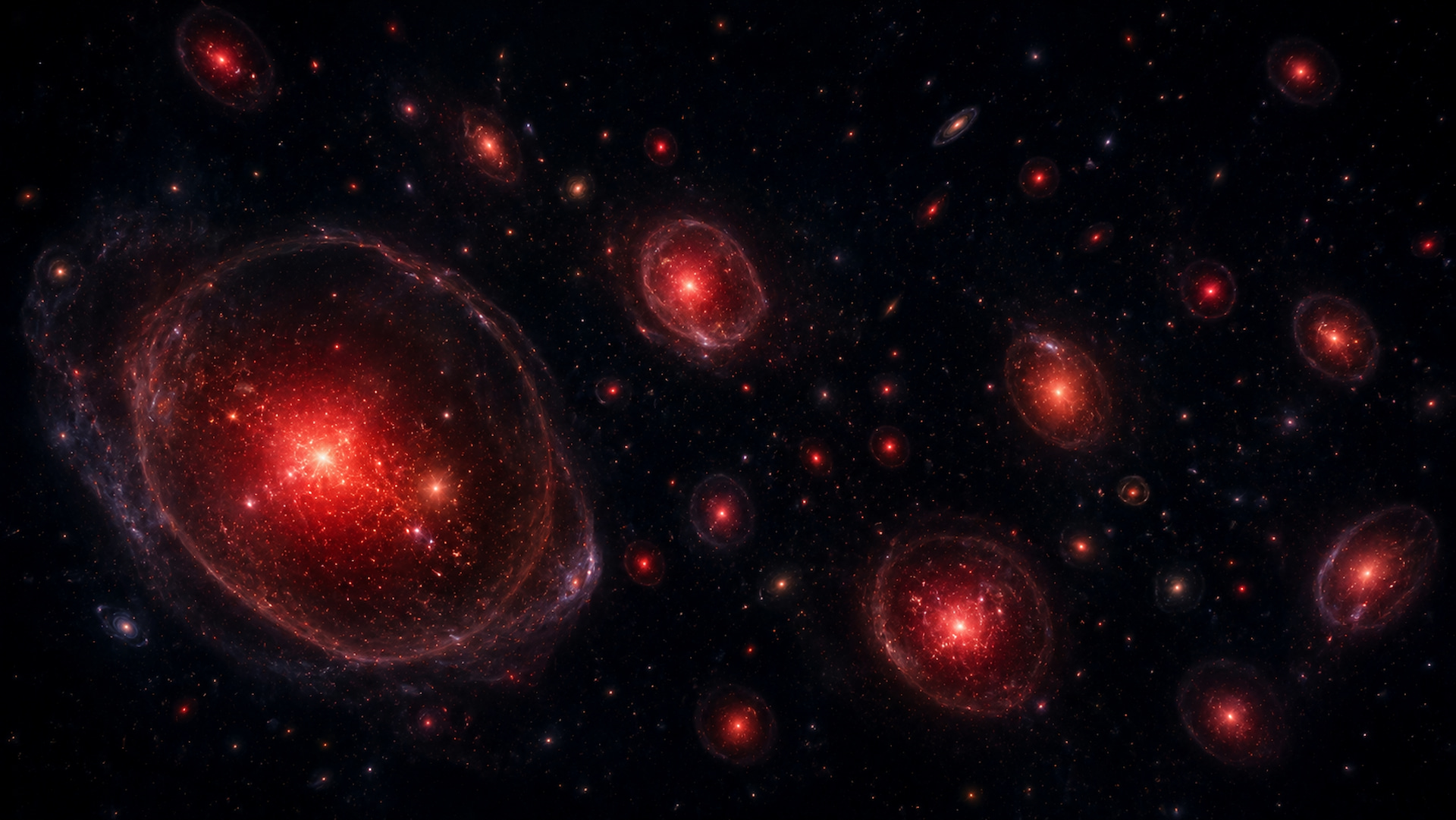
The deepest observations from the James Webb Space Telescope continue to uncover unexpected features of the early universe. Among its most intriguing discoveries is a population of compact, reddish galaxies known as the Little Red Dots. Although modest in size, these distant objects are attracting growing scientific attention because they may contain rapidly developing supermassive black holes concealed within exceptionally dense clouds of gas. Such environments could provide the conditions required to generate some of the universe’s highest energy neutrinos.
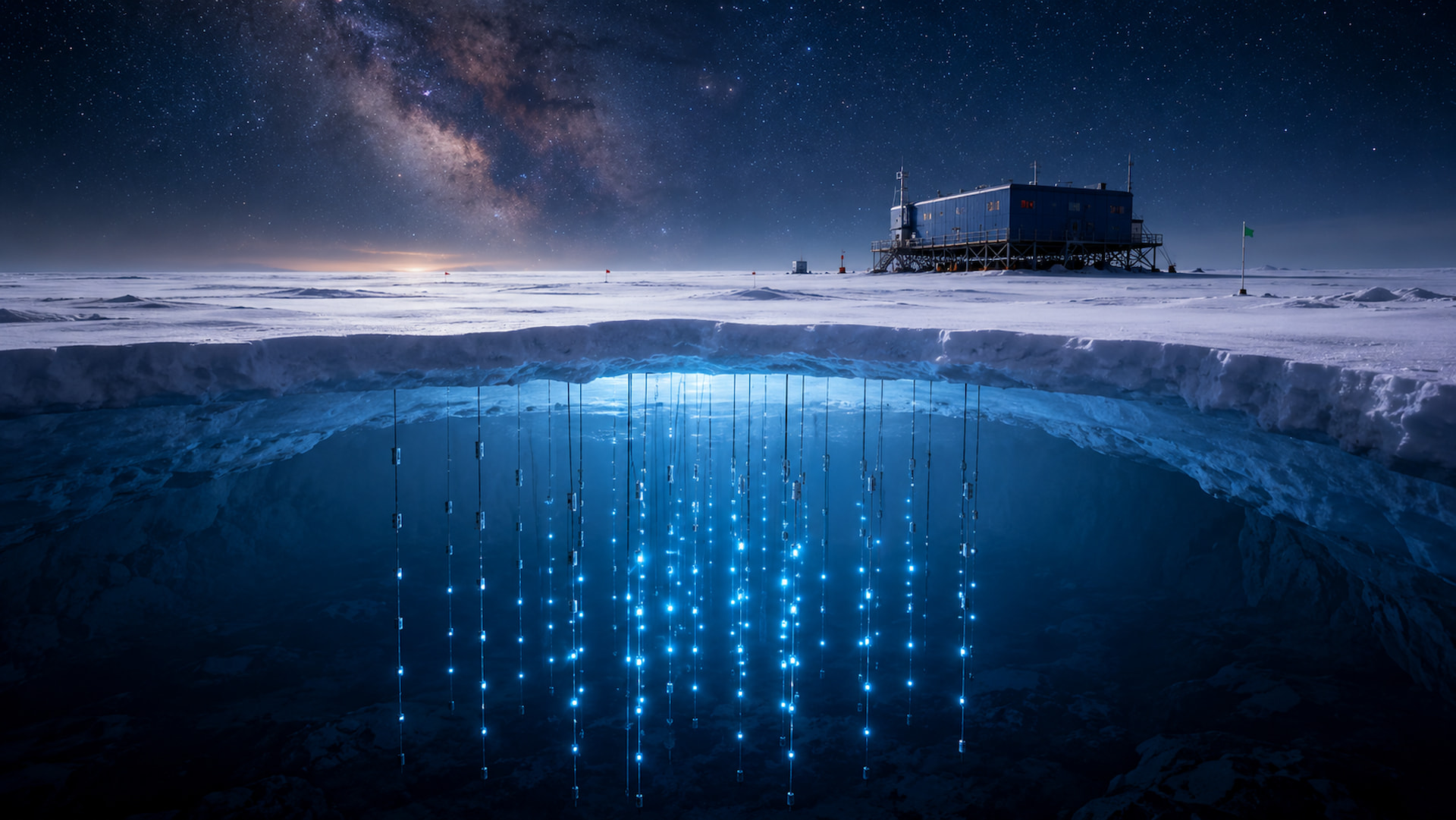
Neutrinos are among the most elusive particles in nature. Carrying no electric charge and possessing only a tiny mass, they travel enormous cosmic distances with very little interaction with matter. Detectors on Earth have recorded a steady stream of high-energy neutrinos arriving from every direction in the sky, yet the astrophysical sources responsible for much of this diffuse background have remained uncertain.
Producing neutrinos with extreme energies requires violent particle collisions. High-speed protons interacting with intense radiation fields or dense matter can generate neutrinos that escape almost unhindered, even from regions that are otherwise opaque. These same interactions are also expected to create gamma rays. However, if every neutrino-producing source freely emitted gamma rays, astronomers would observe a much brighter gamma-ray background than current measurements indicate. This mismatch has led researchers to search for environments where gamma rays are trapped while neutrinos escape.
The Little Red Dots appear to match that description. A research team from Kyoto University proposed that the supermassive black holes inside these galaxies could be surrounded by thick gaseous envelopes capable of burying energetic jets. This idea is supported by the fact that many of the galaxies exhibit little evidence of the radio or X-ray emissions typically associated with exposed jets, suggesting that any powerful outflows may remain hidden beneath dense material.
Lead author Riku Kuze explains that such surroundings would naturally contain abundant photons and large amounts of gas near the central black hole, creating favorable conditions for repeated particle collisions and efficient neutrino production.
To examine this possibility, the researchers combined analytical estimates with sophisticated numerical simulations. Using representative values for the brightness and abundance of the Little Red Dots, they evaluated how much these galaxies might contribute to the diffuse high-energy neutrino background. Their calculations also modeled particle acceleration, the creation of secondary particles, and the cooling processes that shape the final neutrino energy spectrum.
The simulations indicate that buried black hole systems inside the Little Red Dots could indeed generate substantial numbers of high-energy neutrinos while preventing most gamma rays from escaping. If this scenario accurately reflects the physical conditions inside these galaxies, they may account for a meaningful share of the high-energy neutrinos detected on Earth without conflicting with observations of the gamma-ray sky. The findings have been published in the journal Physical Review D.
Although individual Little Red Dots remain extremely difficult to study in detail because of their immense distances, the work provides one of the first quantitative demonstrations that their remarkable abundance could make them an important contributor to the cosmic neutrino population.
The next stage of the investigation will focus on refining predictions for the different neutrino flavors expected from these galaxies and determining how the surrounding gas became dense enough to bury the energetic jets. Answering those questions could bring astronomers significantly closer to identifying the long-sought origins of the universe’s high-energy neutrino background.