IceCube Finds a Fault Line in the Universe’s Neutrino Signal
For years, the universe appeared to whisper in a predictable rhythm. Across the frozen silence beneath Antarctica, the IceCube Neutrino Observatory recorded…
For years, the universe appeared to whisper in a predictable rhythm. Across the frozen silence beneath Antarctica, the IceCube Neutrino Observatory recorded streams of ghostlike particles arriving from violent cosmic environments billions of light-years away. Their distribution seemed to follow a clean mathematical rule, simple, elegant, and stable. The newest IceCube analysis now suggests reality is far less orderly.
In a study published in Physical Review Letters, researchers from the IceCube Collaboration report compelling evidence that the astrophysical neutrino spectrum bends and changes character around 30 teraelectronvolts. The result challenges the long-standing assumption that these particles follow a single uninterrupted power-law distribution across energies.
Neutrinos are among the most elusive particles known to physics. They carry almost no mass, possess no electric charge, and interact so weakly with matter that trillions pass through the human body every second unnoticed. Produced in environments shaped by black holes, exploding stars, relativistic jets, and ultra-energetic cosmic collisions, neutrinos travel across the observable universe largely undisturbed. Unlike light or charged particles, they preserve information about the regions where they originated.
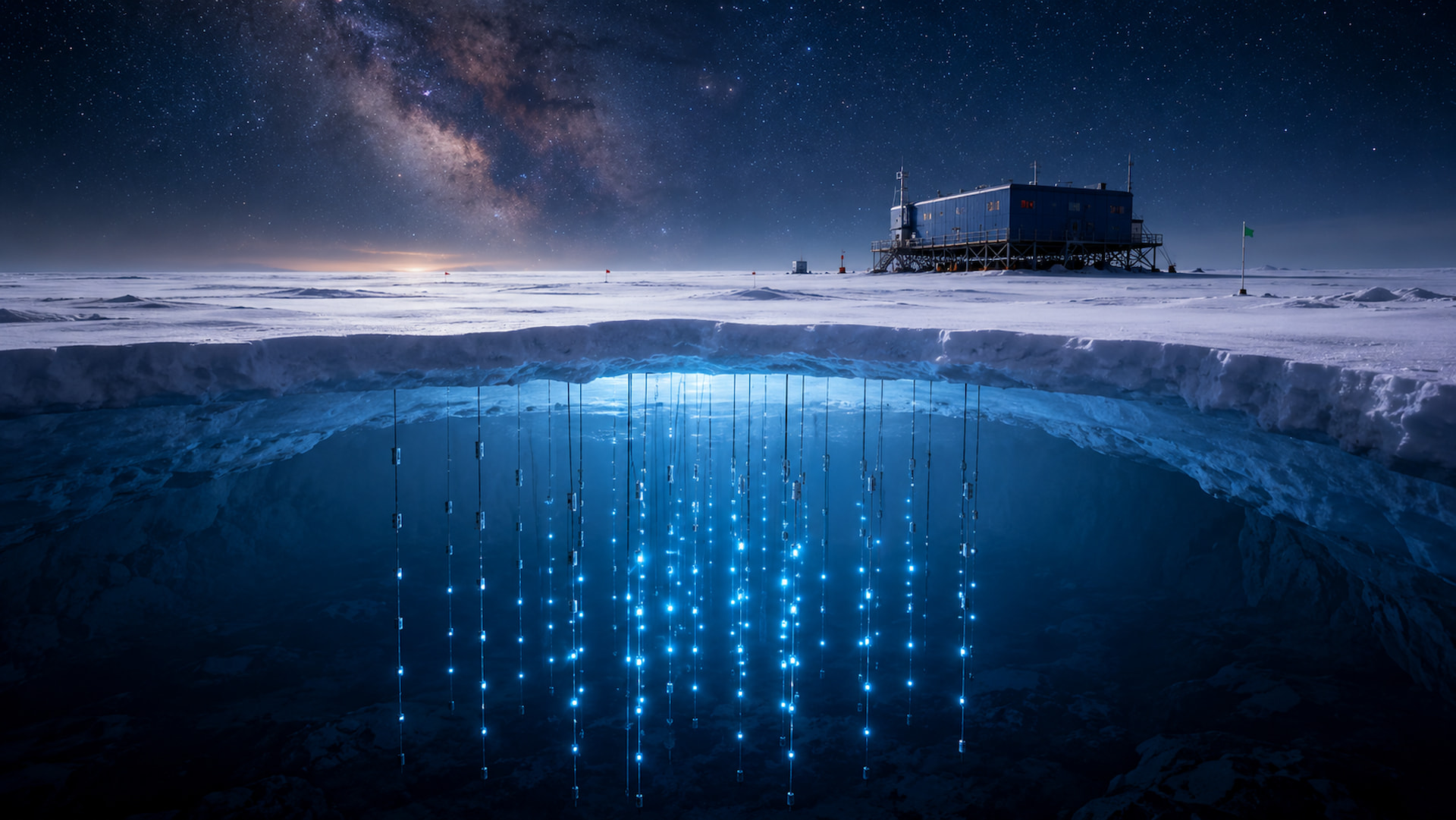
IceCube’s latest measurement draws on more than ten years of observations collected at the South Pole. Buried deep within Antarctic ice, the detector uses 5,160 optical modules distributed across a cubic kilometer of transparent glacier. When a neutrino collides with atomic matter inside the ice, it generates charged secondary particles that emit faint flashes of Cherenkov radiation, a blue glow produced when particles move faster than light propagates through ice. Those flashes become the fingerprints from which scientists reconstruct neutrino energies and trajectories.
According to the collaboration, the newly identified transition near 30 TeV rejects the traditional single power-law interpretation with a statistical significance exceeding four sigma. In practical terms, the likelihood that the feature emerged by random fluctuation is extraordinarily small.
Vedant Basu of the University of Utah described neutrinos as direct carriers of information from regions inaccessible to conventional experiments. Their energies, origins, and distribution patterns allow physicists to study environments far beyond the reach of terrestrial accelerators.
The diffuse astrophysical neutrino flux observed at Earth represents the combined output of every unresolved neutrino source across the cosmos. Mapping the spectrum of that flux is therefore more than a counting exercise. It is a method of reconstructing the architecture of the high-energy universe itself.
Hints of irregularity had surfaced before. Earlier IceCube studies suggested the spectrum might deviate from a smooth decline near the same energy range, but previous datasets lacked the statistical strength required to establish a definitive conclusion. The latest investigation revisited the problem with expanded statistics, refined reconstruction methods, and tighter control over systematic uncertainties.
To verify the result, researchers performed two separate analyses using overlapping but distinct event samples. One approach combined track-like events, typically associated with muon neutrinos, together with cascade events produced by more compact particle showers. The second approach focused exclusively on interactions beginning inside the detector volume itself, creating a cleaner sample that naturally included electron, muon, and tau neutrinos.
Each analysis tested multiple spectral descriptions against the observed data. These included the classic single power law, a power law with exponential cutoff, a logarithmic parabola, and a broken power law. Both analyses independently converged on the same conclusion. The broken power-law model provided the strongest agreement with the measurements.
The implication is subtle but significant. At lower energies, the neutrino spectrum appears comparatively hard, meaning the flux decreases more gradually with energy. Beyond roughly 30 TeV, the decline becomes markedly steeper.
In the MESE analysis, the spectral index shifted from 1.72 below the break to 2.84 above it. The Combined Fit analysis produced comparable values of 1.31 and 2.74. Though derived through different methods, both measurements point toward the same physical transition.
Aswathi Balagopal V. from the University of Delaware explained that IceCube’s immense detector volume is essential because neutrino interactions are exceptionally rare. The Antarctic ice serves simultaneously as detection medium and shielding material, while the detector’s depth beneath the surface suppresses contamination from cosmic-ray air showers.
The findings extend beyond neutrino astronomy alone. For years, a tension existed between IceCube’s older spectrum measurements and observations of the diffuse extragalactic gamma-ray background. Earlier extrapolations predicted more low-energy neutrinos than gamma-ray observations appeared able to support. The newly measured spectral break reduces that discrepancy by lowering the expected neutrino contribution in the 1 to 10 TeV range.
Researchers are now examining whether the feature reflects changes in the underlying populations of astrophysical neutrino sources, shifts in acceleration mechanisms, or even contributions from unknown physical processes. Some theoretical models suggest that dark matter decay or annihilation could leave detectable signatures within the diffuse neutrino background.
Albrecht Karle of the University of Wisconsin–Madison emphasized that the measurement marks only the beginning of a broader effort to decode the structure of the high-energy neutrino sky. Future analyses with improved modeling and larger datasets are expected to sharpen the spectrum further and clarify the mechanisms driving some of the most extreme environments in the universe.
The result does not merely adjust a curve on a graph. It alters the emerging portrait of the cosmos itself. What once looked like a smooth statistical continuum now appears fractured, layered, and potentially shaped by multiple populations of cosmic accelerators operating under radically different conditions. Somewhere beyond the reach of telescopes, the universe may be changing its voice, and IceCube has begun to hear the difference.