The Definitive Search for Sterile Neutrinos: MicroBooNE Results and the Future of Particle Physics
Introduction: Resolving One of Particle Physics’ Most Persistent Mysteries For decades, physicists have investigated anomalies in neutrino experiments…
On this page
Introduction: Resolving One of Particle Physics’ Most Persistent Mysteries
For decades, physicists have investigated anomalies in neutrino experiments suggesting the possible existence of a fourth neutrino type, known as the sterile neutrino. Unlike the three known neutrino flavors—electron, muon, and tau—sterile neutrinos would interact only through gravity and not through the weak nuclear force. Their existence could explain multiple experimental discrepancies and open new pathways beyond the Standard Model of particle physics.
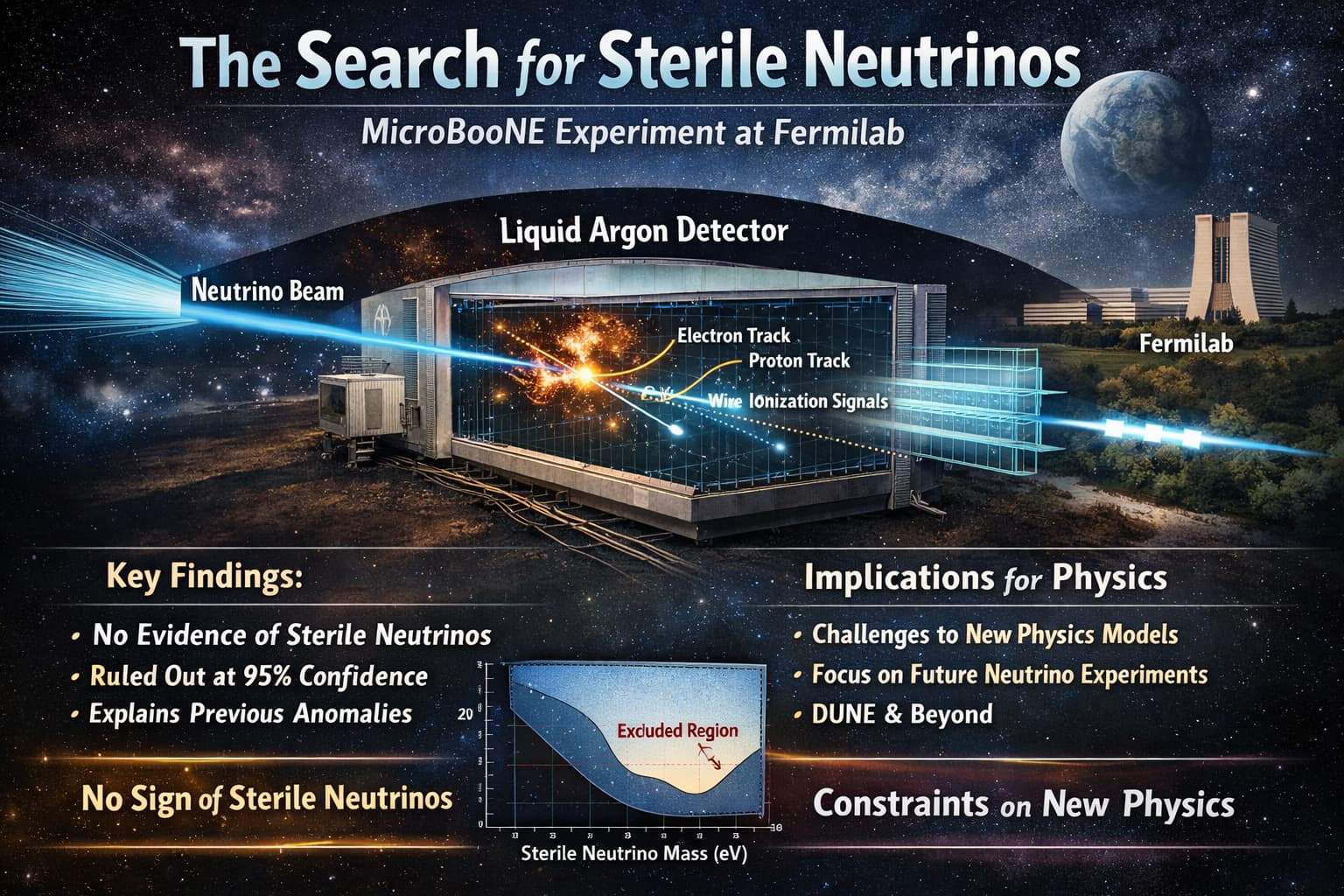
Through high-precision measurements and innovative detector technology, the MicroBooNE experiment at Fermilab has delivered one of the most comprehensive tests of this hypothesis. By analyzing neutrinos generated from two independent beams and observing their interactions inside a liquid-argon time projection chamber, researchers performed a detailed search for signals that would indicate sterile neutrino oscillations.
The result is transformative: no experimental evidence for sterile neutrinos was found, strongly constraining the theory and ruling out the simplest sterile neutrino explanation with approximately 95% confidence.
This article presents a complete overview of the experiment, the underlying physics, the detector technology, and the implications for the future of neutrino research.
Understanding Neutrinos and the Sterile Neutrino Hypothesis
The Three Known Neutrino Flavors
Neutrinos are elementary particles that interact extremely weakly with matter. They are produced in nuclear reactions, including those occurring in stars, nuclear reactors, and particle accelerators.
The Standard Model currently recognizes three neutrino flavors:
-
Electron neutrino (νₑ)
-
Muon neutrino (ν_μ)
-
Tau neutrino (ν_τ)
These neutrinos exhibit a phenomenon known as neutrino oscillation, where a neutrino changes flavor while traveling through space.
Why Scientists Suspected a Fourth Neutrino
Several previous experiments—including the LSND and MiniBooNE experiments—observed anomalies suggesting unexpected transformations of muon neutrinos into electron neutrinos.
One proposed explanation involved an additional neutrino state:
- Sterile neutrino (νₛ)
Unlike standard neutrinos, sterile neutrinos would:
-
Not interact through the weak nuclear force
-
Only influence other particles through mixing with active neutrinos
-
Appear indirectly via oscillation signatures
If real, sterile neutrinos could help explain:
-
Dark matter models
-
Cosmological anomalies
-
Neutrino mass mechanisms
The MicroBooNE Experiment: A Precision Neutrino Observatory
Location and Experimental Setup
The MicroBooNE detector operates at the Fermi National Accelerator Laboratory (Fermilab) in Illinois. It sits along the Booster Neutrino Beamline (BNB), the same beamline previously used by the MiniBooNE experiment.
This strategic placement allows scientists to directly test the earlier anomalies by observing neutrino interactions with significantly higher resolution.
Key experimental features include:
-
Liquid argon time projection chamber (LArTPC)
-
High-resolution 3D particle tracking
-
Precise energy measurement
-
Multi-year neutrino beam exposure
Inside the detector, neutrinos interact with liquid argon atoms, producing charged particles that ionize the medium. These ionization electrons drift in an electric field toward sensor planes where they are recorded as detailed images of particle tracks.
How the Detector Observes Neutrino Interactions
Liquid Argon Time Projection Chamber Technology
The LArTPC design allows scientists to reconstruct particle trajectories with exceptional precision.
Detection Process
-
A neutrino collides with an argon nucleus.
-
Charged particles are produced.
-
These particles ionize the argon atoms.
-
Freed electrons drift toward readout wires.
-
The signals reconstruct a three-dimensional interaction event.
This system enables precise identification of:
-
Electrons
-
Muons
-
Protons
-
Secondary particles
Such clarity is essential to distinguish real electron neutrino events from background processes.
Dual-Beam Strategy: Breaking Oscillation Degeneracies
A key innovation of the MicroBooNE analysis was the use of two neutrino beams to eliminate ambiguities in oscillation measurements.
These beams allow scientists to simultaneously test:
-
Muon neutrino to electron neutrino appearance
-
Electron neutrino disappearance
If sterile neutrinos existed, they would produce measurable deviations in both signals.
The combined dataset provides a powerful method to disentangle competing oscillation hypotheses, dramatically improving experimental sensitivity.
Experimental Results: No Evidence for Sterile Neutrinos
After analyzing years of neutrino interactions, the collaboration found:
-
No excess electron neutrino appearance
-
No measurable electron neutrino disappearance
-
No oscillation patterns consistent with sterile neutrinos
These results strongly constrain the single sterile neutrino model.
Statistically:
- The simplest sterile neutrino explanation for previous anomalies is ruled out at ~95% confidence.
This outcome resolves long-standing experimental discrepancies and significantly narrows the parameter space for new physics.
Why Previous Experiments Saw Anomalies
The earlier MiniBooNE experiment detected signals that initially suggested sterile neutrinos. However, the MicroBooNE detector revealed that these signals were likely misidentified background events.
Major sources of confusion included:
-
Photon-induced events that mimic electrons
-
Neutral pion decays producing similar signatures
-
Detector limitations in particle identification
Because MicroBooNE can distinguish electrons from photons with far greater precision, it successfully clarified the nature of these events.
Implications for Particle Physics
Closing One Door to New Physics
The MicroBooNE findings represent one of the most decisive tests of sterile neutrino models.
Key implications include:
-
Elimination of the simplest sterile neutrino explanation
-
Reassessment of historical neutrino anomalies
-
Improved constraints on beyond-Standard-Model theories
Future Research Directions
Despite the null result, neutrino physics remains one of the most promising areas for discovering new fundamental physics.
Upcoming experiments will explore:
-
Deep Underground Neutrino Experiment (DUNE)
-
Short-Baseline Neutrino Program
-
Precision measurements of neutrino CP violation
-
Neutrino mass hierarchy
Each experiment builds on the technological advances pioneered by MicroBooNE.
The Future of Neutrino Detection Technology
The success of MicroBooNE demonstrates the power of large liquid-argon detectors.
Next-generation detectors will expand this technology dramatically.
Advantages include:
-
Millimeter-scale particle tracking
-
Excellent calorimetric measurements
-
Large detector volumes
-
Scalable design for multi-kiloton experiments
These features will enable scientists to investigate:
-
Proton decay
-
Supernova neutrinos
-
Matter–antimatter asymmetry
Conclusion: A Turning Point in the Search for Hidden Particles
The MicroBooNE experiment has delivered one of the most comprehensive investigations into sterile neutrinos ever conducted. Through high-resolution imaging, dual-beam measurements, and years of precise data analysis, researchers have effectively ruled out the simplest sterile neutrino explanation for earlier neutrino anomalies.
This milestone reshapes the landscape of neutrino physics. While the sterile neutrino hypothesis once offered a compelling route to new physics, the latest evidence redirects the field toward deeper investigations into neutrino mass, oscillations, and the fundamental structure of the universe.
The search for hidden particles continues—but now with clearer guidance, sharper tools, and a renewed focus on the next generation of neutrino experiments.