Seeing the Unseen: Researchers Create a Novel Method for 3D Particle Tracking
By integrating current technology in novel ways, physicists are rethinking how to detect elusive particles like neutrinos.
On this page
By integrating current technology in novel ways, physicists are rethinking how to detect elusive particles like neutrinos.
Unexpected pairings of well-known concepts frequently lead to advancements in physics. This is becoming more and more true in the search for elusive particles like neutrinos and possible dark matter candidates, where detection is constrained not just by theory but also by the size, cost, and accuracy of sensors. Traditional designs that depend on finely segmented materials become more difficult to scale as detectors get larger to increase sensitivity, forcing researchers to investigate radically different strategies.
Three-dimensional (3D) tracking of particles traveling through dense materials is essential to the majority of particle physics studies. This is usually accomplished in scintillators by breaking the material up into numerous tiny active elements. When a charged particle strikes each unit, visible light is released. After that, optical fibers gather the light and send it to photon detectors like silicon photomultipliers or photomultiplier tubes.
Large-scale trials demonstrate this approach’s strengths and limitations. One detector in Japan’s T2K neutrino oscillation experiment has around two tons (4,400 pounds) of active material made up of 60,000 fibers and about two million tiny cubes. Experiments like LHCb and Mu3e at CERN and the Paul Scherrer Institute use millions of thin scintillating fibers to attain submillimeter precision. However, when detector quantities increase, this level of segmentation becomes challenging to scale, potentially leading to a bottleneck.
An alternative approach is being suggested by a group from EPFL and ETH Zurich. A prototype detector that can capture ultrafast, high-resolution 3D images of particle interactions in large, unsegmented scintillator volumes has been developed and tested by researchers, including PhD candidate Till Dieminger, senior scientist Dr. Saúl Alonso-Monsalve, Professor Davide Sgalaberna, and colleagues from EPFL’s Advanced Quantum Architecture Lab under the direction of Professor Edoardo Charbon. Their findings were just published in Nature Communications along with thorough simulations.

Known tools with fresh perspectives
Plenoptic, or light field, cameras serve as an inspiration for the new method. By recording both the direction and the intensity of light, these devices enable the reconstruction of depth information. A micro lens array (MLA) positioned between the sensor and the primary lens is used to accomplish this. The entire light field can be recreated since each tiny lens records a slightly distinct view.
This method can track particles in three dimensions even when relatively few photons are detected when paired with single-photon avalanche diode (SPAD) sensors. Light field imaging has not yet been used for particle tracking, despite its promise.
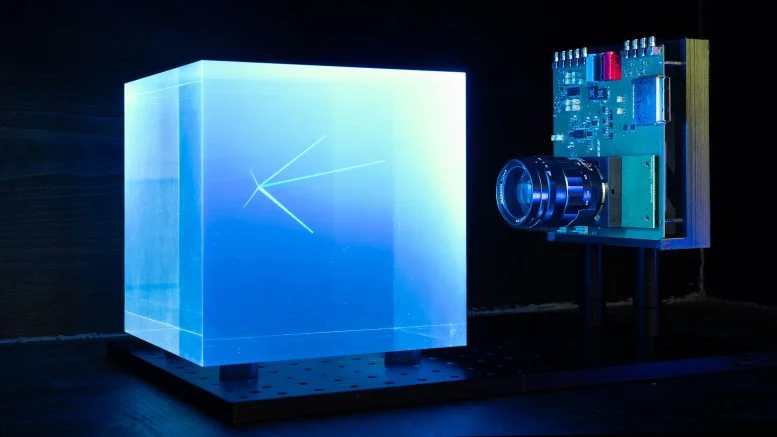
The ETH Zurich and EPFL team developed a functional prototype based on this idea as part of the PLATON project, which is sponsored by the Swiss National Science Foundation. SwissSPAD2, a SPAD sensor created at EPFL, is combined with an MLA in this system. Raytrix GmbH designed and installed the MLA. Gated photon detection, which captures signals within predetermined time periods, is a crucial component of SwissSPAD2. This aids in separating background noise from actual photon signals.
PLATON to the test
By assessing spatial resolution across light levels ranging from several hundred photons to just five detected photons, the scientists assessed the prototype’s performance in a lab setting. Additionally, they used a strontium-90 source to assess its capacity to reconstruct electron tracks in a plastic scintillator. Simulations and experimental results were in close agreement in every instance.
Plans for enhancements have already been influenced by these preliminary tests. A novel SPAD sensor with improved detection efficiency and the capacity to precisely time stamp individual photons at subnanosecond resolution is being developed by the researchers. In order to increase the camera’s field of view and enhance light collecting, they are also improving its design. According to simulations, these improvements will improve spatial resolution even more.
Simulated situations
Further simulations investigate the potential performance of an improved PLATON system in neutrino detection. Similar to big language models, these research use a neural network based on a Transformer architecture for sophisticated picture processing. Patterns and correlations between detected photons can be found by this network.
The results show that in an unsegmented volume of (10x10x10) cm3, the system could reach spatial resolution higher than 1 millimeter (or around 0.04 inches). Additionally, it could accurately detect neutrino interactions involving low-momentum protons.
The scientists used a reduced photon source to model a one cubic meter (about 35 cubic feet) system for larger detectors. Simulations indicate a resolution of a few millimeters even in this scenario, which is similar to the most advanced scintillator detectors available today. The researchers anticipate submillimeter performance in volumes greater than 1 m3 with additional advancements.
Upcoming plans
The possible uses are not limited to particle physics. The group thinks their plenoptic-based method could also enhance imaging in other domains.
Three PLATON-related patent applications for positron emission tomography (PET) have already been submitted by Dieminger, Alonso-Monsalve, and Sgalaberna. Both the scanner design and image processing techniques, such as neural networks, are covered. From the World Wide Web to proton treatment, particle physics has a proven track record of producing technologies with wide-ranging effects. Another example of this tendency may be PLATON.
CREDIT:Reference: Till Dieminger, Saúl Alonso-Monsalve, Christoph Alt, Claudio Bruschini, Noemi Bührer, Edoardo Charbon, Kodai Kaneyasu, Tim Weber, Matthew Franks, and Davide Sgalaberna, “An ultrafast plenoptic-camera system for high-resolution 3D particle tracking in unsegmented scintillators,” Nature Communications, March 21, 2026.
Illustration of the first prototype of a new monolithic detector system capable of performing ultrafast, 3D and high-resolution imaging of particles in large volumes of unsegmented scintillator material. Credit: ETH Zurich/Sgalaberna Group