One Particle, Two Frontiers: The Science Behind ESSnuSB and the Neutrino® Energy Group
The neutrino passes through everything. The question, it turns out, was never whether it interacts with matter. It does.
The neutrino passes through everything. The question, it turns out, was never whether it interacts with matter. It does. The question was always architectural: how do you build the receiver?
One kilometre below the surface of central Sweden, in the Zinkgruvan mine, there is silence of a kind that has no surface equivalent. The rock above absorbs cosmic noise. No wind. No light. The temperature holds steady at a few degrees above freezing regardless of what the seasons do overhead. Scientists have chosen this place, and places like it around the world, precisely because of what gets filtered out.
What doesn’t get filtered out is extraordinary. Even here, shielded by a kilometre of Swedish bedrock, roughly 65 billion neutrinos pass through every square centimetre of that rock every second. They came from the Sun, which has been producing them since before the Earth existed. Some came from supernovae that exploded in other galaxies, their signals travelling tens of thousands of light-years to arrive in this particular seam of zinc ore without slowing, without scattering, without any detectable interaction with the stone they passed through. The rock is not a barrier. For the ESSnuSB collaboration, a European consortium of physicists now planning a detector installation at Zinkgruvan, the rock is a laboratory.
What the ESSnuSB collaboration is proposing to do in that mine is among the more ambitious experiments in the history of particle physics. The concept uses the entire planet Earth as a neutrino interferometer.
What the Planet Reveals
Neutrinos don’t travel silently. They oscillate. As they move through space, they spontaneously change between three distinct types, or “flavours,” a quantum mechanical behaviour that is direct evidence they have mass, a property the original Standard Model of particle physics didn’t predict and still can’t fully accommodate. The rate at which they oscillate is sensitive to the density of matter they pass through. In vacuum, it follows one rhythm. In rock, it follows another. In planetary mantle, another still.
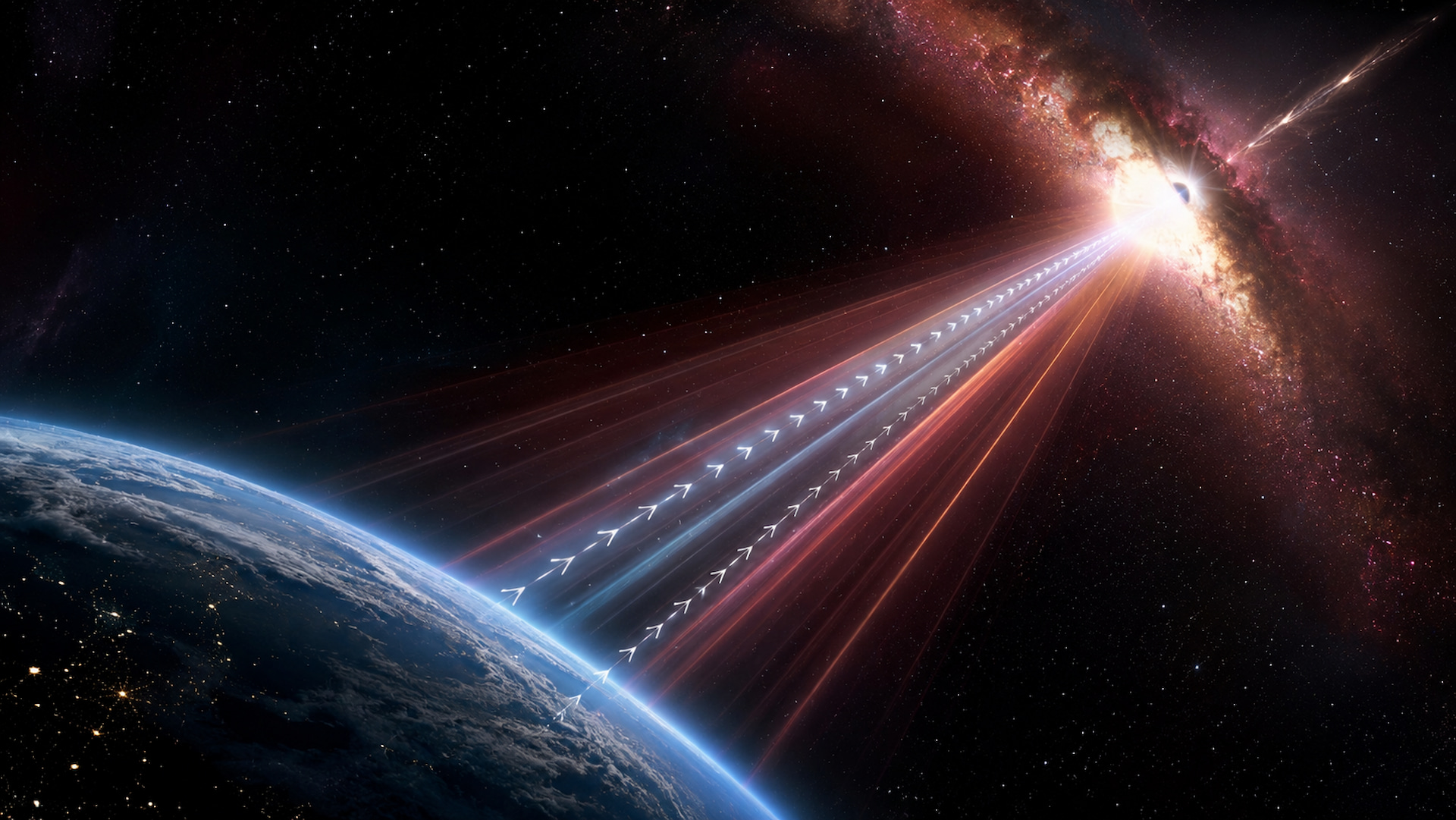
This creates a remarkable opportunity. Neutrinos arriving at Zinkgruvan from directly above have passed through a few dozen kilometres of atmosphere. Neutrinos arriving from directly below have traversed the full diameter of the Earth: 12,742 kilometres of crust, mantle, outer core, and inner core. Every arrival direction is a different chord through the planet’s interior. Every energy bin records a different interference pattern modified by every layer of material along the path.
The ESSnuSB detector doesn’t just observe particles. Across different arrival angles and energies, it reads the planet’s interior structure in the language of oscillation statistics.
The projected sensitivity results from the study are precise. Bounds on non-standard interaction parameters, the additional interaction terms that some extensions of the Standard Model predict but current experiments haven’t resolved, come in at 90 percent confidence intervals tight enough to discriminate between competing theoretical models. The neutrino mass ordering, the question of whether the lightest neutrino type is the first or the third, can still be rejected above six sigma even when an additional non-standard interaction parameter is allowed to vary freely in the analysis.
Six sigma means the probability that the result is accidental is approximately one in five hundred million. To be precise: this is the confidence level at which the particle physics community conventionally declares that a discovery has occurred rather than a fluctuation. It is the standard used to announce the Higgs boson in 2012. The ESSnuSB collaboration is projecting it can reach that standard for the mass ordering question while simultaneously placing constraints on physics beyond the Standard Model. (Note: this refers to the projected statistical significance of the mass ordering determination, not to the detection of any specific new particle or interaction.)
The reader should sit with that for a moment. A particle produced in the Sun travels 150 million kilometres through space, passes unimpeded through a kilometre of Swedish bedrock, and carries in its oscillation pattern a statistical signature of every layer of Earth it traversed on the way. The Earth is not blocking it. The Earth is being read by it.
The Same Particle, a Different Question
The ESSnuSB study is asking: what do neutrino interactions with matter reveal about the structure of those interactions? In following that question, it depends fundamentally on a result that was confirmed experimentally in 2017 by the COHERENT collaboration at Oak Ridge National Laboratory. The process is called coherent elastic neutrino-nucleus scattering, or CEvNS.
In CEvNS, a neutrino strikes an atomic nucleus without fragmenting it. It transfers a small but real momentum, producing a weak recoil. The cross-section for this process, the probability of interaction, scales with the square of the neutron number. It is not negligible. It is not zero. It is a real mechanical event, measurable, reproducible, and now confirmed across multiple experiments including COHERENT, CONUS+, and the LZ dark matter detector, which captured solar neutrino CEvNS signals at 4.5 sigma confidence as recently as 2026. Every new measurement adds precision to our understanding of what happens when a neutrino passes through matter.
There is a second question the COHERENT result makes possible, one that no neutrino physics collaboration is currently pursuing, but which follows with logical directness from the same physics. If neutrinos continuously transfer momentum to matter, and if that matter is engineered at the nanoscale to convert stochastic momentum transfers into directed electrical output through asymmetric architecture, what is the governing mathematical framework for that conversion?
This is the question Holger Thorsten Schubart, mathematician and founder of the Neutrino® Energy Group, formalized through what is now called the Schubart Master Formula:
P(t) = η · ∫_V Φ_eff(r,t) · σ_eff(E) dV
The equation describes multi-channel ambient energy interaction in open non-equilibrium nanoscale systems, integrating effective flux density and interaction cross-section across the active material volume. It does not claim energy from nothing. It describes how existing ambient fluxes are converted through engineered material response, subject to the governing constraint that output power cannot exceed the sum of all coupled external input power multiplied by conversion efficiency.
P(t) is instantaneous electrical output. η is total conversion efficiency, bounded between 0 and 1. Φ_eff(r,t) integrates contributions from neutrinos, cosmic muons, thermal gradients, and electromagnetic background fields at position r and time t. σ_eff(E) draws on the same experimental cross-section data that COHERENT, ESSnuSB, and the broader neutrino physics program are continuously refining. The volume integral reflects a three-dimensional conversion architecture, the same volumetric logic that makes the ESSnuSB detector sensitive to neutrinos arriving from all directions simultaneously.
Internal Monte Carlo simulations and multi-parameter evaluations of the physical model yield statistical consistency reaching 5.9 to 6.0 sigma. To be precise: this figure quantifies the internal consistency of the mathematical framework under applied model assumptions, not commercial performance or delivery at industrial scale. It is a measure of how well the model’s predictions hold together under stress-testing across parameter space. It is stated here at the same confidence level the ESSnuSB study uses as its own evidentiary benchmark, because the underlying physics draws on the same experimental foundation. Both studies ask what matter does when neutrinos pass through it. Both use the same evidentiary standard to answer.
The Architecture of the Receiver
The ESSnuSB detector is designed to maximise coupling between incoming neutrino flux and the detecting medium. A water volume of 540 kilotonnes, buried deep enough to suppress background noise, oriented to receive particles from every arrival direction. Every design choice is made in the same direction: increase the probability that a passing neutrino leaves a detectable trace.
The neutrinovoltaic architecture follows the same logic at a different scale and toward a different purpose. Graphene-silicon heterostructures in alternating layers create an asymmetric three-dimensional medium. In a symmetric material, momentum transfers cancel statistically: electrons drift equally in all directions, and no net current results. Break the symmetry through material geometry, interface engineering, and doping profiles, and a preferred direction of electron flow emerges. That drift is direct current. The process is called stochastic rectification, and it is documented, non-equilibrium transport physics.
It has been confirmed independently of neutrinovoltaic research. Professor Paul Thibado at the University of Arkansas demonstrated that freestanding graphene membranes at room temperature produce measurable continuous electrical output from thermal fluctuations alone, under no external excitation. The same quantum transport properties that make graphene exceptional as a detector medium make it exceptional as a conversion medium. These are not separate scientific stories. They are the same material, viewed from adjacent angles.
In graphene-silicon stacks of twelve to twenty-two alternating layers, individual neutrino-nucleus interactions produce transverse acoustic phonons at frequencies around 10¹² Hz and amplitudes initially on the order of 10⁻¹³ metres, smaller than an atomic radius. At 22 layers, the vibration amplification coefficient across the stack reaches approximately 120, bringing the displacement above the threshold where piezoelectric charge separation and hot carrier transport can produce a measurable potential difference. A 22-layer structure produces a total voltage of approximately 1.5 volts. The copper foil substrate provides both the structural foundation and the charge transport pathway that consolidates billions of these microscale events into macroscopic current.
The Neutrino Power Cube developed by the Neutrino® Energy Group deploys this architecture at practical scale: a 50-kilogram solid-state unit measuring 800 by 400 by 600 millimetres, delivering 5 to 6 kilowatts of continuous net output without fuel, moving parts, or dependence on geography or time of day. The connection to the ESSnuSB study is not metaphorical. The experimental confirmation of CEvNS that justifies building a 540-kilotonne underground detector is the same experimental confirmation that informs the coupling term in the Master Formula. The difference is scale and purpose. One system is designed to read the particle. The other is designed to be moved by it.
The Map From Above
Two research programs, developed by entirely different scientific communities for entirely different purposes, have converged on the same physical territory: the interaction of ambient neutrino flux with condensed matter, and what that interaction reveals or produces.
The ESSnuSB collaboration is not thinking about energy conversion. The Neutrino® Energy Group is not building oscillation detectors. But the non-standard interaction parameters that ESSnuSB will measure, when published, will refine the value of σ_eff in the Master Formula. The graphene quantum transport physics that informs conversion architecture is the same physics that determines detector response in water Cherenkov experiments. Every new neutrino measurement anywhere in the world, from IceCube beneath the Antarctic ice to the Jiangmen Underground Neutrino Observatory in southern China, adds a data point to the flux map that the Master Formula integrates.
The world’s neutrino research infrastructure, built at extraordinary cost to answer fundamental questions about the structure of matter, is simultaneously producing the evidentiary foundation for a new class of energy conversion system. The researchers building it did not design it for this. They are building their own road. But the map, viewed from sufficient altitude, shows where it leads.
The neutrino is the most abundant massive particle in the universe. It is present everywhere, at all times, passing through planetary bodies and atomic lattices without apparent consequence. Except, as a generation of careful physics has established, not without consequence. With matter, in ways the Standard Model may not fully describe, in ways that a kilometre of Swedish bedrock and a carefully engineered graphene lattice are each, in their own way, learning to read.
The physics was never hidden. It was simply never assembled for this purpose.