Neutrino Experiments in the United States and Japan: Advancing the Global Frontier of Particle Physics
Neutrinos are among the most enigmatic particles in the universe. Nearly massless, electrically neutral, and capable of passing through entire planets without…
On this page
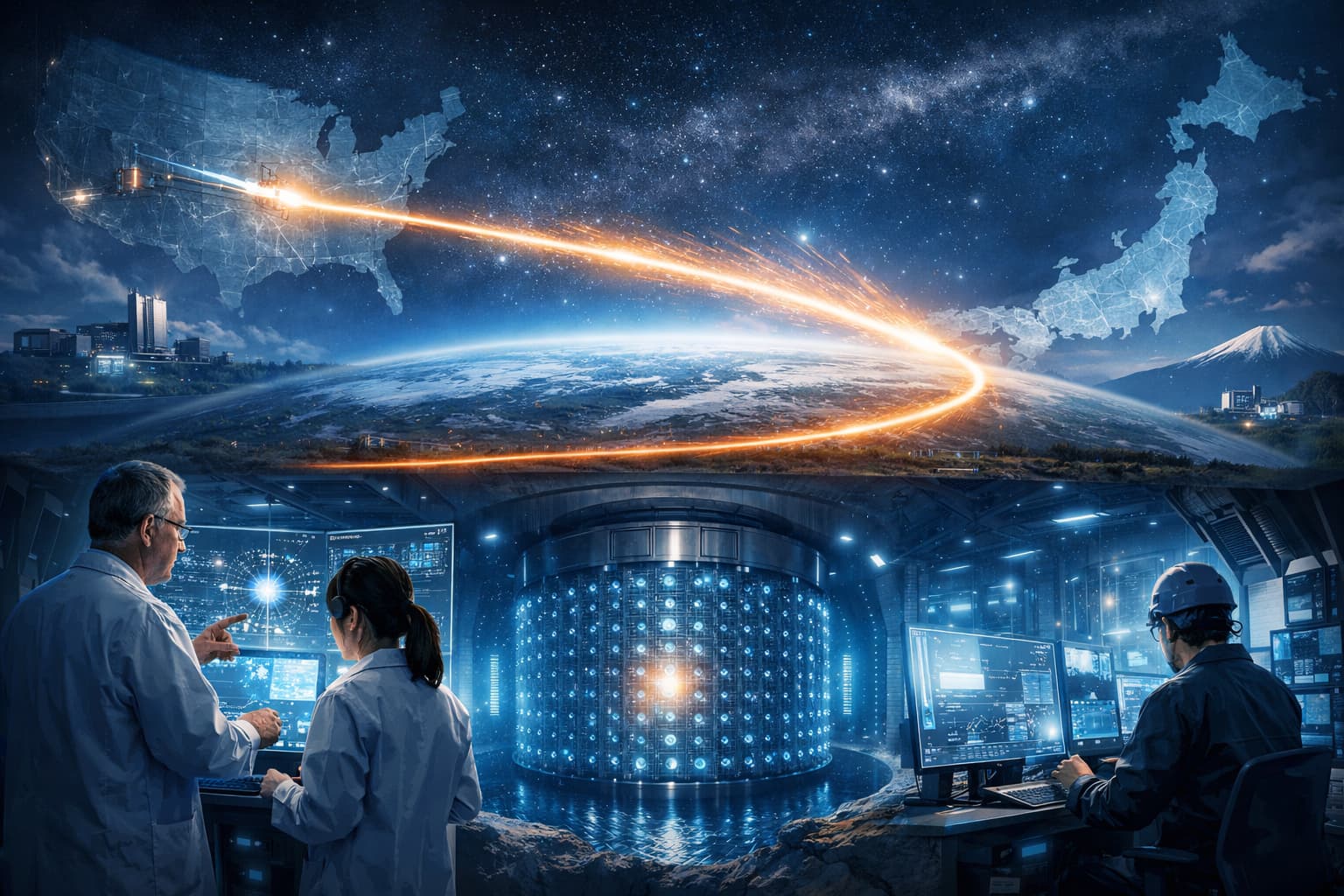
Neutrinos are among the most enigmatic particles in the universe. Nearly massless, electrically neutral, and capable of passing through entire planets without interaction, these particles challenge the limits of modern physics. In recent years, collaborative neutrino experiments in the United States and Japan have significantly accelerated the pace of discovery. By combining technological innovation, massive underground detectors, and high-intensity particle beams, these experiments are transforming our understanding of the universe’s most fundamental forces.
We explore how international cooperation between U.S. and Japanese neutrino research programs is driving breakthroughs in particle physics, cosmology, and our understanding of matter itself.
Understanding Neutrinos: The Universe’s Most Elusive Particles
Neutrinos belong to the family of elementary particles known as leptons. They are produced in enormous quantities during nuclear reactions, including those in stars, supernovae, and particle accelerators. Despite their abundance—billions pass through every square centimeter of Earth each second—neutrinos interact so weakly with matter that detecting them requires extraordinarily sensitive instrumentation.
Key properties of neutrinos include:
-
Extremely small mass
-
No electric charge
-
Three known flavors: electron neutrinos, muon neutrinos, and tau neutrinos
-
Ability to oscillate between flavors while traveling
Neutrino oscillation—the phenomenon where neutrinos change their identity during flight—has profound implications for particle physics. It confirms that neutrinos possess mass, contradicting early assumptions in the Standard Model.
Global Collaboration in Neutrino Physics
Large-scale neutrino research has become inherently international. Modern experiments require multi-billion-dollar infrastructure, vast detectors buried underground, and high-energy particle beams traveling hundreds of kilometers.
Two major regions currently leading this research are:
-
The United States
-
Japan
Their collaborative scientific programs combine complementary technologies and methodologies to push the boundaries of neutrino measurement precision.
Strategic Goals of the Collaboration
The partnership between U.S. and Japanese neutrino experiments aims to address several fundamental questions:
-
Why does the universe contain more matter than antimatter?
-
What is the true mass hierarchy of neutrinos?
-
Do neutrinos violate CP symmetry?
-
Are there additional undiscovered neutrino types?
Answering these questions could reveal physics beyond the Standard Model.
The Japanese Neutrino Research Program
Japan has been at the forefront of neutrino physics for decades, operating some of the world’s most sophisticated detectors.
Super-Kamiokande: A Landmark Detector
Super-Kamiokande is a massive underground water Cherenkov detector located beneath Mount Ikeno in Japan. The detector contains over 50,000 tons of ultra-pure water, surrounded by thousands of photomultiplier tubes that capture faint flashes of light generated when neutrinos interact with water molecules.
Major achievements include:
-
Confirmation of atmospheric neutrino oscillations
-
Precision measurement of neutrino flavor transitions
-
Nobel Prize–winning discoveries in neutrino physics
Hyper-Kamiokande: The Next Generation
Japan is now developing Hyper-Kamiokande, a next-generation detector that will be significantly larger and more sensitive than its predecessor.
Key characteristics:
-
Detector volume nearly 10 times larger than Super-Kamiokande
-
Improved photon detection technology
-
Greater sensitivity to neutrino oscillations and proton decay
Hyper-Kamiokande will dramatically increase detection rates and measurement precision.
The United States Neutrino Research Program
The United States operates some of the most ambitious neutrino experiments ever conceived.
The Deep Underground Neutrino Experiment (DUNE)
DUNE is one of the largest international physics collaborations in history. Located at the Sanford Underground Research Facility in South Dakota, the experiment will detect neutrinos produced at Fermilab near Chicago, approximately 1,300 kilometers away.
Core components include:
-
High-intensity neutrino beam from Fermilab
-
Massive liquid argon detectors underground
-
Long-baseline neutrino measurements
DUNE will enable scientists to observe neutrino oscillations over unprecedented distances.
How Long-Baseline Neutrino Experiments Work
Long-baseline experiments measure neutrino transformations over large distances between their source and detector.
Experimental Process
-
High-energy protons collide with a target at a particle accelerator.
-
These collisions produce secondary particles that decay into neutrinos.
-
The neutrino beam travels hundreds or thousands of kilometers.
-
Large underground detectors capture rare neutrino interactions.
-
Scientists analyze flavor changes and energy distributions.
Measuring CP Violation in Neutrinos
One of the most significant goals of modern neutrino experiments is measuring CP violation, a difference in behavior between particles and antiparticles.
If neutrinos violate CP symmetry, it could explain why the universe is dominated by matter rather than antimatter.
Experiments achieve this by comparing:
-
Oscillations of neutrinos
-
Oscillations of antineutrinos
A measurable difference would signal CP violation.
Such findings could reshape our understanding of cosmological evolution.
Technological Innovations Driving Neutrino Discovery
Advancements in detector technology are enabling unprecedented sensitivity in neutrino experiments.
Liquid Argon Time Projection Chambers
Used in DUNE, these detectors provide extremely detailed particle tracking.
Advantages include:
-
High spatial resolution
-
Precise energy measurements
-
3D reconstruction of particle interactions
Water Cherenkov Detectors
Used in Super-Kamiokande and Hyper-Kamiokande, these detectors identify particles by detecting Cherenkov radiation produced when particles travel faster than light through water.
Benefits include:
-
Massive detection volumes
-
High neutrino interaction rates
-
Proven reliability over decades
The Importance of International Scientific Cooperation
The complexity of neutrino physics demands collaboration across nations, institutions, and scientific disciplines.
The partnership between the United States and Japan demonstrates how shared infrastructure and knowledge accelerate discovery.
Key benefits include:
-
Combined detector capabilities
-
Cross-verification of experimental results
-
Shared computational analysis
-
Global scientific participation
Such collaborations are essential for tackling the deepest questions in physics.
Implications for Cosmology and Fundamental Physics
Neutrino research extends far beyond particle physics. Its implications affect cosmology, astrophysics, and our understanding of the universe’s evolution.
Discoveries from neutrino experiments could reveal:
-
The origin of matter dominance
-
New particles beyond the Standard Model
-
Insights into supernova mechanisms
-
Clues about dark matter and dark energy
Each neutrino detected brings physicists closer to answering some of the most profound questions about the universe.
The Future of Neutrino Exploration
The coming decades promise a new era of neutrino discovery. With next-generation detectors and powerful particle accelerators, researchers expect unprecedented precision in neutrino measurements.
Key milestones expected in the near future include:
-
Full operation of Hyper-Kamiokande
-
First data from DUNE detectors
-
High-statistics measurements of CP violation
-
Discovery of new neutrino properties
As international collaborations deepen, neutrino physics is poised to redefine the boundaries of fundamental science.
Conclusion
Neutrino experiments in the United States and Japan represent one of the most ambitious scientific endeavors of the 21st century. Through massive detectors, high-intensity particle beams, and global cooperation, scientists are unlocking the secrets of the universe’s most mysterious particles.
By advancing precision measurements of neutrino oscillations, investigating CP violation, and exploring new physics beyond the Standard Model, these collaborations are reshaping our understanding of the cosmos and paving the way for the next generation of discoveries in particle physics.