The Cosmic Forge: How Colliding Neutron Stars Cook the Universe's Heaviest Elements
Take a teaspoon. Fill it, in your imagination, with the densest material the universe has ever managed to produce.
Take a teaspoon. Fill it, in your imagination, with the densest material the universe has ever managed to produce. That single spoonful would outweigh a mountain. This is neutron star matter, and it sits at the outer edge of what physics permits to exist without collapsing into a black hole. These objects are not merely extreme. They are the universe stress-testing its own rules.
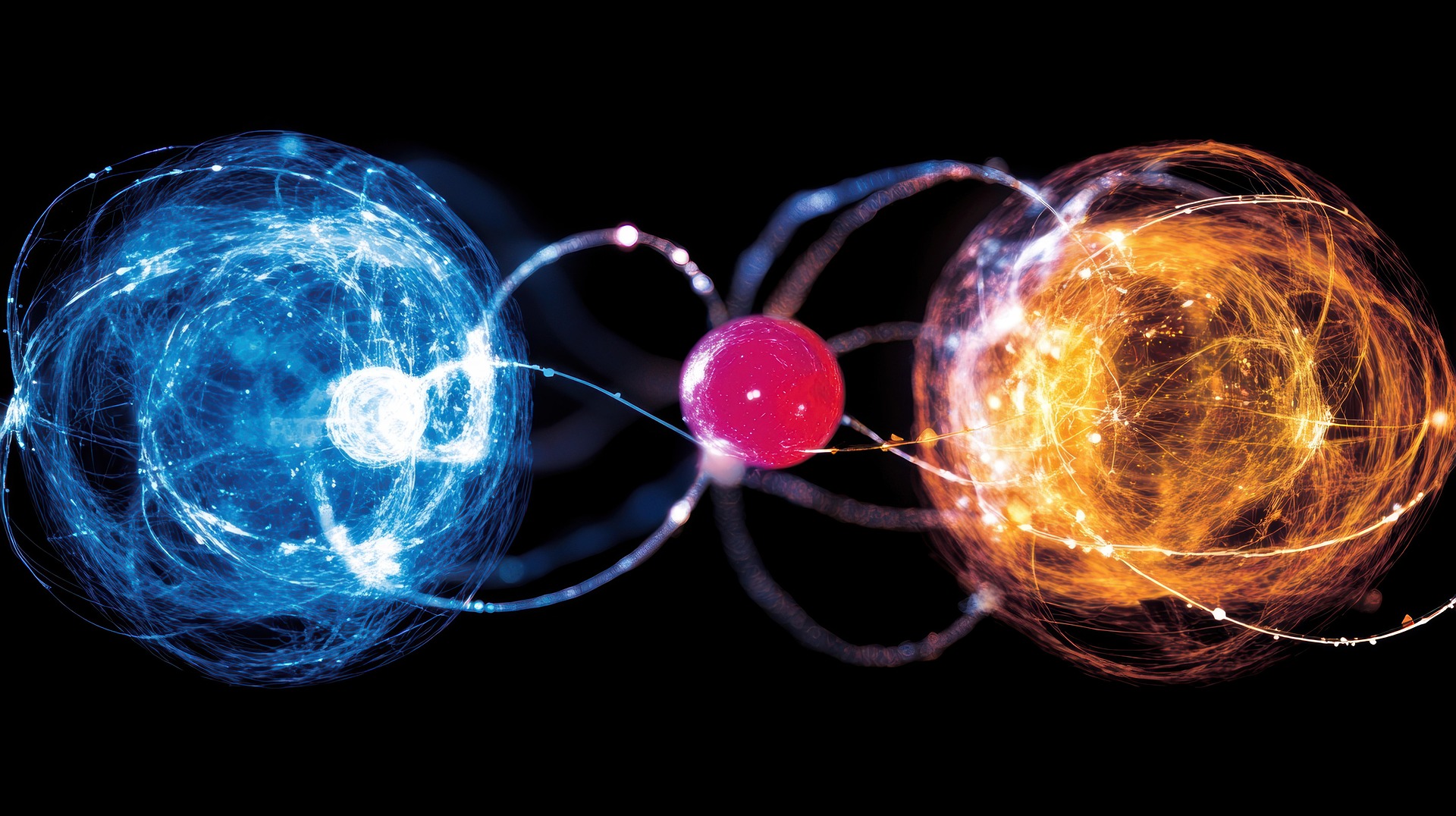
Now picture two of them finding each other across the void, locked in a gravitational embrace that tightens over millions of years until, in a final catastrophic instant, they collide. The explosion that follows is one of the most violent events the cosmos is capable of staging. It shakes the fabric of spacetime itself, sending ripples called gravitational waves rolling outward at the speed of light. It hurls clouds of superheated matter into the surrounding space. And it floods the universe with an almost incomprehensible torrent of neutrinos, those near-massless ghost particles that pass through ordinary matter as though it simply is not there.
For a long time, scientists believed they had a reasonable handle on what happens next. A new set of supercomputer simulations suggests they were missing something significant.
The Flavor Problem
Neutrinos are not a single thing. They come in three distinct varieties, called flavors, each associated with a different partner particle: the electron, the muon, and the tau. What makes them genuinely strange is that these flavors are not fixed. A neutrino born as one type will, as it travels, quietly shift into another, oscillating between identities in a way that has no parallel in everyday physics. This process, known as neutrino oscillation, has been known for decades and earned its discoverers a Nobel Prize. But its consequences inside the firestorm of a neutron star merger had, until now, been left almost entirely out of the equations.
The omission was not careless. Modeling neutrino flavor transformations inside an event of this violence is a computational challenge of staggering proportions. The simulations that could handle it simply did not exist. Now they do, and the results, published by a team of astrophysicists working in numerical relativity, are striking.
Rewriting the Recipe for Gold
When two neutron stars tear each other apart, the debris they fling outward, the so-called ejecta, is a seething mixture of neutrons and protons. The ratio between these two particles is everything. It determines which elements can form through a process called rapid neutron capture, or the r-process, in which atomic nuclei are bombarded with neutrons faster than they can decay, building up into the heaviest elements on the periodic table. Gold. Platinum. Uranium. The kind of atoms that do not form quietly inside ordinary stars but require exactly this kind of apocalyptic environment.
Neutrinos sit at the controls of that neutron-to-proton ratio. They interact with the ejecta and tip the balance one way or the other. What the new simulations reveal is that when you account for flavor transformations, the balance tips harder than anyone had modeled. In the low-density outer regions of the ejected material, electron-type neutrinos become less abundant as they shift into other flavors. The ejecta grows richer in neutrons. In some scenarios, the neutron content increases by more than a factor of five.
The downstream effect on element production is not subtle. The yields of the heaviest elements, the lanthanides and those beyond them on the periodic table, increase by orders of magnitude compared to simulations that ignore flavor mixing entirely. The wedding ring on your finger, the contacts inside your smartphone, the platinum in a catalytic converter: the cosmic accounting for all of it may need to be substantially revised.
Ripples in Spacetime
The implications reach beyond chemistry. Neutron star mergers are among the prime targets of gravitational wave observatories, facilities like LIGO and Virgo that detect the faint trembling of spacetime caused by cataclysmic events billions of light years away. Scientists use the precise shape of those gravitational wave signals to reverse-engineer what happened during the collision, probing the physics of matter at densities no laboratory on Earth can replicate.
If neutrino flavor transformations alter the dynamics of the merger and the structure of the ejecta, they will also leave fingerprints on the gravitational waves those mergers produce. That means the models scientists use to interpret gravitational wave data may be systematically incomplete. Building neutrino oscillations into those models is not merely an academic refinement. It is a prerequisite for reading the signals correctly.
A Hidden Architect
What emerges from this research is a picture of neutrinos as something more than passive bystanders to the universe’s most spectacular events. They are, it turns out, active participants, quietly reshaping the conditions that determine which elements exist and in what quantities, bending the outcomes of collisions that forged the matter from which planets and people are eventually made.
They do this invisibly, passing through walls of nuclear fire without leaving an obvious mark, shifting identity mid-flight, tipping ratios that ripple outward into the composition of the universe itself. Ghost particles, yes. But ghosts, it seems, with a great deal of influence over the world they haunt.
The simulations are a first step. The models will grow more refined, the computational power will increase, and the gravitational wave detectors will accumulate more data from real collisions to test these predictions against. But the conclusion sitting at the center of this work is already reshaping how astrophysicists think about cosmic chemistry: the gold was always made in the stars, but the neutrinos were always in charge of how much.