Q&A: Improvements to IceCube Observatory enhance the hunt for the elusive cosmic message
Researchers at Penn State explain how the discovery of minuscule particles known as neutrinos sheds light on extreme physics and high-energy astrophysical…
On this page
Researchers at Penn State explain how the discovery of minuscule particles known as neutrinos sheds light on extreme physics and high-energy astrophysical phenomena.
UNIVERSITY PARK, PA — Tucked away in the Antarctic ice are over 5,000 light sensors that collaborate to identify some of the universe’s highest energy particles. These minuscule particles, known as neutrinos, shed light on both phenomena that defy conventional physics and the extreme cosmic events that produced them.
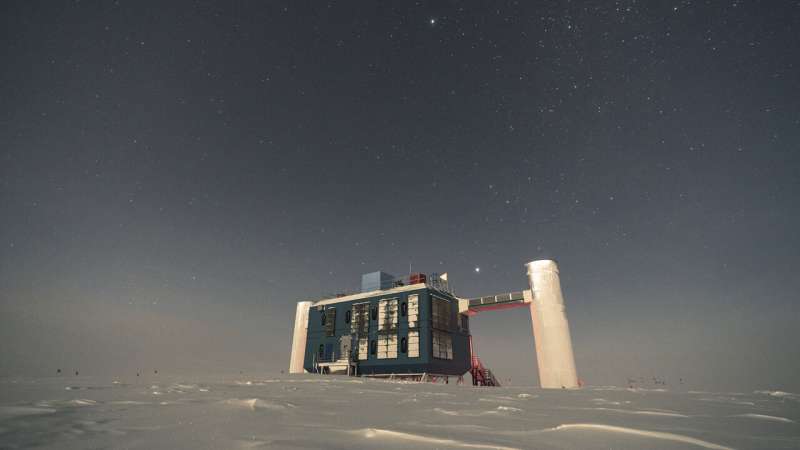
The IceCube Neutrino Observatory, situated at the Amundsen-Scott South Pole Station of the U.S. National Science Foundation, uses the pure ice to detect the minuscule, almost massless neutrinos. Then, in order to ascertain the neutrino’s origin, the international IceCube consortium, which consists of over 450 scientists worldwide, reconstructs the neutrino’s properties and its direction of origin. Neutrinos can travel throughout the universe without losing information because they seldom ever interact with matter.
The IceCube Neutrino Observatory, situated at the Amundsen-Scott South Pole Station of the U.S. National Science Foundation, uses the pure ice to detect the minuscule, almost massless neutrinos. Then, in order to ascertain the neutrino’s origin, the international IceCube consortium, which consists of over 450 scientists worldwide, reconstructs the neutrino’s properties and its direction of origin. Neutrinos can travel throughout the universe without losing information because they seldom ever interact with matter. As a result, they can transmit information about their sources that other particles, like photons, are unable to.
New cosmic discoveries will be made possible by the IceCube Observatory’s recent completion of a significant upgrade, the first since it started operating in 2011.
IceCube researchers Doug Cowen, a professor of physics and astronomy and astrophysics at the Penn State Eberly College of Science, and Kayla DeHolton, an Eberly Research Scholar in the Penn State Department of Physics, discussed Penn State’s role in the IceCube collaboration and how the upgrades will support their research into extreme physics and astrophysical events in the following Q&A.
What are neutrinos, and what can we learn about them?
Cowen: A variety of processes, including fusion in the core of our sun, can produce neutrinos, which are little, almost massless particles. Astrophysical neutrinos produced by some of the universe’s most intense phenomena, including as stellar explosions, gamma-ray bursts, and black hole and neutron star mergers, are of primary interest to IceCube. Neutrinos are cosmic messengers that have a special capacity to reveal information about their origin, even if it is billions of light years distant, because they can travel through space without being deflected or absorbed.
DeHolton: When cosmic rays strike Earth’s atmosphere, neutrinos are also created. We are able to investigate a phenomena called neutrino oscillations thanks to the ensuing atmospheric neutrinos. The three flavors of neutrinos are electron, muon, and tau. A neutrino may occasionally take on a new flavor after traveling a great distance. It would be similar to obtaining a scoop of Grilled Stickies at the Penn State Berkey Creamery, except when you sit down at the table, it’s Death by Chocolate instead. It’s really odd! Thus, some of the concerns we are posing are whether a specific flavor can change into unidentified new flavors or how far a neutrino must travel before changing flavors. Therefore, some of the questions we are posing include whether a neutrino can change into new flavors that we are not even aware of, or how long a neutrino must travel before changing flavors. Although the initial IceCube detector was not intended for this purpose, the IceCube observatory, and especially the recent improvements, will assist us in answering these issues.
How does IceCube operate? What will you be able to do with the upgrade?
DeHolton: IceCube is embedded in Antarctic ice and has over 5,000 sensors placed in an array on cables, or strings. Neutrinos create secondary charged particles that emit weak light as they go through the pure ice. To ascertain the flavor, energy, and origin of a neutrino, the IceCube team examines this light pattern. Six new strings with over 600 new sensors and more accurate calibration tools are part of the upgrade. We will be able to see events in more depth and detect more occurrences thanks to the improvement.
Cowen: The new strings have far more precise and controlled calibration technology and are closer together. Our understanding of how light travels through ice has been greatly enhanced by the remotely controlled light sources we buried in the ice, which can emit light at many wavelengths and in numerous directions. In the end, this will enable us to identify astrophysical neutrino sources considerably more precisely. In fact, we may use all of our prior data to refine the orientations of the detected neutrinos based on the patterns we have already observed. For instance, once a greater understanding of the ice enables us to define a narrower window of the direction from where two neutrinos originated, we might be able to establish whether they came from the same or distinct sources.
What role have Penn State researchers played in the improvements?
Cowen: We had to demonstrate that the upgrades would accomplish our goals before submitting a proposal to NSF. In order to measure the anticipated performance, we at Penn State simulated data that we would anticipate receiving and examined the simulated data. In a recent study, we essentially demonstrated the improved detector’s performance once it was submerged in ice. The firmware for some of the new sensors was also developed by a former postdoctoral scholar at Penn State.
DeHolton: In addition to traveling to the South Pole to assist with the improvements’ installation, I co-lead the 30-person international working group devoted to the study of neutrino oscillations. We completed the on-ice modifications over three 10-week field seasons over three years due to Antarctica’s extreme remoteness. During the second field season, I assisted with the installation of the external cables from the main building to the new string locations, created the electronics rack, and installed power supply and cables. It was an incredible experience.Members from all over the world, including the United States, Germany, Sweden, Japan, Taiwan, and Thailand, were there. Everyone brought refreshments and party supplies from home while we were there for the new year. Seeing a tiny bit of life from so many different areas was really interesting.
What are your team’s and IceCube’s future plans?
DeHolton: Before we begin gathering data, there are numerous measures to ensure that the detector is functioning correctly and that we are truly finding neutrinos among the background noise. To determine whether the detector is operating as anticipated, one of the Penn State graduate students intends to examine the first six months or year of data. After that, we can delve deeply into examining recently discovered occurrences, deepening our comprehension of the ice, and reviewing historical data. Cowen: We are also anticipating IceCube Gen2, which would make the detector ten times larger and ten times more sensitive than it is now. IceCube will continue to stay at the forefront of neutrino astronomy for many years to come because to ongoing improvements and goals like Gen2.
CREDIT:
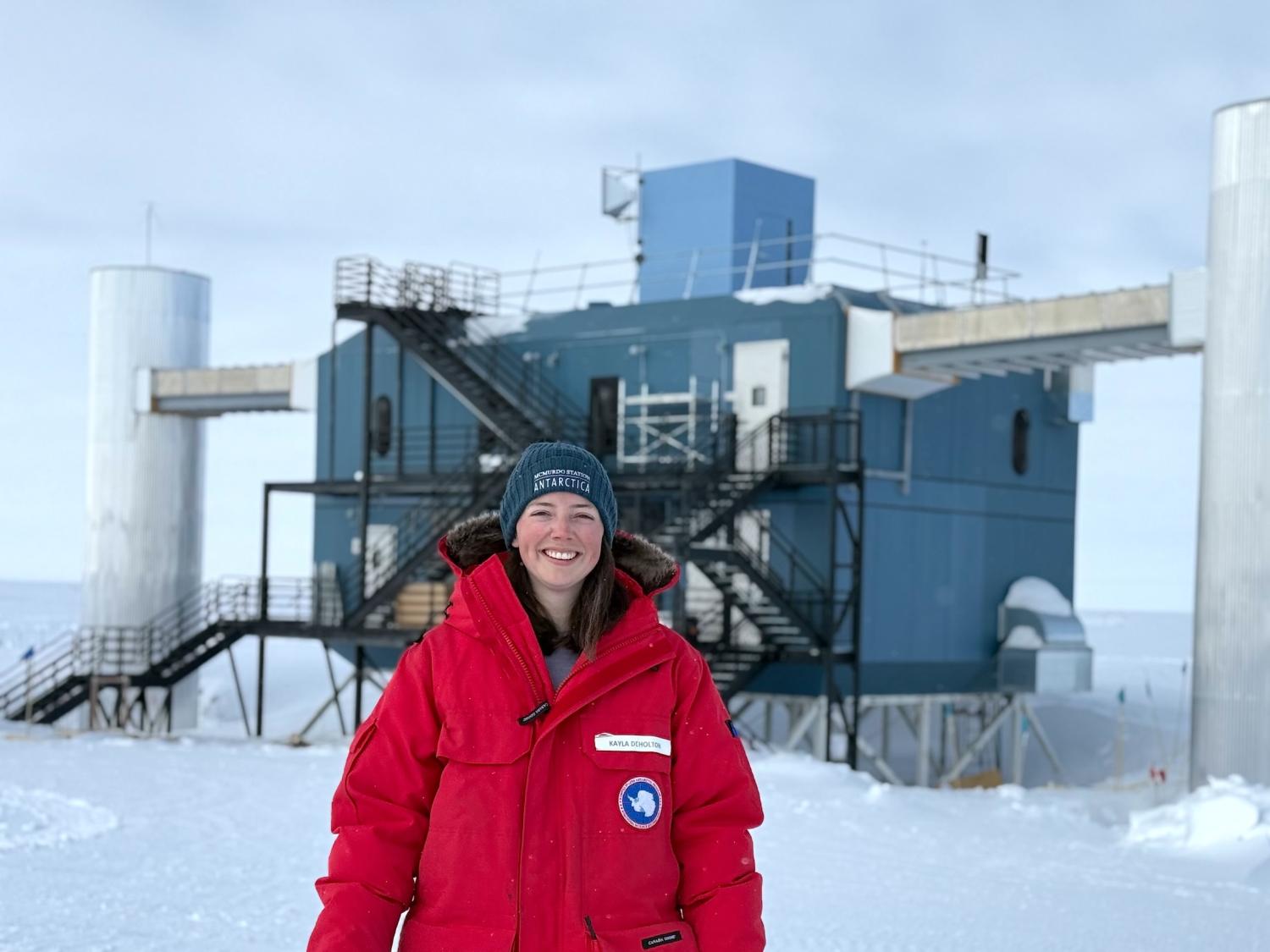
Kayla DeHolton, Eberly Research Scholar in the Penn State Department of Physics, in front of the IceCube Neutrino Observatory at the South Pole. The observatory detects tiny high-energy particles called neutrinos, which can provide insight into the extreme cosmic events that created them as well as phenomena that challenge traditional physics Credit: Provided. All Rights Reserved.