From Reactor Experiments to Giant Underground Detectors: The Long Pursuit of the Neutrino
When thousands of delicate sensors shattered inside Japan's Super-Kamiokande detector, the accident became one of the most remarkable engineering setbacks in…
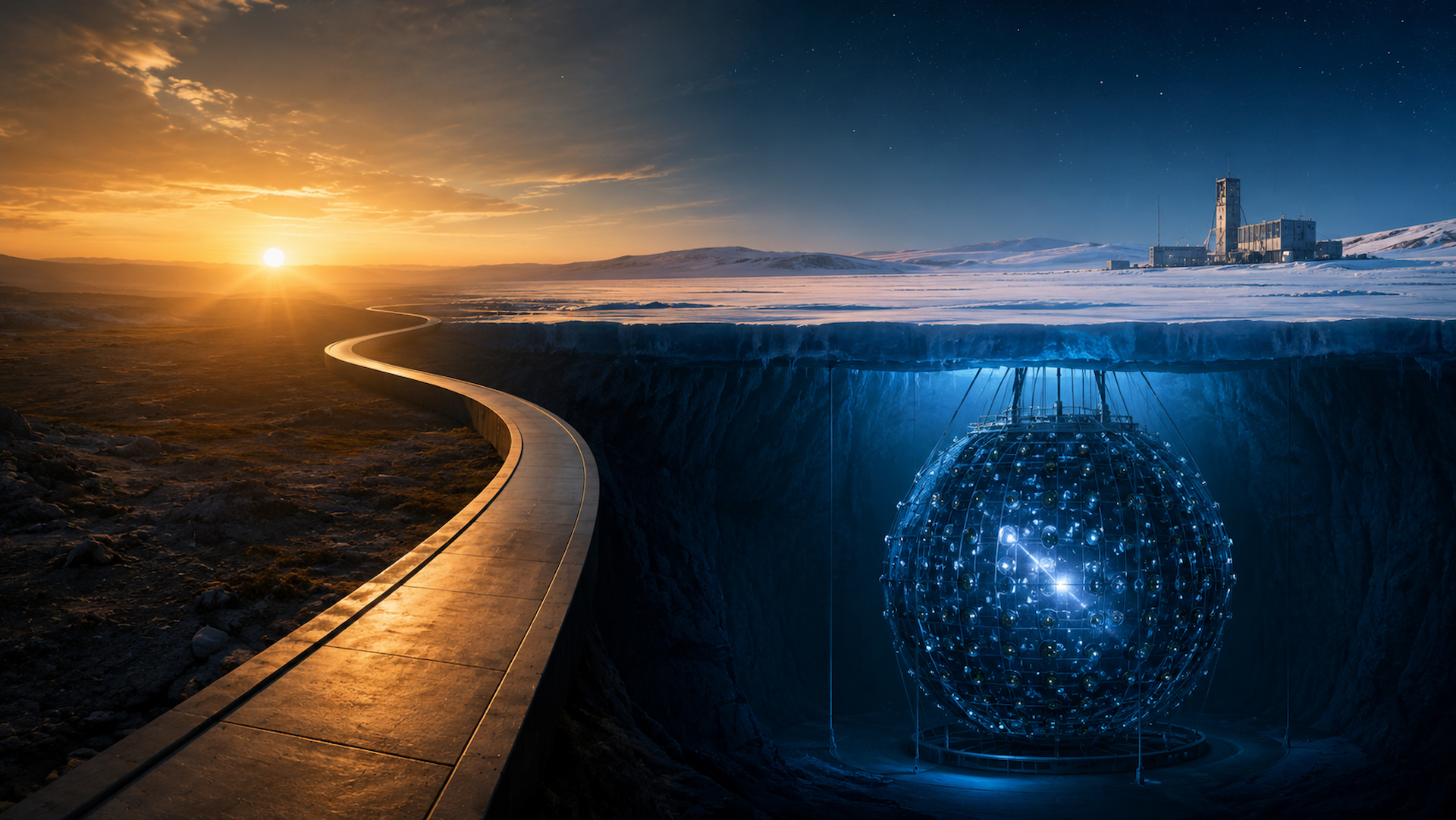
When thousands of delicate sensors shattered inside Japan’s Super-Kamiokande detector, the accident became one of the most remarkable engineering setbacks in modern experimental physics. A single implosion triggered a devastating cascade that destroyed roughly 6,600 of the facility’s 11,151 photomultiplier tubes, forcing researchers to rebuild one of the world’s most sophisticated neutrino observatories almost from scratch. The incident illustrated an uncomfortable reality. Studying the universe’s most elusive particles often requires instruments so sensitive and so immense that even their own precision becomes a source of vulnerability.
The road to that underground laboratory began decades earlier with an entirely different mystery. During studies of beta decay, physicists repeatedly encountered an apparent loss of energy that existing theories could not explain. Rather than abandoning the conservation of energy, Wolfgang Pauli proposed an invisible particle in 1930 that carried away the missing energy. He doubted anyone would ever detect it, famously remarking that he had committed “a terrible thing” by suggesting the existence of a particle beyond experimental reach.
That hypothetical particle eventually became known as the neutrino. Transforming the idea into measurable reality required extraordinary determination.
The Experiment That Proved Pauli Right
By the early 1950s, physicists Clyde Cowan and Frederick Reines recognized that nuclear reactors produced immense numbers of neutrinos. Although individual neutrinos rarely interact with matter, an intense enough source combined with a sufficiently large detector offered at least a statistical chance of observing one.
Their ambitious effort, later nicknamed Project Poltergeist, relied on a detector weighing approximately ten tons and positioned near the Savannah River reactor in South Carolina. Thick lead shielding and layers of wet sandbags surrounded the apparatus to suppress background radiation that could imitate genuine neutrino interactions.
Rather than attempting to observe neutrinos directly, the experiment searched for inverse beta decay. In this process, a neutrino collides with a proton, producing a neutron and a positron whose signatures can be measured.
The strategy succeeded. In June 1956, Cowan and Reines announced their results and informed Pauli by telegram that the particle he once considered practically impossible to detect had finally revealed itself. The confirmation reshaped particle physics by transforming the neutrino from theoretical necessity into experimental reality.
With that achievement secured, researchers immediately turned toward a far more demanding objective. If reactors produced detectable neutrinos, perhaps the Sun did as well.
Searching for the Sun’s Invisible Messengers
Detecting solar neutrinos presented an entirely different challenge. A nuclear reactor provides an intense nearby source, while neutrinos arriving from the Sun are vastly more diffuse after traveling approximately 150 million kilometers through space.
To compensate, Raymond Davis Jr. constructed one of the largest scientific instruments of its era inside the Homestake Mine in South Dakota. Buried about 1.5 kilometers underground to shield it from cosmic radiation, the detector contained nearly 400,000 liters of perchloroethylene, a chlorine-rich liquid commonly used in dry cleaning.
The experiment depended on exceptionally rare interactions in which incoming electron neutrinos transformed chlorine atoms into radioactive argon. Each atom of argon represented evidence that a solar neutrino had passed through the detector.
When measurements accumulated, the results surprised everyone. Only about one-third of the expected neutrinos appeared.
The discrepancy became known as the solar neutrino problem. For years, scientists debated whether the error originated in solar models, detector design, or an incomplete understanding of neutrinos themselves.
Water Instead of Chemicals
A different approach emerged in Japan under the leadership of Masatoshi Koshiba. Instead of chlorine chemistry, the Kamiokande experiment relied on approximately three million liters of ultrapure water enclosed within a vast underground chamber.
When energetic particles generated by neutrino interactions moved through water faster than light travels in that medium, they emitted faint blue Cherenkov radiation. Thousands of photomultiplier tubes lining the detector walls captured these flashes, allowing physicists to reconstruct both the direction and energy of the incoming particles.
Kamiokande independently confirmed the solar neutrino deficit first observed at Homestake. The agreement between two completely different experimental techniques strongly suggested that the anomaly reflected genuine particle physics rather than measurement error.
The technology also demonstrated remarkable versatility. In 1987, Kamiokande detected neutrinos from Supernova 1987A, providing humanity with its first direct observation of neutrinos arriving from an exploding star.
Super-Kamiokande and an Unexpected Disaster
To push neutrino research even further, Japanese scientists constructed Super-Kamiokande, a dramatically larger observatory using approximately 50,000 tons of ultrapure water and more than eleven thousand photomultiplier tubes. Its enormous dimensions provided a substantially greater probability of capturing the exceptionally rare interactions that define neutrino physics.
Then, in 2001, catastrophe struck.
One photomultiplier tube imploded near the bottom of the detector. The resulting pressure wave propagated through the water and shattered neighboring tubes, triggering an expanding chain reaction. Roughly 6,600 sensors were destroyed within moments.
The failure represented far more than damaged hardware. Each photomultiplier tube functioned as a highly sensitive eye capable of detecting single photons from Cherenkov radiation. Losing thousands of them dramatically reduced the detector’s capability.
Engineers eventually rebuilt the observatory, incorporating protective housings around replacement tubes to prevent another cascade of implosions. The redesigned system returned Super-Kamiokande to full scientific operation while significantly improving its resilience.
Solving the Solar Neutrino Puzzle
The apparent shortage of solar neutrinos remained unresolved until evidence from multiple international experiments converged on a striking conclusion.
Neutrinos exist in three varieties, electron, muon, and tau. More importantly, they are capable of transforming from one flavor into another while traveling through space.
The Homestake detector could observe only electron neutrinos. If many of them changed identity before reaching Earth, the detector would naturally record fewer events than solar models predicted.
Canada’s Sudbury Neutrino Observatory supplied the decisive confirmation. By measuring different interaction channels simultaneously, the experiment demonstrated that the total number of neutrinos arriving from the Sun matched theoretical expectations. They had simply changed flavor during their journey.
This phenomenon, known as neutrino oscillation, carries profound implications. Oscillations are only possible if neutrinos possess mass, overturning the original Standard Model assumption that they were entirely massless.
The discovery fundamentally altered modern particle physics and earned international recognition as one of the field’s defining achievements.
A New Generation of Giant Observatories
Neutrino research has continued to expand through increasingly ambitious facilities distributed across the globe.
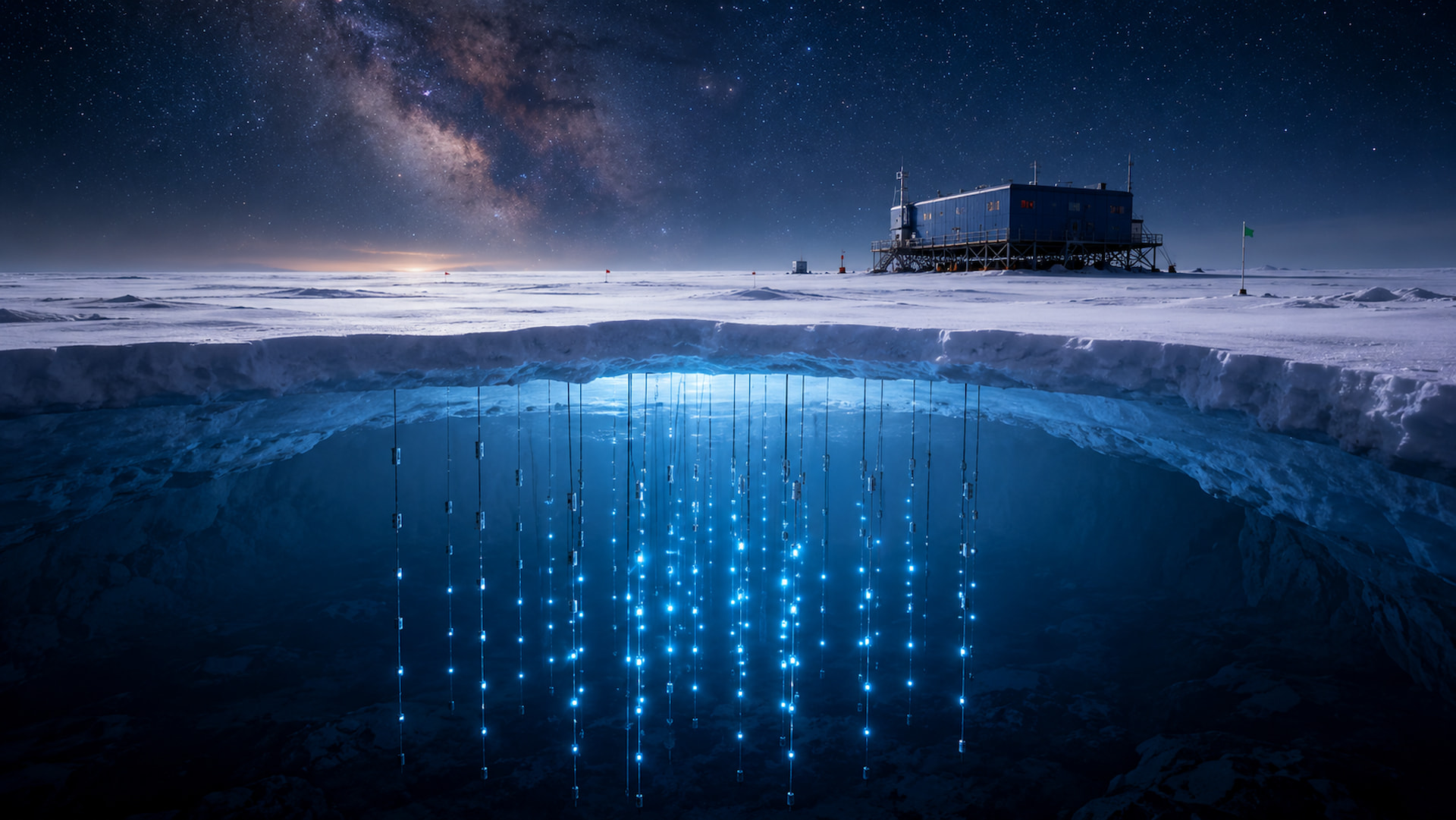
The IceCube Neutrino Observatory transforms a cubic kilometer of Antarctic ice into a particle detector by embedding thousands of optical sensors deep beneath the frozen surface. Rather than relying on water contained inside a tank, IceCube uses the natural transparency of polar ice to capture Cherenkov light generated by extremely energetic cosmic neutrinos.
Far below the Mediterranean Sea, KM3NeT applies a similar principle using seawater. Its optical detection units search for high-energy neutrinos arriving from some of the universe’s most violent astrophysical environments.
China’s Jiangmen Underground Neutrino Observatory, known as JUNO, was designed to deliver exceptionally precise measurements of neutrino oscillation parameters through a massive liquid scintillator detector located deep underground. Its scientific program aims to refine our understanding of neutrino properties beyond previous experimental limits.
Meanwhile, Hyper-Kamiokande in Japan expands upon the legacy established by Kamiokande and Super-Kamiokande with a substantially larger water Cherenkov detector, while the Deep Underground Neutrino Experiment in the United States seeks answers to some of the remaining questions surrounding neutrino masses, oscillations, and the dominance of matter over antimatter.
Chasing the Universe’s Most Elusive Particle
Across nearly a century of research, the guiding philosophy of neutrino physics has remained remarkably consistent. Researchers construct larger detectors, place them deeper underground or beneath ice and oceans, eliminate every possible source of interference, and wait patiently for extraordinarily rare events.
From Cowan and Reines’ reactor experiment to today’s kilometer-scale observatories, each generation has expanded both the scale of instrumentation and the precision of measurement.
The destruction and reconstruction of thousands of photomultiplier tubes inside Super-Kamiokande serves as a reminder that progress in experimental physics is rarely straightforward. Advances often depend as much on engineering perseverance as on theoretical insight.
The particle that Wolfgang Pauli once believed might forever escape observation has instead become one of science’s most valuable messengers. Neutrinos now reveal processes occurring inside stars, exploding supernovae, nuclear reactors, Earth’s interior, and some of the most energetic environments in the cosmos. Every new detector brings physicists one step closer to understanding why these nearly invisible particles behave as they do, and what they may ultimately reveal about the fundamental structure of the universe.