Breakthrough Advances in Quantum Materials: Mechanisms, Applications, and Future Directions
Introduction to Quantum Materials and Their Transformative Potential We are entering an era where quantum materials redefine the limits of physics…
On this page
Introduction to Quantum Materials and Their Transformative Potential
We are entering an era where quantum materials redefine the limits of physics, computation, and energy systems. These materials exhibit emergent properties—such as superconductivity, topological protection, and correlated electron behavior—that cannot be explained by classical models. By harnessing quantum mechanical effects at macroscopic scales, we unlock unprecedented performance in computing, sensing, and energy transmission.
Our focus is to present a comprehensive and technically grounded exploration of cutting-edge quantum material research, including underlying mechanisms, experimental breakthroughs, and real-world applications poised to reshape entire industries.
Fundamental Mechanisms Governing Quantum Materials
Electron Correlation and Many-Body Effects
Quantum materials are governed by strong electron-electron interactions, where collective behavior leads to novel phases of matter. Unlike conventional materials, where electrons behave independently, these systems exhibit:
-
Mott insulating states
-
Heavy fermion behavior
-
Quantum spin liquids
These phenomena arise due to many-body wavefunction entanglement, requiring advanced computational frameworks such as dynamical mean-field theory (DMFT) and tensor network methods.
Topological Order and Protected States
Topological quantum materials exhibit electronic states that are robust against perturbations such as impurities or defects. These include:
-
Topological insulators
-
Weyl and Dirac semimetals
-
Quantum anomalous Hall systems
The key property is the presence of edge or surface states protected by symmetry and topology, enabling dissipationless transport.
Quantum Phase Transitions
Unlike classical transitions driven by temperature, quantum phase transitions occur at absolute zero and are controlled by parameters such as pressure, doping, or magnetic field. These transitions are central to understanding unconventional superconductivity and critical scaling behavior.
Superconductivity Beyond Conventional Limits
High-Temperature Superconductors
We explore materials that exhibit superconductivity far above traditional critical temperatures, including:
-
Cuprate superconductors
-
Iron-based superconductors
-
Nickelates (emerging class)
The pairing mechanism in these materials deviates from phonon-mediated interactions, involving spin fluctuations and electronic correlations.
Mechanism of Cooper Pair Formation
In unconventional superconductors, Cooper pairing arises through non-traditional interactions:
-
Spin-mediated pairing
-
Orbital fluctuations
-
Electron-electron attraction via quantum criticality
This leads to anisotropic gap structures and complex phase diagrams.
Experimental Techniques Driving Discovery
Angle-Resolved Photoemission Spectroscopy (ARPES)
ARPES allows direct mapping of electronic band structures and Fermi surfaces, providing insights into:
-
Energy-momentum relationships
-
Band topology
-
Superconducting gap symmetry
Scanning Tunneling Microscopy (STM)
STM offers atomic-scale resolution of electronic states, enabling:
-
Visualization of quasiparticles
-
Detection of local density of states
-
Identification of defects and impurities
Neutron and X-ray Scattering
These techniques probe lattice dynamics and spin correlations, crucial for understanding:
-
Magnetic ordering
-
Phonon interactions
-
Structural phase transitions
Applications of Quantum Materials in Emerging Technologies
Quantum Computing Platforms
Quantum materials form the backbone of next-generation computing architectures:
-
Topological qubits with fault tolerance
-
Superconducting circuits for quantum processors
-
Spin-based qubits in low-dimensional systems
These systems aim to overcome decoherence and scaling limitations.
Energy Transmission and Storage
Superconductors enable lossless power transmission, while quantum materials enhance:
-
Battery efficiency through solid-state electrolytes
-
Hydrogen storage via engineered lattice structures
-
Thermoelectric conversion efficiency
Advanced Sensing and Metrology
Quantum materials enable ultra-sensitive detection systems:
-
Magnetometers based on SQUIDs
-
Quantum Hall resistance standards
-
Single-photon detectors
Challenges in Scaling and Material Engineering
Material Stability and Fabrication
Many quantum materials require:
-
Ultra-low temperatures
-
High vacuum environments
-
Precise doping control
Scaling production while maintaining quantum properties remains a key challenge.
Disorder and Decoherence
Impurities and environmental interactions degrade quantum coherence. Strategies to mitigate this include:
-
Material purification
-
Topological protection
-
Error correction protocols
Integration with Classical Systems
Bridging quantum and classical technologies requires hybrid architectures that maintain coherence while enabling control and readout.
Future Directions in Quantum Material Research
Artificial Quantum Materials
Engineered systems such as moiré superlattices and cold atom lattices allow tunable quantum phenomena:
-
Twisted bilayer graphene with superconductivity
-
Optical lattices simulating Hubbard models
Room-Temperature Quantum Devices
The ultimate goal is achieving quantum effects at ambient conditions, enabling widespread adoption in:
-
Consumer electronics
-
Energy grids
-
Medical diagnostics
AI-Driven Material Discovery
Machine learning accelerates the identification of novel quantum materials by predicting:
-
Stable crystal structures
-
Electronic properties
-
Phase transitions
Conceptual Diagram of Quantum Material Behavior
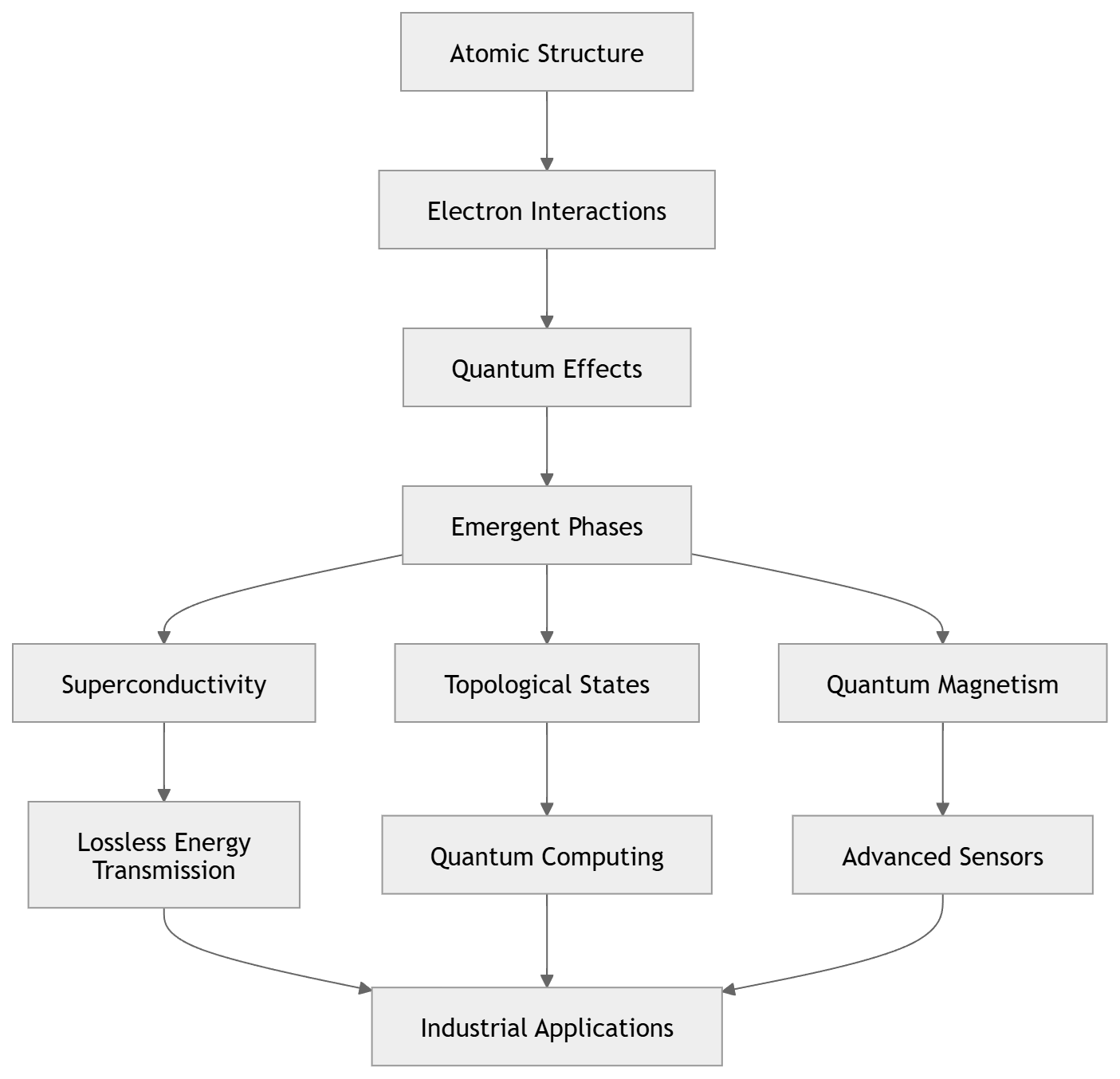
Conceptual Diagram of Quantum Material Behavior
Conclusion: Redefining Technology Through Quantum Materials
We stand at the frontier of a technological revolution driven by quantum materials. By mastering electron correlations, topological protection, and quantum coherence, we unlock capabilities far beyond classical limits. Continued interdisciplinary research, combined with scalable engineering solutions, will accelerate the transition from laboratory discoveries to real-world applications that redefine computing, energy, and sensing systems.